For factories, dental labs and product development teams, resin 3D printing is rarely purchased just because it looks “high resolution.” The real question is whether the technology can solve a production or validation problem better than CNC machining, FDM printing, outsourcing, manual model making or traditional mold sampling.
Resin 3D printing belongs to the wider field of additive manufacturing, where a part is built layer by layer from digital data. ISO/ASTM 52900:2021 defines additive manufacturing terminology around the principle of adding material to create 3D geometry. In resin printing, liquid photopolymer resin is selectively cured by light, commonly through SLA, DLP or LCD/MSLA-based systems.
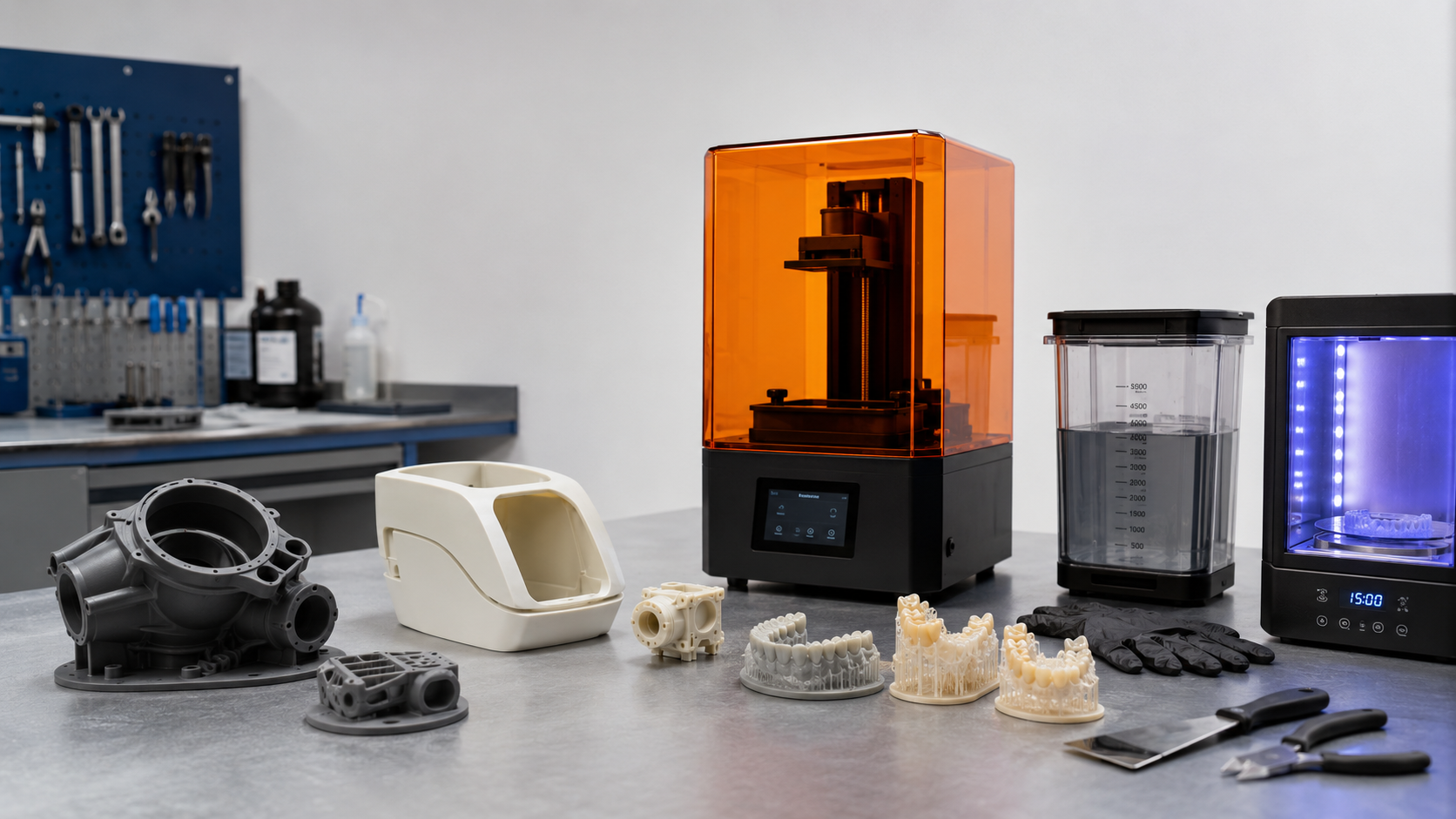
For Yidimu’s typical users, resin 3D printing can support applications such as:
- Factory sample making
- Industrial prototyping
- Dental model production
- Surgical guide model workflow
- Temporary dental model sampling
- Jewelry casting patterns
- Shoe mold prototypes
- Flexible resin samples
- Engineering design verification
- Small-batch production trials
However, resin printing is not automatically the best option for every part. It should be evaluated by application, resin performance, part size, tolerance requirement, operator workflow, cleaning capacity and post-curing control.
Main Advantages of Resin 3D Printing
1. High Detail and Fine Surface Finish
One of the biggest advantages of resin 3D printing is its ability to produce fine details and smooth surfaces. Compared with many filament-based printing workflows, resin printing can often create sharper edges, smaller surface textures, smoother curves and more professional-looking models.
This is valuable for:
- Dental arches and dental models
- Product appearance prototypes
- Jewelry masters and casting models
- Miniature industrial models
- Shoe sole and shoe mold prototypes
- Parts with text, grooves, holes or fine textures
Technical service providers often describe SLA resin printing as suitable for accurate, smooth and detailed parts, although final results still depend on part design, material, machine calibration and post-processing.
For factories, this means a design team can review surface shape, assembly clearance and customer-facing appearance before spending money on mold making or tooling.
2. Strong Value for Industrial Prototyping
Resin 3D printing is especially useful before mold making. A factory can print a prototype, check its form, test assembly, review ergonomics and make changes before committing to tooling.
This may help reduce unnecessary mold revisions, especially for products where small surface details or shape changes matter.
Typical examples include:
- Plastic product shells
- Electronic device housings
- Consumer product appearance samples
- Shoe development samples
- Small mechanical covers
- Industrial model parts
- Display and exhibition models
For product development teams, the main value is speed of iteration. Instead of waiting for outsourced samples, the team can print multiple versions in-house, compare them and update the design file.
3. Useful for Dental Labs and Clinics
Resin 3D printing can support dental model production, surgical guide model workflows, temporary model samples and digital dental workflows. FDA information on 3D printing notes that medical device 3D printing may involve steps such as device design, software workflow and material controls, and that dental restorations are among the medical device examples produced with 3D printing.
For dental users, resin printing may support:
- Dental study models
- Orthodontic models
- Implant planning models
- Surgical guide-related workflows
- Temporary dental model samples
- Digital lab communication
Customers should confirm resin indication, post-curing process and local regulatory requirements before clinical or intraoral use. A printer alone does not make a dental workflow compliant. Resin selection, curing parameters, cleaning process, documentation and local regulations must be reviewed.
4. Good for Complex Shapes and Small Features
Resin printing can produce complex geometries that are difficult or slow to make manually. Thin walls, fine grooves, small holes, curved shapes and organic surfaces can often be produced efficiently when the part is properly supported and oriented.
This is useful for:
- Engineering samples
- Design verification models
- Intricate casting patterns
- Dental arches
- Product details
- Lab research components
- Model-making parts
However, complexity does not mean every geometry is easy to print. Support strategy, suction force, resin viscosity, wall thickness and part orientation still matter.
5. Specialized Resin Options
Another advantage of resin 3D printing is material variety. Depending on supplier and machine compatibility, professional users may choose resins for different goals, such as:
- Standard model resin
- ABS-like resin
- Casting resin
- Water-washable resin
- Dental model resin
- Surgical guide model resin
- Temporary dental model resin
- Flexible resin
- High-temperature or engineering resin
This makes resin printing useful across dental, industrial, model-making and prototyping workflows. The key is not choosing the “strongest” resin in general, but choosing the resin that fits the part’s intended function.
6. Efficient for Batch Printing of Small Parts
For many LCD/MSLA workflows, multiple small parts of similar height can be printed together efficiently. This can be useful for dental models, model-making components, small engineering samples or repeated product details.
For example, a dental lab may print several models in one build. A factory may print multiple prototype variations for review. A model-making company may print repeated decorative or structural parts for assembly.
Batch efficiency depends on build volume, nesting strategy, resin behavior, support placement and post-processing capacity.
7. Professional Appearance for Client Review
For factories and product developers, resin printed samples often look more polished than rough early prototypes. Smooth surfaces and fine detail can make customer review, internal approval and sales presentation easier.
This is especially helpful for:
- Product design review
- Appearance validation
- Exhibition samples
- Client confirmation
- Pre-mold discussion
- Industrial design communication
In many cases, the printed part is not the final production part. It is a communication tool that helps teams make better decisions before manufacturing.
Main Disadvantages of Resin 3D Printing
1. Resin Handling Requires Safety Control
Liquid photopolymer resin must be handled carefully. Operators should review the resin Safety Data Sheet, wear suitable PPE and avoid direct skin contact with uncured resin. PAMA/RadTech’s guidance for UV-curable 3D printing resins recommends consulting supplier SDS documents, using appropriate chemical-resistant gloves, eye protection, ventilation and correct disposal practices.
This means resin printing is not just “press print and remove part.” A professional workshop should prepare:
- Gloves
- Eye protection
- Cleaning tools
- Resin storage area
- Waste container
- Ventilation or local exhaust where needed
- UV curing equipment
- Operator training
This is one of the biggest differences between resin printing and simpler desktop prototyping workflows.
2. Post-Processing Is Required
Most resin printed parts require cleaning, support removal and UV post-curing. If this workflow is poorly controlled, the final part may remain tacky, deform, crack, shrink, smell strongly or fail to reach expected performance.
A typical resin workflow includes:
- Remove the printed part from the build platform.
- Drain excess resin.
- Wash the part using the recommended cleaning method.
- Remove supports carefully.
- Dry the part completely.
- UV cure according to resin supplier guidance.
- Inspect dimensions, surface and function.
For dental and engineering users, post-curing is not optional. It is part of the material performance workflow.
3. Some Resin Parts Can Be Brittle
Many standard resin materials are relatively rigid and may be more brittle than thermoplastic materials used in some other manufacturing processes. This does not mean resin parts are weak in every case. It means users should match the resin to the application.
Standard model resin may be suitable for appearance models, dental models and non-load-bearing samples. ABS-like resin may be better for engineering samples. Flexible resin may be suitable for elastic prototypes. Casting resin may be used for investment casting workflows.
If a part requires long-term impact resistance, repeated bending, abrasion resistance or outdoor exposure, customers should test the material carefully before relying on it.
4. Build Volume Can Limit Large Parts
Resin 3D printers can be excellent for small and medium parts, but build volume is still a purchasing factor. For factories, this is especially important when printing:
- Large industrial models
- Shoe mold prototypes
- Large product housings
- Multiple dental models per batch
- Assembly fixtures
- Large model-making parts
A small printer may deliver high detail but limit productivity. A larger industrial resin 3D printer can support bigger samples or more parts per build, but it also requires more resin, more cleaning capacity and better workflow control.
5. Support Marks and Orientation Issues
Resin prints usually need supports. If supports are placed on visible or functional surfaces, they may leave marks after removal. Poor orientation can also cause print failure, deformation, suction issues or dimensional errors.
Professional users should consider:
- Which surfaces must remain clean
- Where support marks are acceptable
- Whether holes need drainage
- Whether thin walls need reinforcement
- Whether the part should be printed flat, angled or split
- Whether post-processing will affect dimensions
Good print preparation is often the difference between a usable part and a failed part.
6. Material Cost and Waste Management
Resin materials may cost more than some filament materials, depending on resin type and supplier. Specialized dental, flexible, castable or engineering resins may require more careful storage and higher process discipline.
Waste handling also matters. Uncured resin, contaminated cleaning liquid, wipes and failed prints may require controlled disposal depending on local rules and the resin SDS. PAMA/RadTech guidance also warns against pouring uncured resin into sinks or water systems.
For professional users, the cost calculation should include:
- Resin price
- Failed print rate
- Cleaning liquid
- Gloves and consumables
- Curing equipment
- Labor time
- Inspection time
- Waste handling
7. Not Always Best for Final Functional Parts
Resin printing can support functional prototyping, but it is not always the right method for final-use mechanical parts. Applications involving high load, repeated impact, friction, heat, chemical exposure or long-term outdoor use may need careful validation.
For factories, resin printing is often strongest as a tool for:
- Design verification
- Appearance validation
- Pre-mold sample review
- Low-volume trial parts
- Model production
- Dental and casting workflows
It may be less suitable when the part must behave exactly like injection-molded ABS, nylon, metal or rubber in long-term use.
Practical Table: Resin 3D Printing Advantages and Disadvantages by Application
| Application | Main Advantages | Main Disadvantages | Best-Fit Resin / Workflow Notes |
|---|---|---|---|
| Industrial prototyping | High detail, fast iteration, good surface finish | May not match final molded material performance | Use model resin, ABS-like resin or engineering resin depending on test purpose |
| Factory sample making | Useful before mold making, supports design review | Large parts may need bigger machines or splitting | Confirm build volume and surface finishing needs |
| Dental models | Supports digital dental model production | Resin indication and curing must be confirmed | Customers should confirm resin indication, post-curing process and local regulatory requirements before clinical or intraoral use |
| Surgical guide-related workflow | Can support guide model and planning workflows | Regulatory and biocompatibility requirements are strict | Use only suitable resin and validated workflow for intended use |
| Jewelry casting | Fine detail, smooth surface, castable pattern potential | Burnout and casting workflow must be tested | Use casting resin and confirm casting process |
| Shoe mold prototypes | Good surface and shape review | Large size and resin toughness may be limiting | Use large-format resin printer where needed |
| Flexible samples | Can support elastic prototype review | Flexible resin requires careful settings and post-processing | Confirm flexibility, tear resistance and intended test conditions |
| Small-batch trials | Useful for repeated sample production | Cleaning, curing and inspection capacity must match output | Standardize print settings and QC process |
Workflow or Checklist
Professional Resin 3D Printing Workflow Checklist
Use this checklist before buying or setting up a resin 3D printing workflow.
Step 1: Define the Real Application
Ask:
- Is the part for visual review, fit testing, dental model production, casting, flexible testing or functional prototyping?
- Does it need to be handled by customers, doctors, engineers or production workers?
- Is it a model, prototype, production aid or final-use component?
Step 2: Confirm Part Size and Batch Quantity
Check:
- Maximum part length, width and height
- Number of parts needed per build
- Required daily or weekly output
- Whether large parts can be split and assembled
- Whether the printer build volume matches real workflow needs
Step 3: Choose Resin by Function
Match resin to purpose:
- Model resin for general models and appearance samples
- ABS-like resin for stronger engineering samples
- Casting resin for jewelry or investment casting patterns
- Dental model resin for dental model workflows
- Flexible resin for elastic samples
- Water-washable resin when the cleaning workflow supports it
Do not choose resin only by price. Choose it by printability, accuracy, post-curing requirement and application suitability.
Step 4: Plan Post-Processing Before Printing
Prepare:
- Washing method
- Drying area
- UV curing box
- Support removal tools
- Inspection tools
- Waste container
- PPE and cleaning supplies
A printer without a post-processing workflow may create unstable results.
Step 5: Run Test Prints and Record Settings
Before regular production, test:
- Exposure settings
- Layer height
- Support structure
- Orientation
- Cleaning time
- Curing time
- Dimensional change
- Surface quality
Record successful settings for repeatability.
Step 6: Inspect and Improve
After printing, inspect:
- Surface quality
- Dimensional accuracy
- Support marks
- Warping or cracks
- Fit with other parts
- Resin curing condition
- Whether the part meets its intended review or test purpose
For professional users, repeatability is more important than a single successful print.
Common Mistakes to Avoid
1. Buying Only by Resolution Numbers
High resolution does not automatically mean good output. Real print quality also depends on optical system stability, Z-axis movement, resin quality, exposure settings, temperature, support strategy and post-processing.
2. Ignoring Build Volume
A small printer may look attractive, but it may not fit large factory samples, shoe prototypes or batch dental production. Always compare build volume with real part size and weekly output.
3. Using the Wrong Resin for the Job
A beautiful model resin print may fail as a functional test part. A flexible resin may not suit fine rigid details. A dental resin must be reviewed for its intended use. Resin selection should follow application requirements, not general assumptions.
4. Skipping UV Post-Curing
Under-cured parts may remain tacky, weak or unstable. Over-curing may also affect part behavior depending on resin type. Follow resin supplier guidance and validate curing conditions.
5. Poor Support Placement
Support marks on visible or precision surfaces can damage the part’s usefulness. Plan support placement before printing, especially for dental models, industrial appearance samples and client-facing prototypes.
6. Treating Resin Printing Like a Simple Office Printer
Resin printing requires chemicals, cleaning, curing and waste control. Professional users should prepare a dedicated workflow, not place the printer anywhere without considering safety and maintenance.
7. Expecting Resin Parts to Replace Molded Parts Directly
Resin printed prototypes can support design validation, but they may not behave exactly like injection-molded production materials. For mechanical, thermal, dental or end-use applications, testing and confirmation are necessary.
8. Forgetting Documentation
Factories, dental labs and research teams should document resin batch, printer settings, curing time, operator notes and inspection results. This helps improve repeatability and solve problems faster.
When Resin 3D Printing Is a Good Choice
Resin 3D printing is a good choice when your project requires:
- Fine detail
- Smooth surface finish
- Accurate model geometry
- Fast design iteration
- Dental model workflow
- Casting pattern production
- Engineering sample review
- Professional appearance prototypes
- Small-batch validation
- Flexible resin sample testing
It is especially useful before mold making, because it allows teams to check shape, assembly and design issues before investing in tooling.
When Resin 3D Printing May Not Be the Best Choice
Resin 3D printing may not be the best choice when:
- The part is very large and does not fit the build volume
- The part must handle heavy mechanical loads
- The part needs long-term outdoor durability
- The user cannot manage cleaning and curing
- The application requires certified material performance that has not been confirmed
- The workflow does not allow safe resin handling
- The part is better made by CNC, injection molding, SLS, FDM or another process
A balanced evaluation is better than assuming one technology is always better.
How to Choose a Resin 3D Printer for Professional Use
When comparing resin 3D printers, professional buyers should review more than price. Important factors include:
Build Volume
Choose a printer size that matches your real part size and batch needs. Dental labs may focus on model quantity per build. Factories may need larger platforms for prototypes, shoe molds or industrial samples.
Printing Accuracy and Stability
Check the optical system, Z-axis structure, platform stability, exposure control and machine calibration process. Accuracy depends on the complete system, not only screen resolution.
Resin Compatibility
Confirm whether the printer supports the resin types you need, such as dental model resin, ABS-like resin, casting resin or flexible resin.
Post-Processing Equipment
A UV curing box and proper cleaning workflow are important parts of the system. For dental and engineering workflows, curing control can affect final performance.
Technical Support
Professional users often need help with resin settings, support strategy, failed prints, curing process and application selection. Supplier support can reduce trial-and-error time.
Workflow Fit
The right printer should fit your existing team, workspace, safety process and production rhythm.
FAQ
What are the main advantages of resin 3D printing?
The main advantages are high detail, smooth surface finish, good dimensional control and strong value for prototypes, dental models, casting patterns and small professional parts. Resin 3D printing can be especially useful when surface quality and fine features are important.
What are the main disadvantages of resin 3D printing?
The main disadvantages are resin handling, cleaning, UV curing, support removal, material brittleness in some resins, waste management and workflow control. It requires more post-processing than many simple filament-based workflows.
Is resin 3D printing good for industrial prototypes?
Yes, resin 3D printing can support industrial prototyping, especially for appearance samples, design verification, engineering models and pre-mold review. For load-bearing or long-term functional parts, users should choose suitable engineering resin and test the part carefully.
Is resin 3D printing suitable for dental labs?
Yes, resin 3D printing can support dental model workflows, orthodontic models and related digital dental applications. Customers should confirm resin indication, post-curing process and local regulatory requirements before clinical or intraoral use.
Are resin 3D printed parts strong?
Some resin printed parts can be strong enough for prototypes and testing, depending on resin type and workflow. However, many standard resins are more brittle than some thermoplastics. For functional parts, users should test impact resistance, bending, heat resistance and long-term behavior.
Why do resin prints need UV curing?
UV curing helps complete the material’s post-print polymerization process according to the resin supplier’s guidance. Proper curing may affect surface condition, strength, stability and suitability for the intended workflow.
Can resin 3D printing replace mold making?
Resin 3D printing can reduce the need for early mold revisions by allowing teams to test shape and fit before tooling. It usually does not replace mold making for mass production, but it can be very useful before mold investment.
Is water-washable resin safer than regular resin?
Water-washable resin may simplify cleaning in some workflows, but it still requires careful handling. Used wash water may contain uncured resin residue and should not be disposed of casually. Users should follow the resin SDS and local disposal rules.
What should factories check before buying a resin 3D printer?
Factories should check build volume, resin compatibility, print accuracy, machine stability, post-processing equipment, technical support, maintenance needs and application fit. The best printer is the one that matches the actual workflow, not only the one with the highest specification.
Conclusion
Understanding resin 3D printing advantages and disadvantages helps professional users make better equipment and workflow decisions. Resin 3D printing can provide high detail, smooth surfaces, fast prototyping and strong value for dental, industrial, casting, model-making and product development applications. Its limitations are also clear: resin handling, cleaning, curing, support removal, material selection and workflow control must be managed carefully.
For factories, dental labs, clinics and research teams, resin printing works best when the printer, resin, curing process and inspection workflow are selected together. To evaluate the right Yidimu solution, contact Yidimu with your model size, resin requirement, application and expected workflow. The Yidimu team can help review printer options, resin selection and post-processing setup for your professional resin 3D printing needs.
Optional References
- FDA — 3D Printing of Medical Devices and process considerations for medical-device 3D printing.
- ISO/ASTM 52900:2021 — Additive manufacturing fundamentals and vocabulary.
- PAMA/RadTech — Proper Handling of UV Curable 3D Printing Resins.
- Protolabs Network / Hubs — SLA printing characteristics, advantages and limitations.