
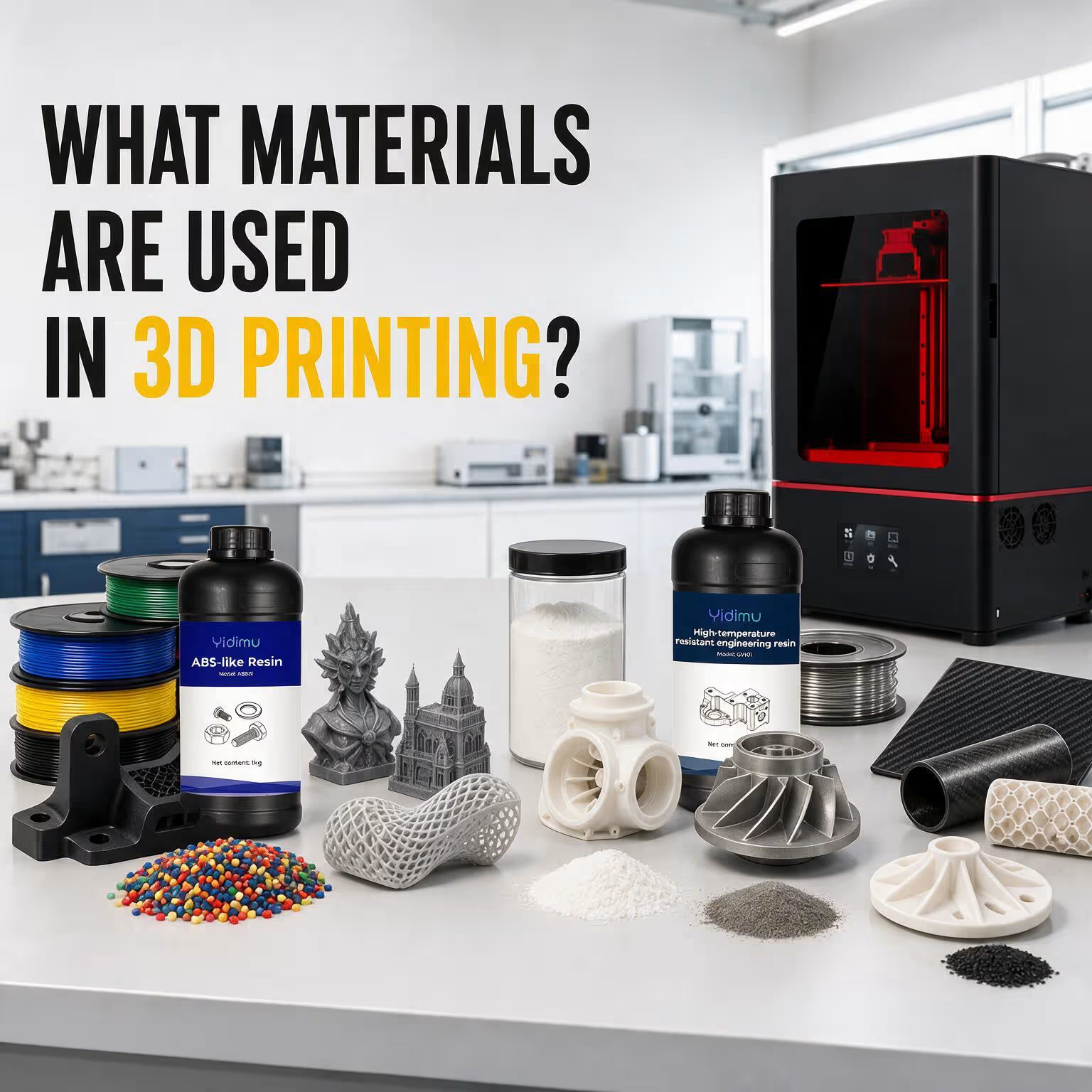
3D printing uses thermoplastics, liquid photopolymer resins, polymer powders, metals, ceramics, composites and specialized application materials. Depending on the printing process, the material may be supplied as filament, liquid resin, powder, pellets, paste or metal wire. There is no single universal “3D printing material.” The correct choice depends on the printer technology, part geometry, required properties, post-processing workflow and acceptance criteria.
The material is only one part of the manufacturing system. Printer settings, model orientation, supports, environmental conditions, cleaning, curing and inspection can all change the quality and performance of the final part.
What Is 3D Printing Material?
A 3D printing material is a feedstock that a compatible additive manufacturing process deposits, melts, fuses, binds or cures layer by layer to create a physical object from digital model data.
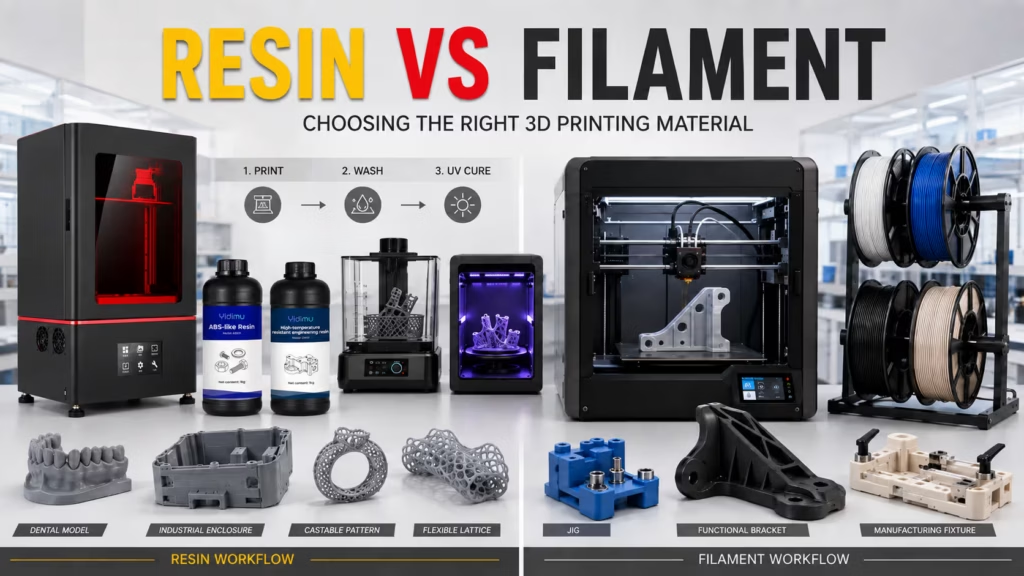
The physical form of that feedstock depends on the process:
| Printing process | Typical feedstock form | Common material categories |
|---|---|---|
| Material extrusion | Filament or pellets | PLA, ABS, PETG, nylon, TPU and reinforced thermoplastics |
| Vat photopolymerization | Liquid photopolymer resin | Model, engineering, flexible, castable and dental-purpose resins |
| Polymer powder bed fusion | Fine polymer powder | PA11, PA12, TPU and filled polymer powders |
| Metal powder bed fusion | Metal powder | Stainless steel, aluminum, titanium, nickel alloys and other qualified alloys |
| Directed energy deposition | Metal powder or wire | Steel, titanium, nickel alloys and other compatible metals |
| Binder jetting | Powder plus a liquid binder | Metal, ceramic, sand and composite feedstocks |
| Ceramic printing | Slurry, paste, powder or ceramic-filled resin | Alumina, zirconia and other technical ceramic systems |
| Large-format extrusion | Pellets or granules | Thermoplastics and fiber-reinforced polymer composites |
Material and process cannot be selected independently. A resin designed for vat photopolymerization cannot be loaded into a standard filament printer, and filament cannot be substituted for polymer powder in a powder bed fusion machine. NIST identifies polymers, metals, ceramics and advanced materials such as composites as major additive manufacturing material families.
Main Types of 3D Printing Materials
Thermoplastic Filament
Thermoplastic filament is commonly associated with material extrusion printers, often described as FFF or FDM-type systems. A motor feeds a continuous strand of plastic into a heated print head, where it softens and is deposited through a nozzle.
Frequently used filament materials include:
- PLA for visual models, general prototypes and relatively easy printing
- ABS for functional models requiring different thermal or mechanical characteristics
- PETG for prototypes, manufacturing aids and general-purpose functional parts
- Nylon for parts that require toughness, wear resistance or repeated use
- TPU and other thermoplastic elastomers for flexible components
- Polycarbonate and engineering thermoplastics for more demanding applications
- Fiber-filled thermoplastics containing chopped carbon or glass fibers
The category name alone does not define performance. Different formulations of PLA, nylon or TPU can have substantially different printing behavior, additives, moisture sensitivity and final properties. UltiMaker’s official material guidance, for example, distinguishes PETG, TPU, ABS and other filaments by printability, flexibility, mechanical behavior and environmental resistance.
Filament printing is often selected for:
- Early functional prototypes
- Jigs and manufacturing aids
- Large, relatively simple components
- Low-cost concept models
- Parts that do not require an extremely smooth as-printed surface
Visible layer lines, directional strength, nozzle diameter, chamber temperature, bed adhesion and moisture control can affect the result. Buyers should evaluate the printed part rather than relying only on the name printed on the filament spool.
Thermoplastic Pellets
Some industrial and large-format extrusion systems use pellets or granules instead of filament. The pellets enter a hopper, pass through a heated barrel and are extruded through a nozzle.
Pellet-fed systems can support high deposition rates and large components. They may also use feedstocks related to those used in conventional plastics processing. However, pellet printing still requires control of drying, melt temperature, material flow, cooling and layer bonding.
Research from NIST and Oak Ridge National Laboratory describes pellet-fed material extrusion and large-format systems using pelletized thermoplastics and composites.
Photopolymer Resin
Photopolymer resin is a liquid material that reacts to a controlled light source. In vat photopolymerization systems, selected regions of the resin are cured layer by layer until the part is formed.
Resin printing includes technologies commonly described as SLA, DLP and LCD-based printing. NIST characterizes vat photopolymerization as a process that forms structures by curing photopolymer resin with light.
Professional resin printing is often selected for:
- Fine features
- Smooth surfaces
- Detailed appearance models
- Dental models and workflow-specific parts
- Casting patterns
- Flexible lattice structures
- Engineering prototypes
- Small and medium batches of detailed parts
- Models that require clear edges, holes, grooves or textural detail
Unlike a thermoplastic filament, a photopolymer resin does not simply cool and become finished. The printed part normally requires controlled cleaning, complete drying and UV post-curing. The resin formulation, printer exposure profile and curing procedure must be treated as one connected system.
Types of Professional Photopolymer Resin
General Model Resin
General model resins are used for visual prototypes, presentation models, figurines, master models and shape verification. They typically prioritize surface quality, feature visibility, dimensional consistency and convenient processing.
A model resin may be appropriate when the team needs to evaluate:
- Product shape
- Surface contours
- Fine decorative details
- Assembly relationships
- Appearance before molding
- Ergonomic form
- Customer approval samples
“General purpose” does not mean suitable for every mechanical or environmental condition. A model that looks accurate on a table may not be suitable for long-term loading, heat exposure, outdoor use or repeated impact.
Engineering Resin
Engineering resins are formulated to target properties such as toughness, rigidity, temperature resistance, impact behavior, dimensional stability or resistance to particular operating conditions.
Examples of broad engineering-resin categories include:
- Tough or ABS-like resin
- Rigid or reinforced resin
- Heat-resistant resin
- Low-shrinkage resin
- ESD-related resin
- Clear engineering resin
- Resin intended for jigs, fixtures or functional prototypes
Terms such as “ABS-like,” “tough” and “high-temperature” are product descriptions rather than universal technical standards. Two products carrying a similar category name may produce different results.
Buyers should compare the applicable Technical Data Sheet rather than assuming that all engineering resins share the same strength, elongation, impact resistance or heat performance. Material suppliers publish TDS documents for property comparison and SDS documents for safety and handling information.
Flexible Resin
Flexible photopolymer resin is used when a part must bend, compress, stretch or recover rather than remain rigid. Potential applications include:
- Flexible product samples
- Shoe components
- Lattice midsoles
- Wearable structures
- Grips and covers
- Seals and cushioning samples
- Soft robotic components
- Flexible connectors
- Protective structures
“Flexible” covers a broad range of behavior. One material may feel soft and rubber-like, while another may be firm but capable of repeated bending. Important evaluation criteria include hardness, tear behavior, elongation, compression response, rebound, fatigue behavior and long-term deformation.
The final flexibility does not come from resin selection alone. Exposure settings, wall thickness, lattice geometry, cleaning conditions and UV curing can all change how the part behaves. Yidimu’s industrial workflow guidance specifically treats flexible resin parameters, cleaning and curing control as connected factors affecting the final result.
Castable Resin
Castable resin is used to print expendable patterns that are incorporated into an investment casting workflow. Applications may include:
- Jewelry casting patterns
- Dental casting patterns
- Small decorative metal parts
- Detailed master patterns
- Components with complex shapes that are difficult to make manually
A castable resin is not selected primarily for long-term mechanical use. Buyers normally evaluate printing detail, surface quality, dimensional behavior, burnout characteristics, residue control and compatibility with the investment and casting process.
The complete casting result depends on more than the printed pattern. Support placement, pattern cleaning, curing, investment preparation, burnout schedule, metal casting and finishing must all be controlled.
Yidimu lists castable resin as a dedicated workflow material for dental, jewelry and detailed casting patterns, while emphasizing that design, support placement, cleaning, curing and the casting process must be managed together.
Dental-Purpose Materials
Dental 3D printing can involve materials intended for different purposes, including:
- Dental study models
- Crown and bridge working models
- Orthodontic models
- Aligner-forming models
- Surgical guide workflows
- Temporary restoration workflows
- Denture-related workflows
- Gingiva masks
- Casting patterns
These categories are not interchangeable. A resin used to print a dental model is not automatically suitable for intraoral contact, surgical guides, temporary restorations or permanent restorations.
Before choosing a dental-purpose material, users should verify:
- The stated indication or intended use
- Compatible printer models
- Approved or recommended layer settings
- Required washing process
- Required curing equipment and procedure
- Whether dedicated tanks, platforms or finishing tools are required
- Applicable Instructions for Use
- Local regulatory and professional requirements
- Required traceability and quality-control records
FDA guidance treats additive manufacturing for medical devices as a process requiring appropriate technical consideration, testing and characterization. Material suitability cannot be established from the generic phrase “dental resin.”
For materials associated with biocompatible applications, the relevant IFU or manufacturing guide should be followed exactly. Supplier documentation may specify compatible equipment, washing conditions, curing conditions and dedicated workflow requirements.
Never assume that a dental-purpose resin is medically suitable merely because it can reproduce a dental shape.
Water-Washable Resin
Water-washable resin is formulated so that uncured surface residue can be removed using the supplier’s specified water-based cleaning process rather than a conventional solvent workflow.
The term describes a cleaning method. It does not mean that:
- Uncured resin is harmless
- Resin-contaminated water can automatically be poured into a sink
- UV curing is unnecessary
- PPE can be omitted
- Every water-washable resin uses the same washing time
- The material is suitable for medical or food-contact applications
Users should consult the applicable SDS and local waste-disposal rules. Yidimu’s resin material guidance also states that water-washable products still require careful handling and safe resin practices.
Polymer Powder
Polymer powder is used in processes such as selective laser sintering and related polymer powder bed fusion technologies. A controlled layer of powder is spread across the build area, and selected regions are fused to form the part.
Common polymer powder families include:
- PA12
- PA11
- TPU
- Filled or reinforced nylon
- Application-specific polymer blends
Polymer powder systems can produce complex geometries without the same type of attached support structures used in many filament and resin processes. The surrounding powder helps support the build, although powder removal, refreshing, sieving, cooling and finishing remain important process steps.
EOS describes PA12 as a widely used polymer powder family and notes that polymer composition and process selection produce different part characteristics.
Powder characteristics such as particle size distribution, flow behavior, moisture condition, thermal history and refresh ratio can affect processing. Buyers should evaluate the qualified material-and-machine combination rather than treating polymer powder as a generic commodity.
Metal Powder and Wire
Industrial metal additive manufacturing systems may use powder or wire feedstocks.
Metal powder can be used in processes such as:
- Laser powder bed fusion
- Electron beam powder bed fusion
- Binder jetting
- Powder-fed directed energy deposition
Metal wire can be used in certain directed energy deposition, arc-based or beam-based processes.
Common alloy families may include stainless steel, tool steel, aluminum, titanium, nickel-based alloys and cobalt-chromium materials. However, available alloys and their qualification status depend on the specific equipment and process.
GE describes additive processes that begin with powder or wire and build material layer by layer. NIST similarly distinguishes powder bed fusion and directed energy deposition as separate technologies with different methods of delivering and consolidating metal feedstock.
Metal printing requires far more than purchasing a container of powder. Important considerations may include:
- Alloy composition
- Powder morphology
- Particle-size distribution
- Oxygen or contamination control
- Powder reuse strategy
- Shielding atmosphere
- Thermal history
- Stress relief
- Heat treatment
- Support removal
- Machining
- Surface finishing
- Non-destructive inspection
- Mechanical testing
- Process qualification
Reactive powders and fine particles can create significant handling hazards. Facilities should use qualified equipment, trained operators and procedures based on the supplier’s SDS and applicable workplace regulations.
Ceramic Materials
Ceramic additive manufacturing may use ceramic powder, paste, slurry or a ceramic-filled photopolymer system.
Potential material families include:
- Alumina
- Zirconia
- Silica-based materials
- Silicon carbide
- Technical ceramic composites
- Application-specific glass-ceramic systems
The printed “green” part may require debinding and sintering before reaching its final ceramic state. Shrinkage, density, cracking risk, geometry and furnace conditions must therefore be evaluated as part of the workflow.
A ceramic-filled resin should not be evaluated like a conventional model resin. The light-curing stage creates the geometry, but thermal processing may determine final density, dimensions and properties. NIST identifies ceramics as a distinct additive manufacturing material research category requiring dedicated characterization and measurement.
Composite Materials
Composite 3D printing materials combine a base material with another phase to change stiffness, weight, thermal behavior, electrical behavior, wear resistance or other properties.
Examples include:
- Carbon-fiber-filled thermoplastic
- Glass-fiber-filled thermoplastic
- Mineral-filled resin
- Ceramic-filled photopolymer
- Metal-filled polymer
- Fiber-reinforced pellets
- Conductive or ESD-related formulations
The word “composite” does not guarantee superior performance in every direction. Chopped fibers may increase stiffness while also changing nozzle wear, surface finish, flow behavior and directional properties. Filled resin can increase rigidity but may settle, require mixing or demand different exposure settings.
NIST studies composites and polymer-metal composite feedstocks across filament, pellet and photopolymer processes, illustrating that the formulation and printing method must be considered together.
Resin vs Filament
The resin vs filament decision should be based on the part and workflow rather than on which machine appears simpler.
| Factor | Photopolymer resin | Thermoplastic filament |
|---|---|---|
| Feedstock | Liquid photopolymer | Solid thermoplastic strand |
| Printing principle | Selective light curing | Heated material extrusion |
| Typical strength | Depends heavily on resin category and curing | Depends on polymer, print direction and layer bonding |
| Fine features | Often well suited to small details | Limited partly by nozzle size and extrusion control |
| As-printed surface | Often relatively smooth | Layer lines are usually more visible |
| Supports | Usually attached supports for overhangs | Supports used where geometry requires them |
| Post-processing | Washing, drying and usually UV curing | Support removal and optional sanding, machining or heat treatment |
| Flexible options | Flexible and elastomeric resins | TPU and other flexible thermoplastics |
| Large parts | Depends on printer build size and resin cost | Commonly used for large prototypes and structures |
| Workflow sensitivity | Exposure, cleaning and curing are critical | Temperature, moisture, extrusion and cooling are critical |
| Typical professional use | Detailed models, dental workflows, casting patterns and high-detail prototypes | Functional prototypes, jigs, fixtures and larger components |
These are general tendencies rather than guarantees. A high-quality industrial filament part may outperform a poorly processed resin part, while a properly selected engineering resin may produce detail and surface quality that are difficult to obtain with a coarse extrusion setup.
Why Professional Resin Printing Requires a Complete Workflow
In resin printing, the material does not work independently of the printer.
The final part is influenced by:
Resin Formulation
The formulation affects viscosity, light response, color, rigidity, flexibility, surface behavior, casting behavior and post-curing requirements.
Printer Light System
The resin must be compatible with the printer’s light source and exposure system. A matching wavelength range alone does not prove that the resin will print correctly. Light intensity, optical uniformity, pixel or projection system, vat design and exposure profile also matter.
Slicing Parameters
Important settings may include:
- Layer thickness
- Normal exposure
- Bottom exposure
- Number of bottom layers
- Lift distance
- Lift and return speeds
- Rest time
- Support-tip size
- Support density
- Model orientation
Copying settings from another machine or resin can produce failed prints, distorted dimensions or inappropriate curing.
Part Geometry
Wall thickness, hollow sections, drain holes, enclosed cavities, cross-sectional area and support placement affect resin flow, suction forces, cleaning and curing.
Washing
Washing removes uncured surface resin. Excessive washing, insufficient washing, dirty cleaning liquid or incompatible cleaning chemicals can damage the surface or leave residue.
Drying
A part should be dried according to the material workflow before final UV curing. Trapped wash liquid can contribute to surface defects, cracking or inconsistent curing.
UV Post-Curing
Post-curing can affect rigidity, toughness, dimensional stability, temperature behavior, surface condition and suitability for the intended workflow. The correct process varies by resin, geometry and curing equipment.
Inspection
The part should be inspected after processing for:
- Surface residue
- Cracks
- Warping
- Blocked holes
- Support damage
- Dimensional deviation
- Incomplete curing
- Fit and assembly problems
- Application-specific defects
Yidimu’s professional workflow guidance treats printing, cleaning, drying, support removal, UV curing and final inspection as connected production stages.
Material Properties Buyers Should Evaluate
Strength
Strength indicates how much stress a material can withstand under a defined test condition. It should not be confused with stiffness, toughness or impact resistance.
The relevant strength property may be tensile, compressive, flexural, shear or another application-specific measurement.
Stiffness
Stiffness describes resistance to elastic deformation. A stiff part changes shape less under load, but high stiffness does not automatically mean that the material is difficult to break.
Toughness
Toughness relates to the ability to absorb energy before failure. A tough prototype may survive impacts or repeated handling better than a rigid but brittle model.
Flexibility and Elastic Recovery
For flexible materials, buyers should examine more than whether a sample can bend. Relevant questions include:
- Does it return to its original shape?
- How does it respond to repeated compression?
- Does it tear around holes or thin sections?
- Does it remain deformed after loading?
- How does wall thickness change the feel?
- Does curing make it significantly firmer?
Temperature Resistance
Temperature requirements should be defined by the real use condition. A short laboratory test is not equivalent to continuous service near a heat source.
Review the test method, cure state, loading condition and specimen orientation in the TDS.
Surface Finish and Detail
For visual prototypes, dental models and master patterns, the important properties may include:
- Edge sharpness
- Margin visibility
- Hole definition
- Texture reproduction
- Support-mark behavior
- Sanding and painting response
- Transparency or opacity
- Color contrast during inspection
Dimensional Behavior
Dimensional acceptance can be influenced by:
- Material shrinkage
- Exposure
- Orientation
- Support forces
- part thickness
- washing
- curing
- temperature
- machine calibration
- measurement method
A material advertised as “low shrinkage” still requires process validation on representative parts.
Environmental and Chemical Resistance
Consider whether the part will encounter:
- Water
- Oil
- Cleaning chemicals
- Sunlight
- Outdoor weather
- Elevated temperature
- Repeated washing
- Skin contact
- Lubricants
- Fuels or industrial chemicals
Compatibility should be confirmed through supplier information and application-specific testing.
Aging and Long-Term Stability
A sample that passes inspection immediately after printing may change during storage or use. Potential concerns include creep, embrittlement, color change, moisture absorption, UV aging and continued dimensional change.
Read the TDS, SDS and IFU Correctly
Three documents serve different purposes.
Technical Data Sheet
The TDS may describe:
- Mechanical test results
- Test methods
- Cure conditions
- Printed specimen orientation
- Thermal behavior
- Hardness
- Color
- Viscosity
- Recommended processing conditions
TDS values should not be treated as universal guaranteed properties for every geometry and workflow.
Safety Data Sheet
The SDS provides information related to:
- Hazards
- PPE
- Exposure response
- Storage
- Spill handling
- Fire response
- Transport
- Disposal considerations
The SDS should be treated as the primary source for safe material handling.
Instructions for Use
The IFU is especially important for regulated or application-specific materials. It may define:
- Intended use
- Compatible equipment
- Washing steps
- Curing process
- Dedicated equipment requirements
- Warnings
- Contraindications
- Finishing procedure
- Storage conditions
For a dental or medical-related workflow, ignoring the IFU can invalidate the intended process even when the printed object appears visually correct.
Storage and Handling
Different feedstocks require different controls.
Filament and Pellets
Some thermoplastics absorb moisture from the air. Poor storage can contribute to inconsistent extrusion, surface defects, reduced layer quality or unstable processing.
Use the material supplier’s recommendations for sealed storage, drying temperature and drying time.
Polymer Powder
Powder storage should control contamination, humidity, thermal history and mixing of used and new powder. Refresh or reuse practices should follow the material and equipment supplier’s qualified process.
Metal Powder
Metal powder requires specialized safety procedures, equipment and operator training. Dust, reactivity, ignition, inhalation and contamination risks depend on the alloy and particle characteristics.
Liquid Resin
Store resin according to the label and SDS. Protect it from uncontrolled light, contamination and inappropriate temperatures. Agitate or mix it when required by the supplier, particularly when pigments or fillers can settle.
Uncured resin, contaminated cleaning liquid and resin waste should be managed according to the SDS and applicable waste regulations. They should not be treated as ordinary household liquids. Official resin-disposal guidance instructs users to place uncured resin and resin-contaminated solvent into an appropriate chemical-waste stream in accordance with local requirements.
Why the Cheapest Material May Not Produce the Lowest Accepted-Part Cost
Comparing only the price per kilogram or liter can lead to the wrong purchasing decision.
A more useful calculation is:
Accepted-part cost = material consumed + machine time + labor + supports + cleaning + curing + finishing + inspection + failed-print cost + rework + waste handling
A cheap material can become expensive when it causes:
- Frequent print failures
- Excessive supports
- Long exposure times
- Difficult cleaning
- Surface defects
- Dimensional rejection
- Cracking after curing
- Excessive finishing labor
- Short material shelf life
- Inconsistent batch performance
- Repeated customer sample revisions
A higher-priced material may reduce total cost when it provides a more stable process, higher build yield, shorter finishing time or better acceptance rate.
The correct comparison is therefore not “Which bottle is cheapest?” It is “Which validated workflow produces the lowest cost per acceptable part?”
How to Choose the Right 3D Printing Material
Define the Part’s Real Function
Clarify whether the part is intended for:
- Visual review
- Assembly testing
- Mechanical testing
- Customer approval
- Casting
- Dental model production
- Flexible performance
- Heat exposure
- Short-term use
- Repeated production
- Regulated use
Identify the Required Properties
Create an acceptance list covering the properties that matter. Do not use broad requirements such as “strong” or “flexible” without defining the actual test or use condition.
Choose a Compatible Printing Process
The required size, detail, quantity, geometry and material behavior may narrow the choice to filament extrusion, resin printing, powder bed fusion, metal additive manufacturing or another process.
Review Documentation
Check the current TDS, SDS and, where applicable, IFU. Confirm that the document corresponds to the exact material version being purchased.
Confirm Printer Compatibility
Check more than whether the material physically fits into the machine. Confirm:
- Printing technology
- Material delivery system
- Light or temperature requirements
- Qualified parameter profile
- Vat, nozzle or powder compatibility
- Cleaning requirements
- Curing requirements
- Software support
Print a Representative Sample
A small generic test block may not reveal the problems that matter in the final application. Test a representative geometry containing the actual wall thicknesses, holes, supports, flexible sections, mating features and surface requirements.
Validate the Full Workflow
Standardize the complete sequence from storage and preparation to final inspection. For professional resin production, validation should include the resin batch, printer settings, orientation, washing, drying, curing and measurement process.
Which Material Is Best for Industrial 3D Printing?
There is no single best industrial 3D printing material.
A suitable material is one that:
- Runs on the selected equipment
- Can reproduce the required geometry
- Meets the defined performance criteria
- Has a controllable post-processing workflow
- Produces repeatable accepted parts
- Can be handled safely
- Has appropriate technical documentation
- Fits the project’s total cost target
- Meets any applicable regulatory requirements
For high-detail industrial prototypes, dental models, casting patterns, flexible lattices and appearance samples, professional photopolymer resin can be a strong option. For large structural prototypes, jigs or manufacturing aids, thermoplastic extrusion may be more appropriate. For complex nylon production parts, polymer powder processes may be considered. Metal and ceramic systems serve a different class of applications and require substantially different equipment and qualification procedures.
Frequently Asked Questions
What Materials Are Used in 3D Printing?
3D printing materials include thermoplastic filament, liquid photopolymer resin, polymer powder, metal powder, metal wire, thermoplastic pellets, ceramics, composites, sand and specialized application materials. The usable material depends on the printing technology.
What Is Used for 3D Printing?
A 3D printer uses a compatible feedstock and an energy or deposition system. Depending on the process, it may melt filament, extrude pellets, cure liquid resin with light, fuse powder with a laser or deposit metal powder or wire into a melt pool.
What Is 3D Printing Material Made From?
It depends on the product. Filament is usually a thermoplastic formulation. Resin is a mixture of photoreactive components, additives, pigments and other formulation ingredients. Powder can be polymer, metal, ceramic or composite material.
Consult the product documentation for the exact composition and handling requirements.
What Are the Most Common Types of 3D Printing Materials?
Common categories include PLA, ABS, PETG, nylon and TPU filament; standard, engineering, flexible, castable and dental-purpose resins; PA11 and PA12 powders; and qualified metal alloys.
Is Resin Better Than Filament?
Neither is universally better. Resin is often selected for fine details, smooth surfaces and specialized professional workflows. Filament is often selected for larger parts, functional prototypes and relatively straightforward thermoplastic processing.
The better choice is the one that satisfies the part’s acceptance requirements at an appropriate total cost.
Can Any Resin Be Used in Any Resin Printer?
No. Resin compatibility depends on the printing technology, light system, exposure behavior, software profile, vat design, processing temperature and post-curing workflow. A similar wavelength label does not guarantee a validated process.
Do All Resin Prints Need UV Curing?
Most professional photopolymer resin workflows include UV post-curing, but the required equipment, time, temperature and sequence vary. Always follow the material supplier’s current instructions.
Are Water-Washable Resins Safe to Pour Down the Drain?
The term “water-washable” describes the cleaning method, not the waste classification. Resin-contaminated water should be handled according to the SDS and local waste regulations.
Is Dental Resin Automatically Safe for Intraoral Use?
No. Dental model resin, surgical guide material, temporary restoration material and other dental-purpose products have different intended uses. Confirm the exact indication, IFU, compatible equipment, post-processing workflow and local regulatory requirements.
Why Do Printed Parts From the Same Material Perform Differently?
Performance can change because of printer calibration, orientation, layer settings, supports, temperature, moisture, exposure, washing, curing, geometry and material batch condition.
Final Material Selection Principle
Understanding what materials are used in 3D printing begins with recognizing that material, process and workflow are inseparable.
Filament, resin, powder, pellets, metal wire and ceramic feedstocks each require different equipment and controls. Within each category, the product name alone is not enough to predict final performance.
For professional resin printing, evaluate the printer, resin, slicing profile, cleaning process, UV curing procedure and final inspection method together. The most valuable material is not necessarily the cheapest bottle or the one with the most impressive marketing description. It is the material that repeatedly produces parts that meet the project’s documented requirements.
For mechanical properties, handling requirements, medical or dental indications and processing conditions, always consult the applicable TDS, SDS, IFU and local regulatory requirements.