Buying a resin 3D printer for a factory is a manufacturing investment, not just an equipment purchase. The financial case depends on how many usable parts the factory needs, what those parts currently cost, and whether in-house printing can produce acceptable results at a lower total cost.
What Does ROI Mean for a Factory Resin 3D Printer?
Return on investment measures the financial value generated relative to the capital invested. For industrial resin printing, that value may come from replacing outsourced prototype work, reducing repeated tooling expenditure, shortening development cycles, or supporting additional production that generates measurable contribution margin.
Not every operational improvement is automatically a financial saving. A faster design cycle has real engineering value, but its monetary value should only be included when the factory can demonstrate avoided expenditure, additional profitable output, or another measurable financial benefit.
ROI should also be distinguished from two related metrics:
- Cost per accepted part: The production cost of a completed component that meets defined requirements.
- Payback period: The time required for cumulative net cash benefits to recover the initial investment.
- ROI: The financial return relative to the initial investment over a specified period.
A printer may have a competitive cost per part without recovering its investment quickly if production demand is low. Conversely, avoiding expensive one-off tooling may justify an investment even when the printer is not continuously operating.
How to Calculate Factory Resin Printer ROI
Start by comparing two alternatives over the same evaluation period: continuing the existing manufacturing or outsourcing method, and introducing in-house resin 3D printing.
Step 1: Define the initial investment
Include everything needed to establish a usable production workflow, not merely the printer quotation.
- Resin 3D printer purchase cost
- Washing and UV post-curing equipment
- Installation, training and commissioning
- Necessary software and accessories
- Facility preparation, ventilation and safety controls
- Initial tooling, fixtures and other required setup expenses
Identify any costs already included in the supplier quotation so they are not counted twice.
Step 2: Measure the current production cost
Collect quotations, purchasing records and manufacturing data for the parts the printer is intended to replace.
For outsourced prototypes, record supplier charges, shipping, applicable tooling or setup charges, and the quantity purchased. For internal manufacturing, identify costs that would genuinely disappear or decrease if the process changed.
Only count avoidable costs. Allocated overhead that remains unchanged after the investment should not be presented as a cash saving.
Step 3: Estimate in-house operating costs
Calculate the additional operating costs associated with the proposed resin printing workflow.
| Cost Category | What to Include | How to Verify |
|---|---|---|
| Resin materials | Printed parts, supports and process losses | Measured resin consumption and purchase records |
| Operator labor | Preparation, setup, unloading, washing, support removal and inspection | Hands-on labor time records |
| Post-processing | Cleaning media, drying, UV curing and secondary finishing | Representative workflow measurements |
| Maintenance | Replacement components, servicing and wear-related consumables | Supplier information and maintenance records |
| Facility expenses | Additional energy, ventilation, safety supplies and waste handling | Facility requirements and actual or documented estimates |
| Quality and rework | Inspection, failed builds, rejected parts and necessary reprints | Acceptance records and trial production results |
These costs should be assigned consistently to the same period and workload used to calculate the benefits.
Step 4: Calculate net operating benefit
Additional contribution margin means incremental revenue minus the associated variable costs, not gross sales revenue.
If a factory is purchasing prototypes from an outside supplier, the avoided procurement cost may be a direct and measurable benefit. If printing merely improves internal convenience without reducing expenditure or creating additional profitable work, the financial benefit may be more limited.
Step 5: Calculate simple ROI
This is a simplified, undiscounted cash-based ROI calculation. The evaluation period must be stated clearly, and the result should not be interpreted as an annualized return unless an annualized method is used.
Avoid double-counting: When the complete upfront equipment investment is deducted in the ROI calculation, do not also deduct depreciation of that same equipment as an operating cash expense. Depreciation may be used in cost accounting or tax analysis, but the treatment must remain internally consistent.
How Long Does a Factory Resin Printer Take to Pay Back?
The payback period depends on the size of the initial investment and the net cash benefit actually generated by the printer.
This shortcut applies when the annual net cash benefit is reasonably stable and positive. When production volume, operating expenses or savings vary between years, calculate the cumulative net cash flow period by period instead.
If annual net benefits are zero or negative, the simple payback formula does not produce a meaningful recovery period.
For longer-term investment decisions, procurement and finance teams may also consider net present value (NPV), financing costs, taxes, residual value and the company’s required return on capital.
Which Factors Have the Greatest Impact on ROI?
Production demand and equipment utilization
A printer only creates economic value when there is suitable work for it to perform. Estimate demand from actual prototype orders, planned engineering revisions, factory sample requirements and qualified small-batch production.
Do not base the investment case on a theoretical maximum operating schedule. Account for maintenance, material changes, setup, unavailable operators and changing production priorities.
Accepted-part yield
A full build plate does not guarantee economically useful output. Some parts may fail during printing, suffer damage during support removal, distort during curing or fail dimensional inspection.
For consistent accounting, define what constitutes a started part and apply the same rule throughout the evaluation.
Compare fully processed, accepted components rather than counting every printed object as successful production.
Material and geometry suitability
Resin selection affects cost and feasibility. A part may print successfully but still fail its functional requirements because its material behavior, heat resistance, chemical resistance or long-term durability is unsuitable.
The selected resin should be evaluated together with model geometry, orientation, supports, exposure settings, washing and UV post-curing.
Post-processing capacity
Printing is only one stage of production. Washing, drying, curing, finishing and inspection can become bottlenecks even when the printer itself has available capacity.
The useful throughput figure is the number of parts that pass all required production and inspection steps within the target schedule.
In-House Resin Printing vs Outsourcing: Which Is More Economical?
The lower-cost option depends on production frequency, component geometry, material requirements and the resources available at the factory.
| Decision Factor | In-House Resin Printing | Outsourced Production |
|---|---|---|
| Initial investment | Requires equipment and workflow setup | Usually avoids printer ownership investment |
| Recurring prototypes | May reduce repeated external purchases | Cost depends on supplier pricing and order frequency |
| Design changes | Allows internal scheduling and iteration | Changes depend on supplier response and production schedule |
| Technical resources | Requires trained operators and process control | Production activities are performed by the supplier |
| Variable demand | Idle equipment still carries ownership costs | Purchasing can be adjusted to actual demand |
| Quality management | Factory manages printing, finishing and inspection | Acceptance and supplier qualification remain necessary |
| High-volume repeat parts | Economics depend on qualified throughput and material performance | Conventional manufacturing may offer lower unit costs at scale |
In-house printing is often worth evaluating when a factory regularly purchases prototypes, needs frequent engineering changes or produces specialized low-volume parts.
Outsourcing may remain preferable when demand is intermittent, parts require processes unavailable internally or the required quality cannot be achieved economically with the proposed resin system.
A Practical ROI Validation Method Before Buying
A spreadsheet based only on supplier specifications is not sufficient for an investment decision. Use a representative production trial to validate the most important assumptions.
Gate 1: Confirm technical acceptance
Select a representative part family and establish the acceptance criteria before printing.
- Choose parts that reflect the intended production workload.
- Document critical dimensions, surfaces and functional requirements.
- Print using the intended resin, orientation and support strategy.
- Complete washing, drying, support removal and UV curing.
- Inspect the finished components against the defined requirements.
- Repeat builds when production consistency matters.
If the parts cannot consistently meet the requirements, favorable theoretical economics should not justify the equipment purchase.
Gate 2: Confirm production economics
Once technical suitability has been established, record the complete process from build preparation to accepted components.
| Measurement | Record During Trial | Why It Matters |
|---|---|---|
| Parts started | Quantity per build | Defines the production input |
| Accepted parts | Quantity meeting acceptance criteria | Establishes actual usable output |
| Build time | Actual machine processing time | Supports capacity planning |
| Resin consumption | Material used, including supports and losses | Establishes material expense |
| Hands-on labor | Operator minutes across all process steps | Establishes labor expense |
| Post-processing time | Washing, drying, curing and finishing | Identifies downstream bottlenecks |
| Rejected output | Failures, reprints and rejection reasons | Exposes process-related cost |
Calculate cost per accepted part using the measured data, then compare it with the appropriate outsourced or conventional manufacturing cost.
For a detailed breakdown of this calculation, see the industrial resin 3D printer cost-per-part guide.
Gate 3: Test the investment assumptions
Prepare three scenarios using documented demand rather than invented production capacity:
- Conservative: Lower confirmed demand, additional rework, reduced utilization and longer operator involvement.
- Expected: Workload and operating conditions supported by existing records or representative trials.
- Higher-utilization: Additional qualified work that the factory can realistically schedule and process.
Recalculate ROI and payback for each scenario. Identify the minimum accepted output needed to achieve the company’s investment target.
If a small deterioration in yield, demand or post-processing time removes the expected financial benefit, the business case needs further validation.
How Should a Factory Select a Resin Printer for Better ROI?
The most economical printer is not necessarily the machine with the lowest purchase price, largest build volume or highest nominal printing speed.
Equipment selection should start with part dimensions, required resin characteristics, build layout, production frequency and inspection requirements.
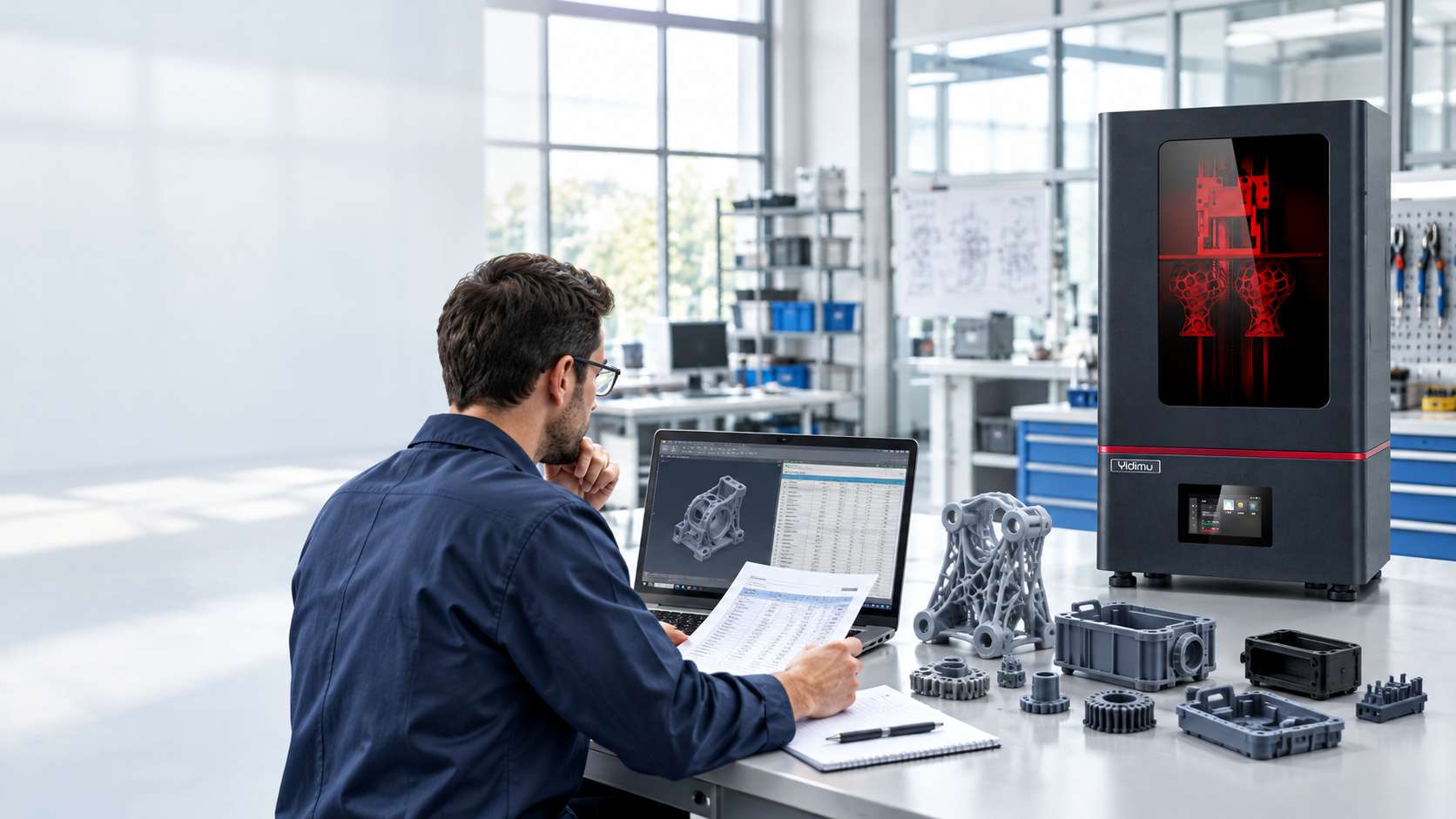
For example, the Yidimu Eternal M2 industrial resin 3D printer is positioned for industrial prototypes, factory samples, engineering models and small-batch production trials.
Its suitability for a particular factory should be assessed by checking how many representative parts fit within the usable build area, the supporting and finishing requirements, and the number of acceptable parts produced per complete workflow cycle.
Factories evaluating flexible components should also confirm the necessary resin behavior and post-curing conditions rather than assuming a rigid-model process is suitable for elastomer parts.
Common Mistakes That Overstate Resin Printer ROI
- Using the purchase price alone: Excludes installation, washing, curing, safety controls and other startup expenses.
- Assuming maximum utilization: Ignores actual demand, downtime and workflow constraints.
- Counting all printed parts: Overstates output when some parts fail inspection.
- Ignoring operator labor: Confuses unattended machine time with the complete manufacturing workflow.
- Treating every time saving as cash savings: Adds benefits that may not translate into realized financial value.
- Double-counting equipment investment: Mixes full capital expenditure with depreciation without a consistent accounting method.
- Skipping material validation: Assumes visually acceptable prototypes are suitable for production use.
Safety and Environmental Costs Belong in the Business Case
Factories should include appropriate resin handling, worker protection, ventilation, cleaning and waste-management arrangements in the investment evaluation.
Uncured photopolymer materials and cleaning chemicals can present workplace exposure hazards. Operators should follow the material safety data sheets and applicable safety procedures, including suitable personal protective equipment and ventilation controls.
Cleaning and UV post-curing requirements must be matched to the actual resin and application. These steps should not be shortened merely to improve a calculated ROI.
Frequently Asked Questions
Is a resin 3D printer profitable for a small factory?
It can be, but profitability depends on recurring demand, the cost of the existing manufacturing method, material suitability and actual accepted output. A small factory with frequent prototype requirements may have a stronger investment case than a larger facility with only occasional printing needs.
How many parts must a printer produce to break even?
There is no universal quantity. The answer depends on initial investment, net savings per accepted part, fixed operating expenses and the evaluation period. Calculate the required output from verified costs and confirm that the expected workload can support it.
Does a larger resin printer always provide better ROI?
No. A larger platform may support bigger models or more parts per build, but equipment cost, material consumption, loading efficiency, build reliability and post-processing capacity all affect the final economics.
Should labor be included in the ROI calculation?
Yes. Include additional hands-on operating labor and any real labor cost reductions compared with the baseline process. Do not treat an employee’s available time as a cash saving unless the benefit is financially realizable.
Can faster prototype development improve ROI?
Potentially. Faster development may reduce outside purchasing costs, avoid certain tooling expenses or create opportunities for additional profitable work. The monetary value should be documented rather than assumed.
Final Investment Checklist
Before approving a factory resin printer investment, confirm that:
- The proposed parts are suitable for the selected printer and resin.
- Finished samples meet documented acceptance criteria.
- Demand is supported by actual production or development requirements.
- Machine and post-processing capacity are evaluated together.
- Material, labor, maintenance and safety costs are included.
- ROI and payback calculations use consistent financial assumptions.
- Conservative scenarios remain acceptable to the factory.
The purpose of ROI analysis is not to prove that every factory needs a resin printer. It is to determine whether a specific printing workflow produces enough measurable value to justify its investment.
Evaluate Your Factory’s Resin Printing Requirements
Before committing to equipment, Yidimu can help review representative part geometry, material requirements and suitable printing workflows.
Send your 3D model, overall dimensions, intended application, critical requirements and expected production quantity to discuss a resin 3D printing sample evaluation.
A representative sample provides a practical starting point for assessing technical suitability and collecting the production data needed for a more reliable investment calculation.
References
- National Institute of Standards and Technology (NIST). Costs and Cost Effectiveness of Additive Manufacturing.
https://www.nist.gov/publications/costs-and-cost-effectiveness-additive-manufacturing - OpenStax. Additive Manufacturing Essentials — 8.4 AM Economics.
https://openstax.org/books/additive-manufacturing-essentials/pages/8-4-am-economics - National Institute of Standards and Technology (NIST). Guide for Environmentally Sustainable Investment Analysis Based on ASTM E3200.
https://www.nist.gov/publications/guide-environmentally-sustainable-investment-analysis-based-astm-e3200 - CDC / National Institute for Occupational Safety and Health (NIOSH). 3D Printing (Additive Manufacturing).
https://www.cdc.gov/niosh/manufacturing/additive/