For professional users, resin 3D printing is more than a way to produce attractive sample parts. When the application, resin, printer size and post-processing method are selected correctly, it can become part of a repeatable production support workflow.
Factories and development teams often face the same challenges: long sample lead times, high mold costs, repeated design changes, limited internal prototyping capacity and difficulty checking fine details before production. Dental labs and clinics may need a reliable way to print dental models or workflow-related parts from digital scan data. Model-making companies may need smooth, detailed parts for presentation models. Shoe sample factories may need elastic material testing or visual prototypes before mold confirmation.
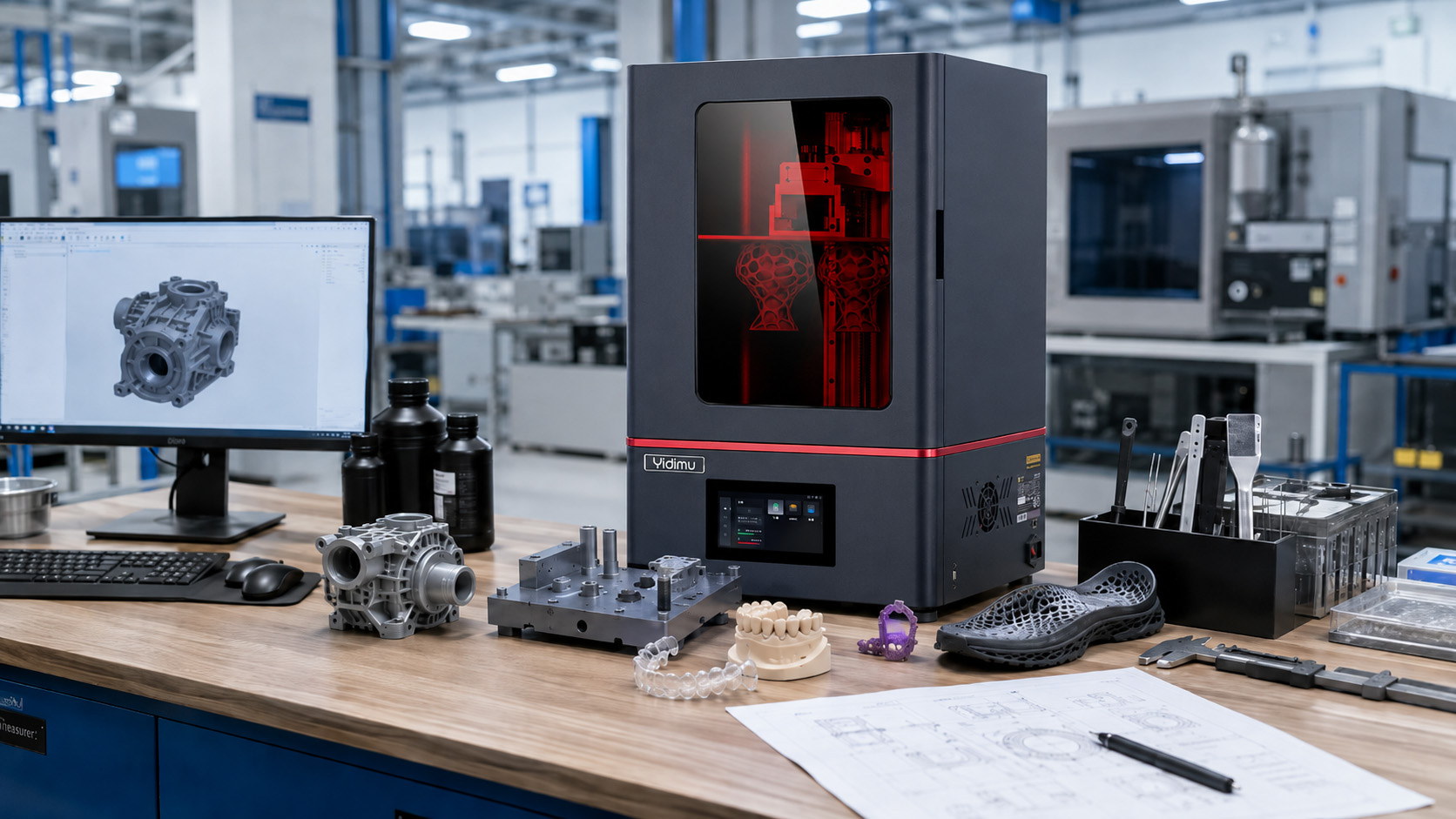
Industrial resin 3D printers can support these needs because vat photopolymerization uses light to cure liquid photopolymer resin layer by layer. Depending on the system, resin, exposure settings and post-curing process, this method can produce parts with fine surface detail and relatively smooth finishes. Results should still be evaluated against the actual workflow, since material behavior, support design, cleaning, UV curing and inspection all affect the final part.
Main Industrial Resin 3D Printer Applications
1. Product Development and Engineering Prototypes
Product development is one of the most common industrial resin 3D printer applications. Engineers and product teams use resin printing to check form, size, surface detail and assembly relationships before committing to tooling or CNC machining.
Resin 3D printing can support:
- Appearance prototypes
- Design validation parts
- Engineering samples
- Assembly mockups
- Internal review models
- Customer approval samples
For product development teams, the main benefit is faster iteration. A design file can be adjusted, sliced and printed again without waiting for a mold modification or an external sample supplier, which is especially useful during early development when geometry changes frequently.
Factory users should confirm the purpose of the prototype before choosing the resin. A model used only for visual review may need surface detail and dimensional consistency. A fitting test sample may need better toughness or heat resistance. A part used for mechanical evaluation may require a resin specifically designed for that purpose, and even then, performance should be tested under real working conditions.
2. Factory Sample Making
Factory sample making differs from hobby-level printing. In a factory environment, a sample often needs to support communication between engineering, sales, purchasing, production and end customers.
Industrial resin printing can help factories prepare:
- New product samples
- Display models
- Structural samples
- Pre-production samples
- Appearance confirmation models
- Packaging fit-check models
- Small components for customer review
For many factories, the main value is speed and control. Instead of relying only on outsourced sample shops, a factory can build an internal workflow for early sample production, shortening communication cycles and reducing repeated sample shipping.
Resin printed samples should not automatically be treated as final production parts. The user should confirm whether the printed part is for appearance review, fit checking, assembly discussion or limited functional testing.
3. Industrial Model Making
Industrial model-making companies often require smooth surfaces, sharp details and stable repeatability. Resin 3D printing may be suitable for model houses, product display models, engineering models, machinery miniatures, educational models and exhibition samples.
Typical model-making applications include:
- Product display models
- Architecture-related models
- Industrial machinery scale models
- Equipment demonstration models
- Transparent or semi-transparent parts, depending on resin
- Complex decorative or detailed components
Compared with some filament-based printing methods, resin printing may reduce visible layer lines and support finer detail, which can matter when the model is used for photography, sales presentation or customer approval.
The practical challenge is post-processing. Supports must be removed carefully, surfaces may need sanding or finishing, and UV curing must be controlled according to resin requirements. For presentation models, workflow discipline matters as much as the printer itself.
4. Dental Models and Dental Workflow Support
Dental applications are an important professional use case for resin 3D printing. Dental labs, clinics and digital dental centers may use resin 3D printers for model-based workflows, including dental arch models, orthodontic models, implant planning models and crown and bridge model support.
Possible dental-related applications include:
- Dental study models
- Orthodontic models
- Implant planning models
- Crown and bridge working models
- Surgical guide models, depending on resin indication
- Temporary dental parts, depending on approved resin and workflow
Dental users should be especially careful with material selection and post-processing. A dental model resin, surgical guide resin or temporary crown resin may have different intended use, curing requirement, biocompatibility expectation and regulatory status.
Customers should confirm resin indication, post-curing process and local regulatory requirements before clinical or intraoral use.
For Yidimu customers, dental printer selection should consider build size, accuracy requirement, resin compatibility, cleaning method, UV curing equipment and whether technical support is needed for print parameters.
5. Jewelry Casting Models
Jewelry workshops and design studios may use resin 3D printing to produce detailed casting patterns, ring models, pendants and decorative pieces. Resin printing can be useful where fine details, thin features and complex shapes are required.
Typical jewelry applications include:
- Ring prototypes
- Pendant models
- Decorative components
- Castable resin patterns
- Customer review samples
- Design approval models
For jewelry casting, resin choice is critical. A general model resin is not the same as a castable resin. Users should confirm burnout behavior, ash content expectations, support placement, cleaning and curing requirements before using printed parts in a casting workflow.
Jewelry users should also check whether the printer can reproduce fine engraving, prong details and thin decorative structures at the required scale.
6. Shoe Mold Prototypes and Footwear Development
Shoe sample factories and footwear development teams may use resin 3D printing during design validation and sample development. Resin printing can support fast review of sole structures, shoe mold concepts, texture details and component geometry.
Possible applications include:
- Shoe sole prototypes
- Mold concept models
- Texture review samples
- Midsole or outsole design samples
- Elastic component prototypes, depending on resin
- Design communication models
For footwear applications, users should separate visual review from functional testing. A rigid resin may be useful for shape confirmation, while elastic or flexible resin may be needed for soft part evaluation. The final result depends on the printer, resin properties, part thickness, curing process and test method.
Flexible resin 3D printers and elastic resin workflows can support some soft part applications, but performance should always be validated under the intended working conditions.
7. Jigs, Fixtures and Factory Support Tools
Resin 3D printing may support certain jigs, fixtures and production support tools, especially when fine detail, small geometry or quick iteration is required.
Applications can include:
- Inspection fixtures
- Positioning aids
- Assembly guides
- Checking gauges
- Small tooling aids
- Holding or alignment components
This does not mean every jig should be resin printed. Some factory tools require high impact strength, heat resistance, chemical resistance or long-term load-bearing performance. In these cases, CNC machining, metal fabrication or another material may be more suitable.
Resin printed jigs and fixtures are often most useful when the part is small, design changes are frequent, the load is limited and the factory needs quick internal validation.
8. Research, Education and Laboratory Use
Research centers, universities and technical teams may use industrial resin 3D printers to prepare test samples, demonstration models, experimental fixtures and custom parts for laboratory workflows.
Common uses include:
- Research models
- Teaching samples
- Experimental fixtures
- Device housings
- Small test geometries
- Custom lab supports
Research users should document print parameters carefully. Resin type, exposure time, orientation, support design, cleaning duration and post-curing conditions can all affect part behavior. For repeatable experiments, the workflow should be controlled and recorded.
9. Small-Batch Trial Production
Small-batch trial production is one of the most practical industrial resin 3D printer applications, but it requires realistic expectations. Resin printing can help prepare low-volume parts for internal testing, market review, customer approval or early-stage validation before mass production.
Small-batch trial applications may include:
- Pilot samples
- Low-volume display parts
- Trial parts before tooling
- Customer evaluation samples
- Internal training parts
- Limited functional prototypes, depending on resin
Before using resin printing for small-batch production, users should calculate printing time, cleaning time, curing capacity, labor cost, resin consumption, failure rate, inspection requirements and batch consistency.
A printer alone is not a production workflow. The full process must be planned.
Practical Table
Industrial Resin 3D Printer Applications Comparison Table
| Application | Typical User | Main Purpose | Key Printer Requirement | Resin Consideration | Important Workflow Note |
|---|---|---|---|---|---|
| Product prototypes | Product development teams, factories | Form, fit and design validation | Accuracy, stable Z-axis, suitable build size | Model resin, tough resin or application-specific resin | Confirm whether the prototype is visual, fitting or functional |
| Factory sample making | Manufacturers, sales engineering teams | Fast internal and customer sample review | Repeatability, surface quality, efficient printing | Standard model resin or engineering resin | Track file version and inspection result |
| Dental models | Dental labs, clinics | Model-based digital dental workflow | Dental accuracy, stable exposure, reliable calibration | Dental model resin | Confirm resin indication and post-curing process |
| Surgical guide models | Dental labs, digital dental centers | Implant planning or guide-related workflow | Precision, resin compatibility, clean workflow | Surgical guide resin if intended for clinical workflow | Confirm local regulatory requirements before use |
| Jewelry casting patterns | Jewelry workshops | Detailed models for casting preparation | Fine detail, small feature reproduction | Castable resin | Confirm burnout behavior and casting workflow |
| Shoe mold prototypes | Shoe sample factories | Sole structure, texture and mold concept review | Large enough build area, stable detail output | Rigid or flexible resin depending on purpose | Separate visual review from functional testing |
| Jigs and fixtures | Factory engineering teams | Positioning, inspection and assembly support | Dimensional consistency, stable repeatability | Tough or rigid resin depending on load | Avoid high-load use without testing |
| Industrial display models | Model-making companies | Presentation, exhibition and sales models | Smooth surface, detail quality | Model resin, transparent resin or finishing-friendly resin | Plan support removal and surface finishing |
| Small-batch trials | Factories, R&D teams | Low-volume validation before production | Print capacity, curing capacity, workflow control | Application-specific resin | Calculate total workflow time, not only print time |
Workflow or Checklist
Step-by-Step Workflow for Industrial Resin 3D Printing
Step 1: Define the Application
Start by identifying what the printed part must do. Is it a visual sample, a fit-check part, a dental model, a casting pattern, a fixture or a small-batch trial part? This decision affects printer size, resin selection, accuracy requirements and post-processing.
Step 2: Confirm Model Size and Print Orientation
Check the maximum part dimensions and the best orientation for printing. Orientation affects support marks, surface quality, accuracy and printing time. Large flat parts, thin walls and tall structures may require different preparation strategies.
Step 3: Select the Right Resin
Choose resin based on the application, not only price. Dental model resin, temporary dental resin, castable resin, flexible resin, rigid model resin and water-washable resin may serve different purposes. Customers should confirm material datasheets, intended use and post-curing requirements.
Step 4: Prepare the 3D File
Check the file for wall thickness, open surfaces, non-manifold geometry and unsupported details. A clean STL, OBJ or other compatible 3D file can reduce print failures.
Step 5: Slice and Set Parameters
Use suitable layer thickness, exposure settings, support density and lift speed. Incorrect parameters may cause deformation, poor detail, weak parts or failed prints.
Step 6: Print the Part
During printing, monitor resin level, build platform adhesion, temperature conditions and any early signs of failure. For repeated factory workflows, keep records of settings and results.
Step 7: Clean the Printed Part
After printing, remove uncured resin according to the resin manufacturer’s instructions. Cleaning time and method may affect surface quality and final material performance.
Step 8: Remove Supports Carefully
Support removal should be done after the correct cleaning stage and before or after curing depending on the workflow. Poor support removal can damage fine features or leave visible marks.
Step 9: UV Cure the Part
Post-curing is important for many resin printed parts. Curing time, wavelength, temperature and part orientation may affect final strength, stability and surface condition.
Step 10: Inspect and Record Results
Measure critical dimensions, inspect surface quality and record the workflow. For factory users, repeatability depends on documentation as much as equipment capability.
Factory User Checklist Before Buying an Industrial Resin 3D Printer
- What applications will the printer mainly support?
- What is the largest part size required?
- Do you need rigid resin, flexible resin, dental resin, castable resin or model resin?
- Is the part for visual review, fitting, workflow support or limited functional testing?
- What accuracy and surface finish are required?
- How often will the machine be used?
- Do you need one printer or multiple printers for batch work?
- Do you already have cleaning and UV curing equipment?
- Who will prepare files, supports and slicing parameters?
- Do you need supplier support for resin parameters and troubleshooting?
- How will finished parts be inspected?
- Are there any dental, safety or regulatory requirements?
Common Mistakes to Avoid
1. Choosing a Printer Only by Resolution
Resolution matters, but it is not the only factor. Build size, exposure stability, Z-axis structure, resin compatibility, software workflow, after-sales support and post-processing equipment all affect actual results.
2. Using the Same Resin for Every Application
A model resin may not be suitable for a fixture. A rigid resin may not be suitable for an elastic part. A general resin should not be used for dental clinical purposes unless the resin indication and workflow support that use.
3. Ignoring Cleaning and UV Curing
Industrial resin printing does not end when the printer finishes. Cleaning and UV curing are part of the production process. Poor post-processing may affect accuracy, surface quality and material behavior.
4. Treating Printed Samples as Final Production Parts Too Early
Printed parts can support validation, but users should test them under real conditions before treating them as production components. Load, heat, chemical exposure, wear and long-term stability should all be considered.
5. Poor Support Design
Support placement affects surface marks, deformation and print success. Professional users should build internal support rules for recurring applications.
6. Not Recording Parameters
Factories need repeatability. If the operator does not record resin type, layer thickness, exposure, orientation, support style, cleaning time and curing time, it becomes difficult to repeat successful results.
7. Overlooking Safety Procedures
Liquid photopolymer resin should be handled carefully. Operators should follow resin safety instructions, use suitable personal protective equipment and maintain a clean, controlled working area.
8. Buying Equipment Without Defining the Workflow
A printer is only one part of the system. A complete workflow may include CAD software, slicing, printer operation, resin storage, cleaning, UV curing, inspection, finishing and technical support.
FAQ
What are the most common industrial resin 3D printer applications?
Common applications include product prototypes, factory samples, dental models, jewelry casting patterns, shoe mold prototypes, industrial display models, jigs, fixtures, research models and small-batch trial parts. The best application depends on the resin, printer size, accuracy requirement and post-processing workflow.
Is an industrial resin 3D printer suitable for factory prototyping?
Yes, an industrial resin 3D printer can support factory prototyping when the part requires fine detail, smooth surface quality and fast design iteration. Users should confirm whether the prototype is for appearance review, fit checking or limited functional testing before selecting the resin.
Can resin 3D printers make functional parts?
Resin 3D printers can make some functional parts, depending on resin type, part geometry, load condition and post-curing process. However, users should avoid assuming that every resin printed part is suitable for high-load, high-temperature or long-term production use without testing.
What resin should be used for industrial prototypes?
The resin should match the application. Standard model resin may be suitable for visual samples. Tough or engineering resin may be needed for fitting or handling tests. Flexible resin may be required for elastic parts. Dental or castable applications require resins designed for those workflows.
Are resin 3D printers useful for dental labs?
Yes, dental labs may use resin 3D printers for dental models, orthodontic models, implant planning models and other digital dental workflows. Customers should confirm resin indication, post-curing process and local regulatory requirements before clinical or intraoral use.
What is the role of a UV curing box?
A UV curing box supports post-curing after printing and cleaning. For many resin parts, post-curing helps complete the material workflow and may affect strength, surface condition and stability, depending on resin requirements.
How should factories choose build size?
Factories should choose build size based on the largest expected part, batch quantity and preferred print orientation. A larger build platform may help with multiple parts or large models, but users should also consider accuracy, resin use, machine stability and curing capacity.
Is resin 3D printing better than FDM printing?
It depends on the application. Resin printing may be preferred for fine details, smooth surfaces and dental or model workflows. FDM may be suitable for larger, lower-cost or less detailed parts. Factory users should compare part size, surface finish, material needs, strength requirements and total workflow cost.
Can resin 3D printing replace injection molding?
Usually, resin 3D printing is better used before injection molding rather than as a full replacement. It can help with design validation, sample review, small-batch trials and early testing. For mass production, injection molding may still be more suitable depending on quantity, material and cost requirements.
What should professional users prepare before contacting Yidimu?
Professional users should prepare the target application, maximum model size, resin requirement, expected accuracy, sample images or files if available, production frequency, post-processing needs and whether they require dental, flexible, industrial model or casting-related workflows.