
Where Do I Buy a 3D Printer for Professional Use?
If you are asking, “where do I buy a 3D printer?”, the practical answer is to buy from a manufacturer, authorized distributor or specialized industrial equipment supplier that can match the machine to your parts, materials and production workflow. For professional resin printing, the purchasing decision should include application review, sample testing, post-processing, installation, training, maintenance and technical support—not only the printer listing. YIDIMU provides professional resin 3D printing equipment and workflow solutions for engineering, dental, jewelry, footwear and small-batch applications.
Key Takeaways
- Choose the purchasing channel according to your application risk, support needs and internal technical capability.
- Define the required part before choosing a printer technology or build size.
- Laser-based SLA, DLP and LCD/MSLA are different vat photopolymerization architectures and should be evaluated separately.
- Ask for representative sample parts, documented material compatibility and a complete post-processing workflow.
- Judge the investment by accepted parts, repeatability, labor, downtime and validation effort—not by machine price alone.
Where Can You Buy a 3D Printer?
Professional users typically buy through one of four channels. None is automatically suitable for every project. The correct choice depends on how much application engineering, local service, commercial flexibility and process validation you require.
| Purchasing channel | Typical advantages | Questions to resolve | Most suitable when |
|---|---|---|---|
| Direct from the manufacturer | Direct technical communication, application matching, configuration options and access to product specialists | Installation scope, shipping terms, response times, spare parts, remote support and local service coverage | You need a professional system, application review or a project-specific quotation |
| Authorized distributor | Local communication, regional logistics, installation and potentially faster on-site service | Authorization status, technical competence, stock, training capability and escalation path to the manufacturer | Local support and local commercial terms are operational priorities |
| Specialized industrial equipment supplier or integrator | Can combine printers with scanning, post-processing, inspection or production-cell requirements | Who owns process responsibility, which components are supported and how system-level acceptance will be tested | The printer is one element of a broader engineering or manufacturing workflow |
| General online marketplace | Fast comparison and simple ordering for standardized products | Seller identity, technical support, warranty handling, resin compatibility, replacement parts and authenticity | The application is low risk and your team can independently operate and troubleshoot the system |
For a production team, the seller should be able to explain what happens after delivery. A machine without a defined material, preparation method, washing process, drying step, post-curing method and inspection plan is not yet a complete resin printing workflow.
Start With the Part, Not the Storefront
Before comparing suppliers, define the part and its purpose. A printer selected for a visual presentation model may be unsuitable for a load-bearing test component, a dental appliance workflow or a flexible lattice. The same CAD file can also produce different results when the resin, orientation, support strategy, exposure, layer separation, temperature and post-processing conditions change.
Specify the output category
- Visual prototype: intended mainly to assess shape, scale, surface appearance, assembly presentation or design communication.
- Functional sample: used for a defined mechanical, fit, movement, handling or short-duration engineering test under stated conditions.
- Validated production part: produced through a controlled process with documented acceptance criteria, inspection and repeatability evidence.
- Long-term end-use part: expected to retain required properties under actual thermal, mechanical, chemical, environmental and service-life conditions.
These categories should not be treated as interchangeable. Fine detail and a smooth surface do not prove mechanical strength, heat resistance, chemical resistance, dental suitability, medical suitability or long-term durability. The supplier should ask how the part will be used and what evidence is required before claiming that a material is appropriate.
Define the geometry and workload
Provide the overall part dimensions, smallest critical features, wall thicknesses, holes, channels, mating surfaces, unsupported spans and dimensional tolerances. Also state the number of parts per batch, expected batches per week, acceptable finishing labor and inspection method. Build volume alone does not determine usable capacity; orientation, support access, separation forces, drainage and post-processing capacity may reduce practical throughput.
Choose the Appropriate Printing Process
The phrase “3D printer” covers several process families. Thermoplastic material extrusion can suit fixtures, concept models and larger structural prototypes. Polymer powder-bed systems can produce complex parts without attached support structures, but require powder handling and a different facility workflow. Vat photopolymerization is often selected for fine features, smooth surfaces and application-specific resin systems.
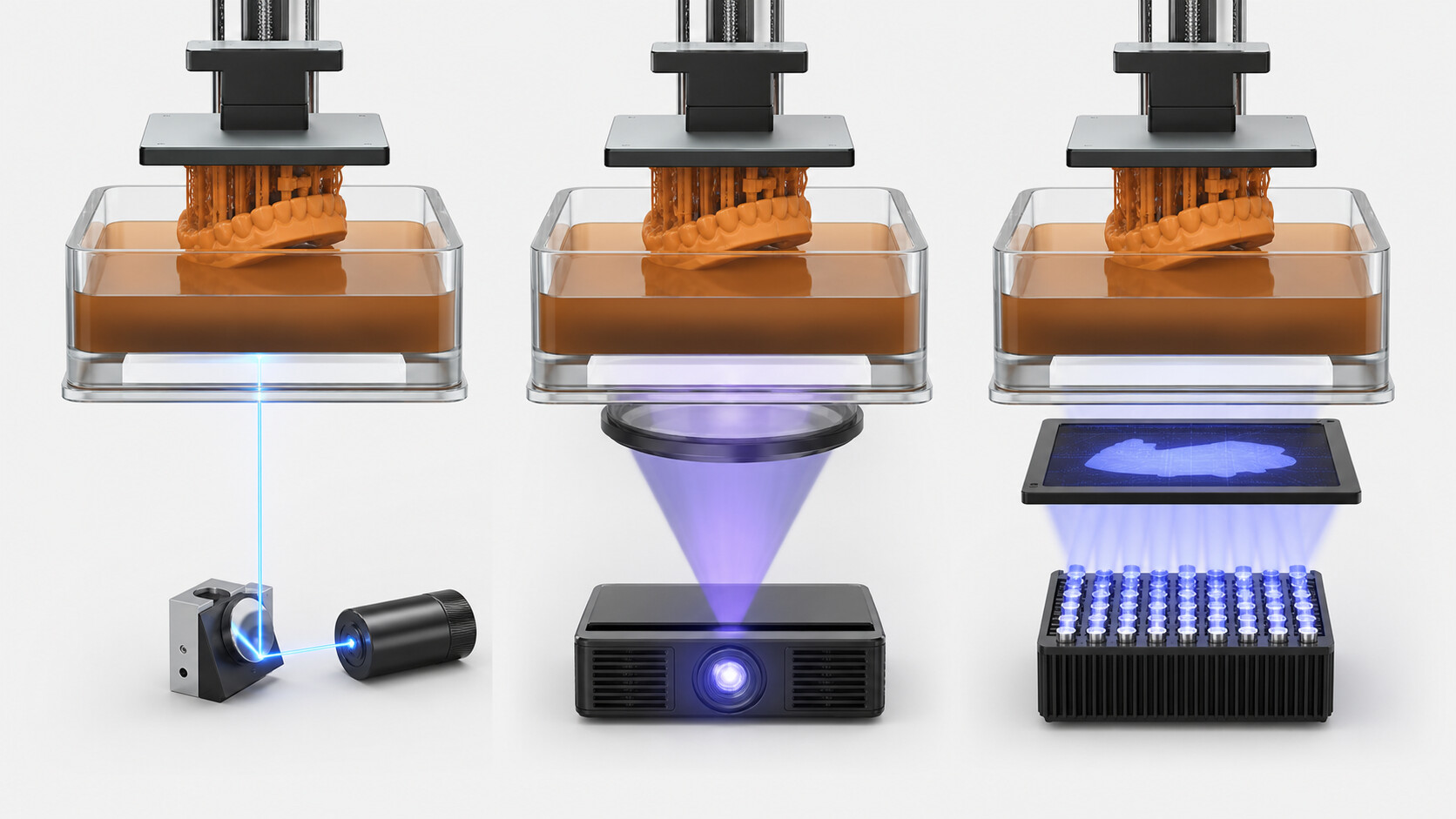
Within vat photopolymerization, the light architecture matters:
| Technology | How a layer is exposed | Evaluation focus |
|---|---|---|
| Laser-based SLA | A laser spot scans the selected cross-section of each layer | Laser spot behavior, scan strategy, optical calibration, resin response, recoating and geometry-dependent build time |
| DLP | A projector, commonly using a digital micromirror device, projects the layer image | Projected pixel size, optical distortion, irradiance uniformity, build-area scaling and resin compatibility |
| LCD/MSLA | An LCD mask selectively transmits light from an underlying light source across the layer | Pixel size, light uniformity, screen and film service items, thermal control, exposure window and separation behavior |
Nominal pixel size, laser spot size or layer thickness should not be interpreted as actual part accuracy. Final dimensions also depend on light spread, resin conversion, shrinkage, machine mechanics, feature direction, support removal and post-curing. Ask the supplier how representative parts are evaluated across the build area and how process changes are controlled.
What to Check Before You Place an Order
Application evidence
Ask for samples that resemble your geometry, feature scale and intended material class. A decorative sample does not validate an engineering or production application.
Material system
Review available resin materials for professional printing, their technical documentation, storage conditions, post-processing requirements and stated limitations.
Complete workflow
Confirm file preparation, support generation, printing, part removal, washing, complete drying, post-curing, support finishing and inspection responsibilities.
Service scope
Clarify installation, training, maintenance intervals, remote support, replacement parts, consumables, troubleshooting and escalation procedures.
Commercial scope
Request a written quotation that identifies equipment, accessories, freight, installation, taxes or duties where applicable, consumables and optional services.
Acceptance criteria
Agree on what will be checked after installation: machine operation, sample build, dimensional inspection, workflow training or another documented acceptance method.
For engineering teams, reviewing real industrial prototyping applications can help frame the discussion, but the final decision should still be based on your own part files and acceptance criteria.
Application and Material Considerations
Industrial prototyping and engineering development
Identify whether the part is used for appearance review, fit checking, airflow evaluation, assembly rehearsal, tooling support or mechanical testing. Resin selection should be tied to the specific load case and test duration. A rigid resin may provide useful dimensional feedback yet fail under impact, heat or sustained loading if those conditions exceed its intended use.
Dental laboratory work
Dental workflows require application-specific material documentation, controlled processing and verification appropriate to the intended dental use. Printer compatibility alone is insufficient. The laboratory must assess the printer, resin, software, washing, drying, post-curing and quality-control procedure as a connected workflow. Local regulatory obligations and the material manufacturer’s instructions also remain relevant.
Jewelry and casting preparation
For jewelry patterns, assess surface detail, small-feature reproduction, support placement, burnout behavior and the compatibility of the printed pattern with the selected investment and casting process. A successful visual print does not by itself establish reliable casting performance.
Footwear, elastomers and flexible parts
Flexible resins can be sensitive to temperature, geometry, lattice design, support strategy, washing, drying and post-curing. Shore hardness alone does not describe tear behavior, compression response, rebound, fatigue or long-term aging. Request samples that reproduce the relevant wall thickness, lattice cell and loading direction.
Small-batch production
Production planning should include build nesting, resin replenishment, platform turnover, washing capacity, drying time, curing capacity, finishing labor, inspection, traceability, failed-build allowance and machine downtime. Compare cost per accepted part under a defined workload rather than comparing only purchase quotations.
Plan the Facility and Resin-Handling Workflow
Uncured photopolymer resin and cleaning chemicals require controlled handling. Follow the current safety data sheet and equipment instructions for every material in use. Use compatible chemical-resistant gloves, appropriate eye protection and suitable ventilation. Keep food and drink outside the work area, control spills, label containers and train operators in the actual handling procedure.
Do not pour uncured resin, contaminated wash liquid or resin-soiled materials into ordinary drains. Collect, store and dispose of resin, solvents, filters, wipes and gloves according to their condition, the SDS and applicable local waste requirements. Washing and curing do not remove the need for a documented waste plan.
Important: There is no universal exposure, washing or post-curing setting. Results depend on the printer, resin, geometry, orientation, supports, exposure, layer separation, temperature, washing, complete drying, post-curing and inspection method.
Common Buying Mistakes
- Buying by headline resolution: pixel count or layer height does not represent the complete dimensional-performance chain.
- Choosing build volume without checking usable layout: supports, orientation, peel forces, drainage and access can limit effective capacity.
- Testing only a demonstration model: use your own difficult features and intended material class.
- Ignoring post-processing: insufficient washing, incomplete drying or unsuitable curing can alter surfaces, dimensions and properties.
- Assuming one resin covers every application: appearance, stiffness, toughness, flexibility, casting behavior and dental use require different evidence.
- Leaving support undefined: determine who provides training, troubleshooting, spare parts and process guidance after delivery.
- Comparing purchase price alone: include consumables, labor, rejected parts, maintenance, downtime and validation.
A Practical Purchasing Workflow
- Define the application. Record intended use, dimensions, critical features, tolerances, material behavior, quantity and validation requirements.
- Select the process family. Decide whether material extrusion, powder-bed processing or vat photopolymerization is technically appropriate.
- Shortlist qualified suppliers. Review application capability, support structure, material range and service scope.
- Submit representative files. Include difficult geometries rather than only simple showcase models.
- Evaluate samples. Inspect dimensions, surfaces, support marks, fit, post-cure condition and application-specific performance.
- Review the complete quotation. Include equipment, accessories, post-processing, consumables, delivery, installation and training.
- Define acceptance and support. Document installation checks, operator training, sample verification and the troubleshooting route. YIDIMU also provides technical support and troubleshooting resources for resin printing users.
Frequently Asked Questions
Should I buy directly from a 3D printer manufacturer?
Direct purchasing can be appropriate when you need application review, configuration guidance, sample testing or direct access to product specialists. Confirm delivery terms, installation, training, support response and local service arrangements before ordering.
Is an online marketplace suitable for a professional printer?
It may be suitable for a standardized, low-risk purchase when your team can independently install, operate and troubleshoot the system. For production or regulated workflows, verify seller identity, technical competence, material documentation, warranty handling and parts availability.
What information should I send to a supplier?
Send part files where possible, overall dimensions, critical features, intended use, required material behavior, quantity, production target, inspection method and validation needs. Also state site voltage, delivery location and desired support scope.
Can I choose a printer only by resolution and build size?
No. Those values are useful screening inputs, but they do not establish dimensional accuracy, surface quality, repeatability, material performance or throughput. Evaluate the complete optical, mechanical, resin and post-processing system.
Do I need washing and UV post-curing equipment?
Most vat-photopolymer workflows require removal of residual resin, complete drying and controlled post-curing, but the approved process depends on the specific resin and application. Ask the supplier to define compatible equipment and follow the material instructions rather than applying universal settings.
How should I compare two supplier quotations?
Normalize the scope. Compare the printer, included accessories, post-processing equipment, initial consumables, freight, installation, training, warranty terms, spare parts, support and the expected cost per accepted part under the same workload.
Conclusion
Where you buy a 3D printer matters because professional results depend on more than access to a machine. Select a supplier that can connect the printer technology, resin, part geometry, post-processing, safety controls, inspection and support plan to your actual application. A technically justified purchase begins with representative parts and measurable acceptance criteria.
Discuss Your 3D Printing Requirement With YIDIMU
For a project-specific equipment recommendation, contact YIDIMU with your part dimensions, intended use, critical features, material requirements, expected quantity, production goals and validation needs. The information will help the technical team evaluate a suitable resin printing and post-processing workflow without relying on unsupported assumptions.