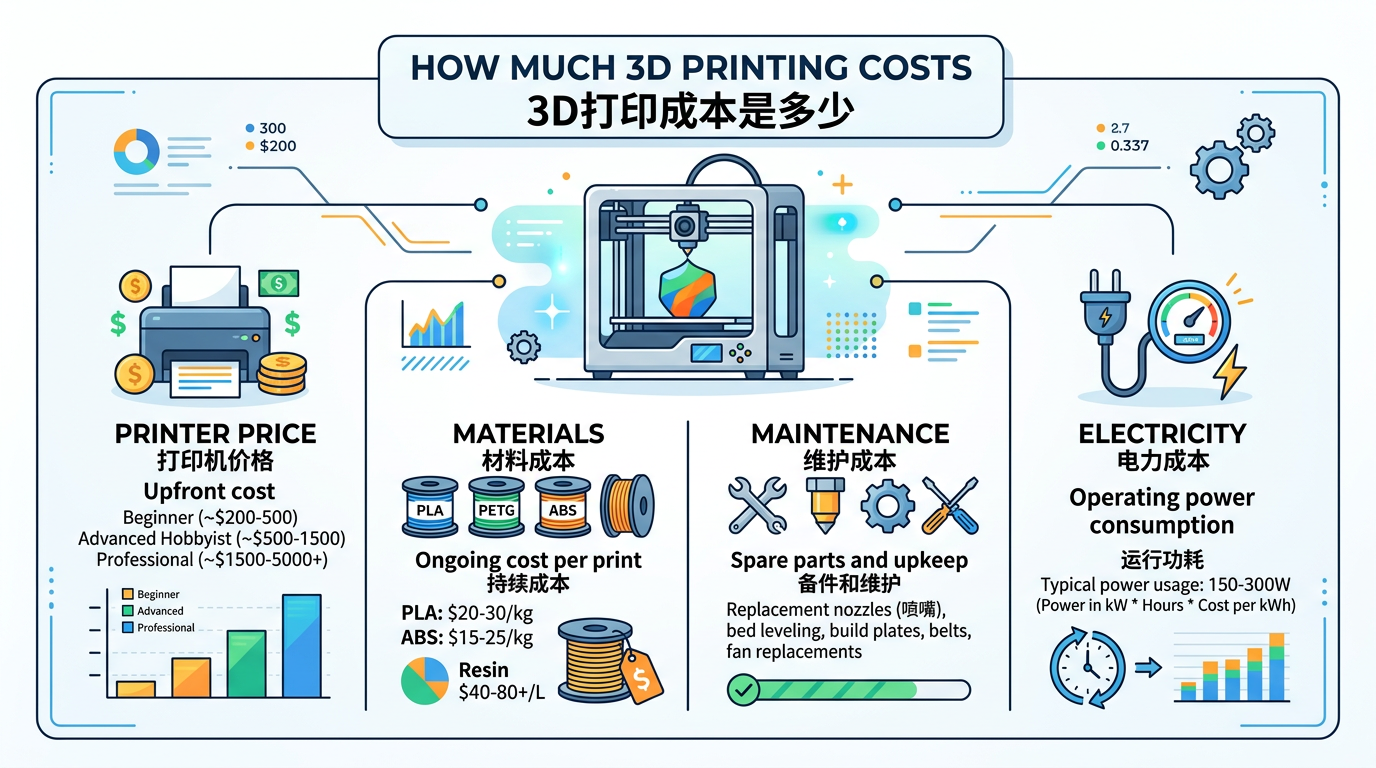
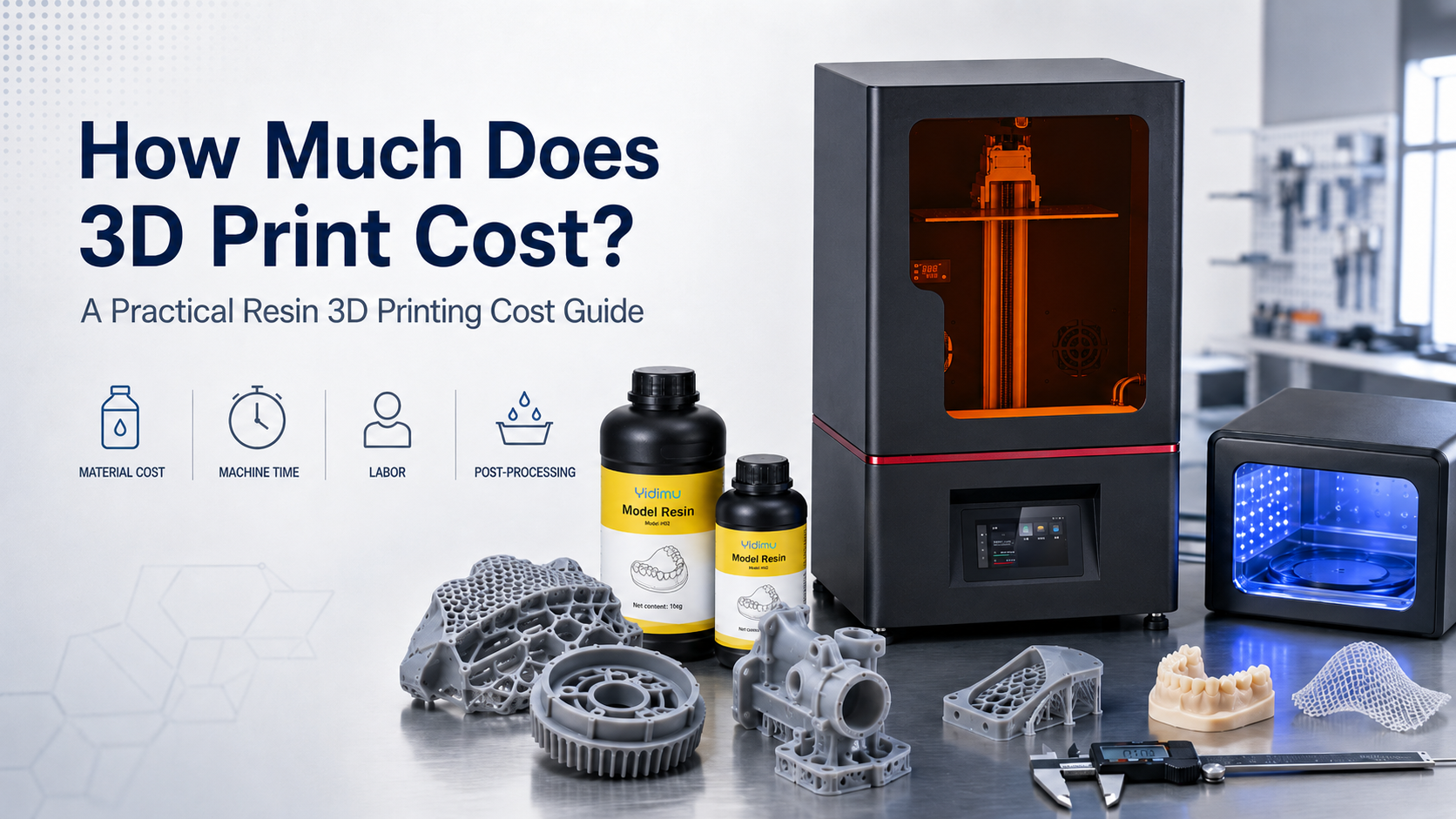
How much does 3D print cost depends on part size, resin type, model complexity, machine time, support structure, post-processing, labor, inspection requirements and whether the print is a one-off sample or repeated production batch. For professional resin 3D printing, the visible material cost is only one part of the total cost. A complete quote may also include file review, slicing, support design, printing, cleaning, UV curing, finishing, quality checking, packaging and technical communication. For factories, dental labs and engineering teams, the better question is not only “how much does one print cost,” but “what workflow gives the right accuracy, surface quality and repeatability for this application?”
Introduction
Many people search “how much 3D printing cost” expecting a simple price per gram or price per hour. In real professional resin 3D printing, that approach is often too simple. Two parts with similar weight can have very different costs if one requires high accuracy, fine surface detail, difficult support removal, special resin, long cleaning time or controlled UV curing.
In industrial and dental workflows, 3D printing is usually evaluated as a complete process rather than a single machine operation. ISO/ASTM 52900 describes additive manufacturing as building physical 3D geometries by successive addition of material, which helps explain why process planning, material behavior and post-processing all affect the final result.
This guide explains the main cost factors behind resin 3D printing so professional buyers can request more accurate quotations and avoid underestimating the full workflow.
What Is Included in 3D Printing Cost?
A professional 3D printing cost usually includes more than the resin consumed by the part. In many projects, material is visible, but labor and workflow control are the hidden cost drivers.
A realistic resin 3D printing cost may include:
- 3D model checking and file preparation
- Orientation and support design
- Slicing and parameter setup
- Resin material consumption
- Support material and failed-print allowance
- Machine printing time
- Cleaning and resin removal
- UV post-curing
- Support removal and surface finishing
- Dimensional inspection or visual inspection
- Packaging, handling and communication
- Reprint risk for difficult models or unclear requirements
For a simple display model, the cost may be mainly related to model volume and finishing. For a dental model, engineering prototype, jig, fixture or flexible test part, the cost may also depend on accuracy, resin selection, repeatability and application requirements.
Main Factors That Affect Resin 3D Printing Cost
| Cost Factor | Why It Matters | Typical Impact on Cost |
|---|---|---|
| Part size | Larger parts consume more resin and build space | Higher material and machine cost |
| Part height | Taller parts often increase print time in layer-based resin printing | Longer machine occupation |
| Resin type | Standard model resin, ABS-like resin, dental resin and flexible resin have different material costs and handling needs | Strong effect on quote |
| Model complexity | Thin walls, hollow structures, fine details and undercuts need careful support planning | More preparation and finishing time |
| Support structure | More supports mean more resin, removal work and surface touch-up | Higher labor cost |
| Layer thickness | Thinner layers may improve detail but can increase print time | Higher machine time |
| Accuracy requirement | Tighter tolerance requires more process control and inspection | Higher technical cost |
| Surface finish | Display-quality parts need more cleaning, sanding or finishing | Higher post-processing cost |
| Batch quantity | Multiple parts may improve machine utilization if arranged efficiently | Lower unit cost when planned well |
| Risk level | Difficult geometries or new materials may require testing | Higher quotation buffer |
Why Material Cost Is Not the Whole Price
Many buyers ask for a price based only on resin weight. This is understandable, but it can lead to inaccurate expectations.
For example, a small dental model and a small engineering connector may use a similar amount of resin. However, the engineering connector may need stronger resin, tighter dimensional control, a specific orientation and a cleaner support-contact area. The dental model may require a dental workflow, model accuracy, controlled post-curing and resin indication review.
Material cost is only one part of the quote. The full cost depends on whether the printed part needs to be beautiful, accurate, functional, repeatable, flexible, heat-resistant, castable, biocompatibility-related or simply used for visual checking.
If resin selection is an important part of the project, buyers can review Yidimu resin materials before requesting a workflow recommendation.
How Part Size and Build Height Affect Cost
In resin 3D printing, part size affects cost in several ways.
A wider part consumes more build area. A taller part may increase total printing time because the machine builds the object layer by layer. Even if two parts use similar resin volume, the taller part may take longer to print if it requires more layers.
Cost can also increase when a large model needs to be split, hollowed, thickened or redesigned for printing. For factory prototypes and engineering samples, it is useful to provide the model’s maximum length, width and height when asking for a quote.
For larger prototypes or production-oriented parts, buyers can compare industrial resin 3D printer options or discuss application requirements through industrial 3D printing solutions.
How Resin Type Changes the Cost
Different resins are designed for different applications. A low-detail visual model, a dental model, a flexible shoe prototype and an engineering fixture should not automatically use the same material.
| Resin Type | Common Use | Cost Consideration |
| Model resin | Appearance models, dental models, display samples | Usually cost-effective for visual and model applications |
| ABS-like resin | Engineering prototypes, functional samples, assembly checks | May cost more than basic model resin but can support stronger test parts |
| Water-washable dental model resin | Dental model workflows where water-wash cleaning is preferred | Cost depends on resin indication and workflow requirements |
| Surgical guide model resin | Dental-related guide model applications | Requires careful confirmation of indication, curing and local requirements |
| Temporary dental model resin | Dental-related temporary model workflows | Application requirements should be confirmed before use |
| Casting model resin | Jewelry, casting patterns and burnout-related workflows | Cost may include workflow testing and casting-process compatibility |
| Flexible resin | Shoe prototypes, elastic parts, lattice samples, soft functional tests | Often needs more careful support and parameter control |
For engineering prototypes, ABS-like resin may be considered when the part needs better functional handling than a basic visual model. For dental model workflows, Yidimu model resin or other dental-related materials may be reviewed depending on the application.
Customers should confirm resin indication, post-curing process and local regulatory requirements before clinical or intraoral use.
Machine Time and Build Efficiency
Machine time is another major cost factor. In professional resin printing, cost is not only determined by how much resin is used, but also by how long the printer is occupied and how efficiently the build plate is used.
A single small part printed alone may have a higher unit cost because the machine still needs setup, resin preparation, cleaning and post-processing. A batch of compatible parts may reduce unit cost when they can be printed together without affecting quality.
Research on additive manufacturing cost has also shown that capacity utilization and build planning can strongly affect unit cost in additive manufacturing workflows.
For buyers, this means batch planning matters. If you need ten similar prototypes, it may be more cost-effective to quote them together rather than one by one.
Post-Processing Cost: Cleaning, UV Curing and Finishing
Resin prints are not finished immediately after printing. Most resin parts require cleaning to remove uncured resin and UV curing to complete the post-processing workflow. Support removal and surface finishing may also be required.
Post-processing may include:
- Removing the build platform from the printer
- Draining excess resin
- Washing the printed part
- Drying the part before curing
- UV curing under controlled conditions
- Removing supports
- Sanding or trimming support marks when needed
- Checking surface quality and dimensional fit
OSHA’s Hazard Communication guidance emphasizes that hazardous chemical information should be available and understandable to workers, and that labels, safety data sheets and training are part of workplace chemical safety communication. For resin printing workflows, buyers and operators should review the resin SDS, use suitable gloves and eye protection, and follow local disposal rules for uncured resin and contaminated cleaning liquid.
If post-curing consistency is important, buyers may also consider UV curing equipment for resin prints.
How Much Does 3D Print Cost for Different Applications?
The final 3D printing cost depends heavily on the application. Below is a practical comparison for professional resin printing projects.
| Application | Main Cost Drivers | What Buyers Should Provide |
| Visual prototype | Size, surface finish, color expectation, detail level | STL/STEP file, size, surface requirement |
| Engineering prototype | Resin type, tolerance, strength requirement, assembly fit | CAD file, load direction, fit tolerance, test purpose |
| Dental model | Accuracy, resin indication, post-curing workflow, batch quantity | Model type, dental workflow, resin requirement |
| Flexible sample | Shore hardness target, lattice structure, support difficulty | Hardness range, use case, bending requirement |
| Jewelry casting pattern | Burnout behavior, detail, surface finish, casting process | Design file, casting method, detail requirement |
| Small-batch production | Repeatability, inspection, packaging, production schedule | Quantity, tolerance, resin, delivery expectation |
| Sample printing before equipment purchase | Model complexity, application test, resin match | Sample file, target material, evaluation standard |
If the project is still at the evaluation stage, Yidimu’s sample printing service can help buyers test model size, resin behavior and workflow feasibility before choosing equipment.
A Simple Formula for Estimating 3D Printing Cost
A practical cost estimate can be structured like this:
Estimated 3D printing cost = file preparation + resin consumption + machine time + support/waste allowance + post-processing + labor + inspection + packaging + risk allowance
This formula does not replace a formal quote, but it helps buyers understand why two similar-looking parts may have different prices.
Example Cost Logic
If a part is large but simple, the quote may be driven by resin volume and machine time.
If a part is small but complex, the quote may be driven by support design, cleaning, support removal and finishing.
If a part is for dental or engineering use, the quote may be driven by accuracy, material selection, curing control and inspection.
If a part is flexible, the quote may be driven by resin type, support difficulty and test requirements.
Step-by-Step Workflow to Request an Accurate Quote
Use this workflow before asking “how much does 3D print cost?”
1. Prepare the 3D Model
Send a printable 3D file such as STL, OBJ or STEP when available. If the model is not ready, explain whether you need design support, file repair or printability review.
2. Confirm the Final Part Size
Provide length, width and height. Do not assume the supplier can identify the intended scale from the file alone.
3. Explain the Application
State whether the part is for display, assembly testing, dental model workflow, flexible testing, casting, factory prototyping or small-batch production.
4. Define Material Requirements
Mention whether the part needs rigidity, impact resistance, flexibility, transparency, dental model use, casting behavior or only visual appearance.
5. Clarify Surface and Accuracy Needs
A basic prototype and a high-detail display sample may require different finishing levels. If dimensional accuracy matters, state the critical dimensions.
6. Provide Quantity
Unit cost may change when multiple parts can be arranged in one build. Provide the first sample quantity and expected future batch quantity.
7. Confirm Post-Processing Requirements
Mention whether the part needs support marks reduced, surface sanding, UV curing, water-wash workflow, assembly fit checking or special packaging.
8. Ask for Workflow Advice
For professional projects, the supplier should not only quote a price but also review whether the selected material and workflow match the application.
For equipment selection and quotation planning, buyers can review professional resin 3D printer options or contact Yidimu for workflow review.
Cost Checklist for Professional Buyers
Before confirming a 3D printing quote, check the following:
- Have you provided the correct model file?
- Is the model scale confirmed?
- Is the part for appearance, function, dental workflow or production testing?
- Is the resin type confirmed?
- Are tolerance and surface requirements realistic?
- Is post-curing required?
- Are support marks acceptable?
- Is the quantity clear?
- Is the expected delivery schedule realistic?
- Are safety, resin indication and local requirements confirmed for dental-related use?
- Is the quote for one sample or repeated batches?
- Does the supplier understand the final application?
Common Mistakes to Avoid
Mistake 1: Asking Only for Price Per Gram
Price per gram can be useful for rough estimation, but it ignores labor, machine time, support structure, cleaning, curing and finishing.
Mistake 2: Choosing the Cheapest Resin Automatically
A cheaper resin may not meet the application requirement. For engineering samples, dental models or flexible parts, material suitability is more important than resin price alone.
Mistake 3: Ignoring Post-Processing
Cleaning, UV curing and support removal directly affect the final part. Poor post-processing can cause sticky surfaces, weak performance, deformation or inconsistent results.
Mistake 4: Not Explaining the Application
A supplier cannot properly recommend resin or printing parameters if the application is unclear. “Print this model” is less useful than “print this model for assembly testing with moderate strength and smooth surface.”
Mistake 5: Assuming All Resin Prints Have the Same Accuracy
Accuracy depends on printer condition, resin behavior, exposure settings, part orientation, layer thickness, support design, curing and inspection method.
Mistake 6: Forgetting Batch Planning
Printing one part at a time may not be cost-effective. If you need multiple samples, ask whether they can be arranged in one build.
Mistake 7: Treating Dental Use Too Casually
Dental-related applications may involve specific resin indications, post-curing requirements and local regulatory rules. Customers should confirm resin indication, post-curing process and local regulatory requirements before clinical or intraoral use.
When Is In-House Resin 3D Printing More Cost-Effective?
Outsourcing is useful when a company only prints occasionally or wants to test a workflow first. In-house printing may become more cost-effective when a factory, dental lab or engineering team prints frequently, needs faster iteration or wants better control over material and workflow.
In-house printing may be suitable when:
- You need repeated prototype iterations
- You print dental models or engineering samples regularly
- You need confidentiality for product development
- You want faster design-to-sample turnaround
- You have staff who can manage cleaning, curing and maintenance
- You need consistent resin and parameter control
- You plan to move from samples to small-batch production
However, in-house printing also adds equipment cost, resin inventory, operator training, cleaning equipment, curing equipment, maintenance and quality control. Buyers should evaluate total workflow cost, not only printer purchase price.
For factory users, Eternal M2 industrial resin 3D printer may be reviewed as part of a professional resin printing workflow. For dental labs and clinics, dental 3D printers for labs and clinics may be more relevant.
How to Reduce 3D Printing Cost Without Reducing Quality
Professional buyers can often reduce cost by improving model preparation and workflow planning.
Useful methods include:
- Confirm the application before choosing resin
- Avoid unnecessary solid models when hollowing is acceptable
- Reduce excessive wall thickness when not required
- Combine compatible parts in one batch
- Use suitable orientation to reduce supports
- Avoid over-demanding tolerances on non-critical surfaces
- Choose the right resin for the job
- Confirm surface requirements before printing
- Test one sample before ordering a larger batch
- Keep files organized for repeat orders
Cost reduction should not mean using the cheapest process blindly. The goal is to remove unnecessary cost while keeping the part suitable for the intended application.
FAQ
How much does 3D print cost?
3D print cost depends on model size, resin type, print time, support structure, post-processing, labor, inspection and quantity. For professional resin printing, the final quote usually includes more than material cost.
Why are two 3D printed parts with similar size priced differently?
They may require different resins, orientations, support structures, layer settings, cleaning time, curing time, finishing quality or inspection requirements. Complexity can matter as much as size.
Is resin 3D printing charged by weight?
Sometimes material weight is part of the estimate, but professional resin 3D printing is rarely priced by weight alone. Machine time, labor and post-processing also affect cost.
Does a larger 3D print always cost more?
Usually, larger parts cost more because they consume more resin and build space. However, a small but complex part can also be expensive if it needs difficult support removal, special resin or tight tolerance.
Does layer thickness affect 3D printing cost?
Yes. Thinner layers may improve detail or surface quality, but they can increase print time. The best layer thickness depends on the part geometry, resin and final application.
How can I get a more accurate 3D printing quote?
Send the 3D model file, final dimensions, resin requirement, application, quantity, surface requirement, tolerance requirement and expected post-processing needs.
Is dental 3D printing more expensive than standard model printing?
It can be, depending on resin indication, accuracy requirement, post-curing workflow and quality control. Dental-related use should be confirmed carefully before production or clinical application.
Is flexible resin more expensive to print?
Flexible resin printing may cost more because the material can require careful support design, parameter control and post-processing. The final cost depends on hardness requirement, part geometry and testing purpose.
Should I outsource 3D printing or buy a printer?
Outsource first if you are testing an application or printing occasionally. Consider buying equipment if you print frequently, need fast iteration, require workflow control or plan regular small-batch production.
Can Yidimu help estimate resin 3D printing cost?
Yes. You can provide model size, resin requirement, application, expected workflow and sample-making or production needs so Yidimu can review the printing approach and recommend a suitable workflow.
Conclusion
How much does 3D print cost depends on the complete workflow, not only resin weight. In professional resin 3D printing, part size, resin type, build height, support design, machine time, cleaning, UV curing, finishing, inspection and quantity all affect the final quote.
For factories, dental labs, clinics, engineering teams and product development users, the best approach is to define the application first. A visual model, dental model, flexible sample, engineering prototype and small-batch production part may each require a different resin and workflow.
If you are not sure how to estimate the cost, send Yidimu your model size, resin requirement, application, expected workflow and production or sample-making needs. The team can help review whether your project is better suited for sample printing, industrial resin 3D printing, dental 3D printing or flexible resin testing.