
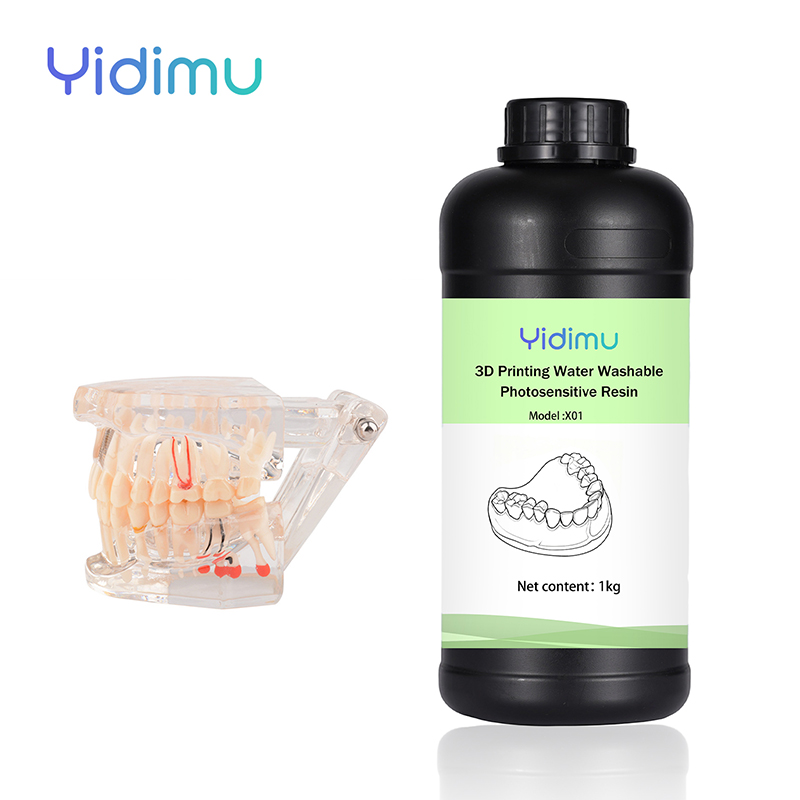
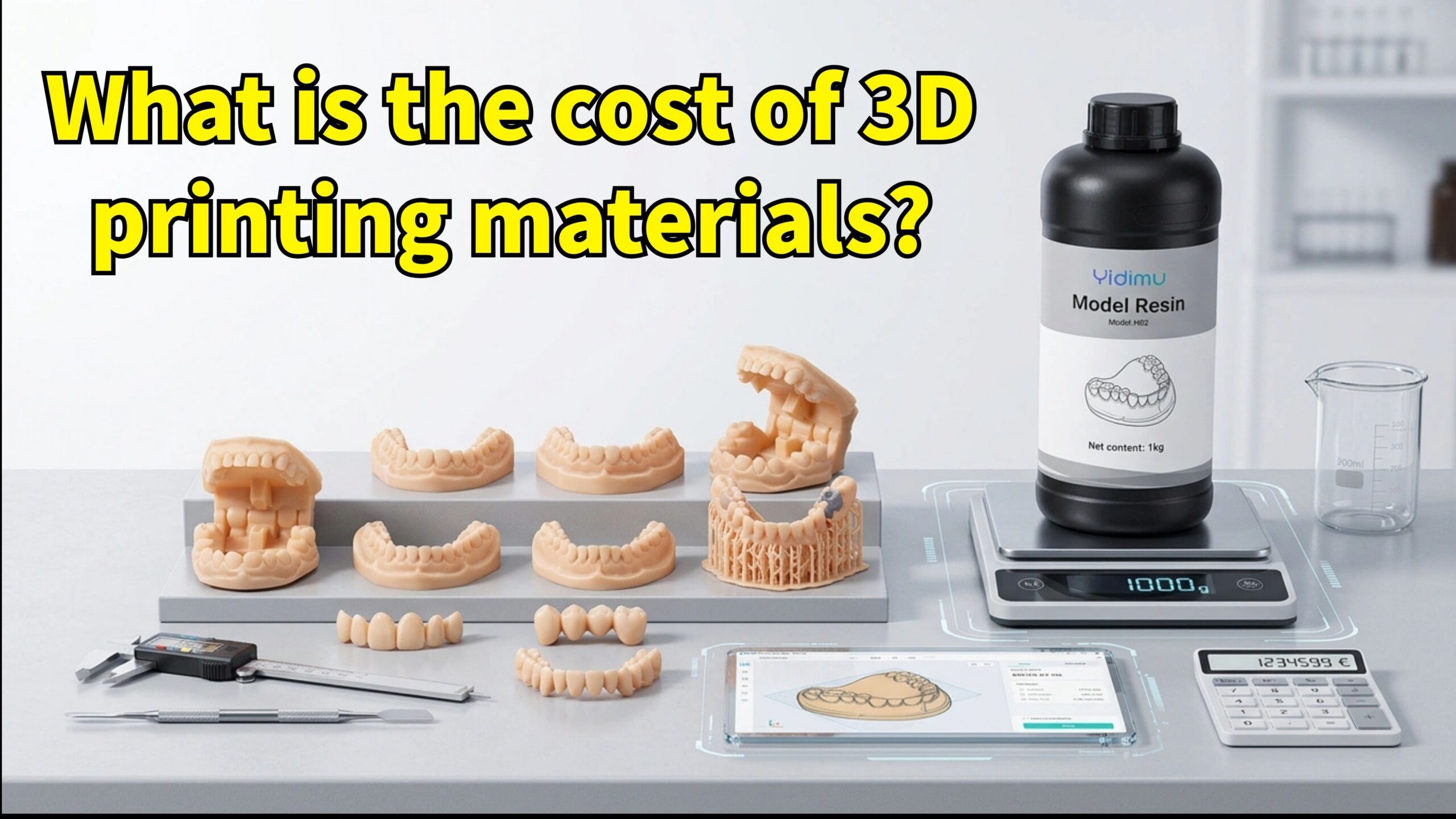
Professional 3D printing material costs depend on the printing process and material specification. For resin 3D printing, general model resin may cost approximately $20–$60 per kilogram, while engineering, flexible, castable, or application-specific dental resins can cost $60–$200 per kilogram or more. Some regulated or highly specialized materials may be substantially more expensive.
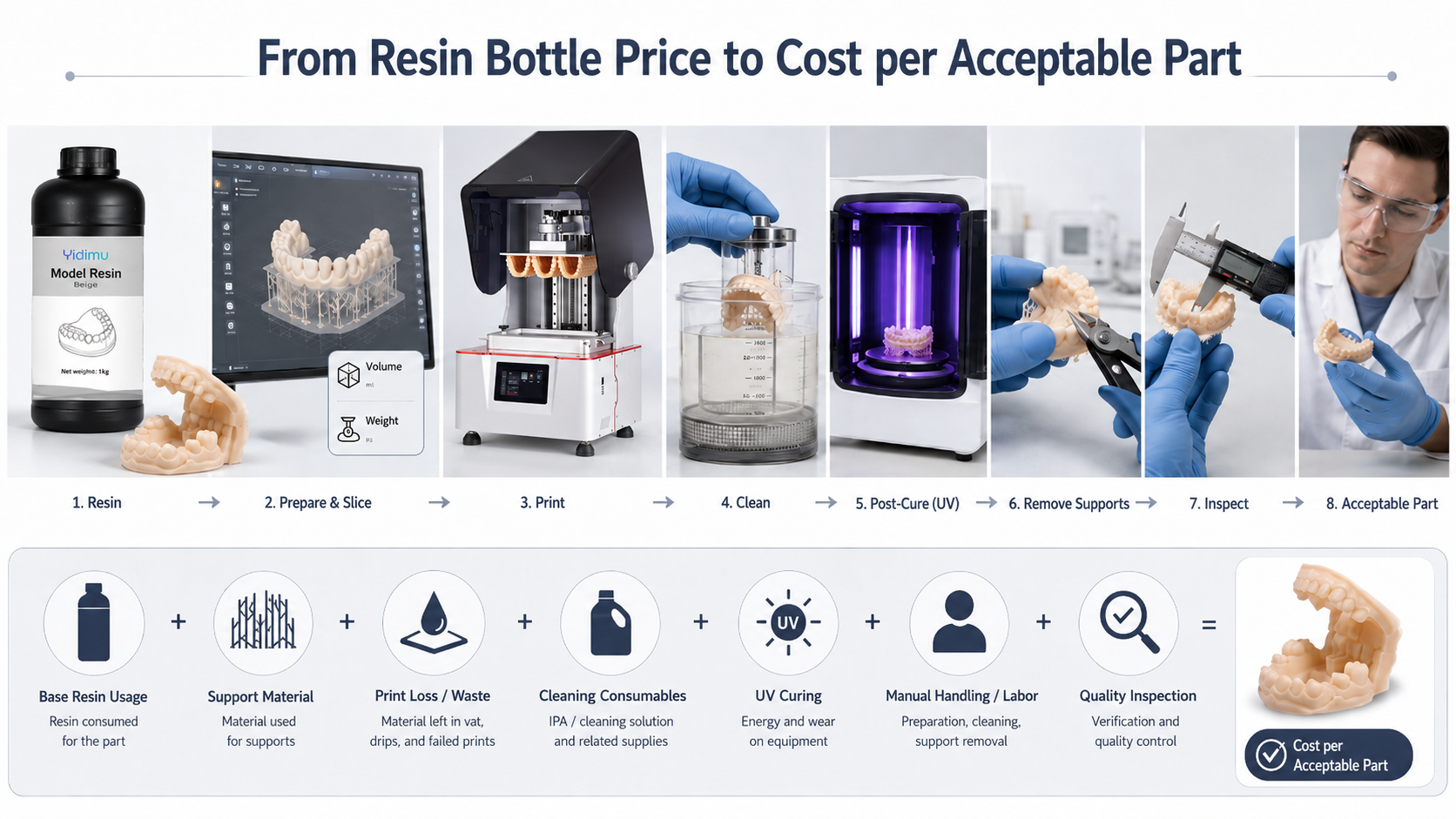
However, bottle price is not the same as finished-part cost. Buyers must also account for supports, hollowing, failed prints, cleaning liquid, filters, gloves, post-curing, labor, waste handling, and quality inspection.
How Much Does 3D Printing Material Cost in Practice?
There is no universal price for 3D printing material. Resin prices differ according to formulation, mechanical requirements, color, packaging quantity, printer compatibility, intended application, documentation, and purchasing volume.
For preliminary budgeting, professional users can divide photopolymer resins into several broad cost bands.
| Resin category | Indicative planning range | Common applications | Main purchasing consideration |
|---|---|---|---|
| General model resin | $20–$60/kg | Visual models, concept samples, display parts | Surface quality and reliable exposure settings |
| ABS-like or engineering resin | $30–$100+/kg | Functional prototypes, housings, assembly checks | Toughness, dimensional behavior, and post-curing |
| Flexible or elastic resin | $60–$200+/kg | Flexible structures, soft prototypes, shoe samples | Hardness, rebound, tear behavior, and viscosity |
| Dental model resin | $40–$150+/kg | Dental models, working models, laboratory evaluation | Color, surface detail, dimensional workflow, and documentation |
| Castable resin | $80–$250+/kg | Jewelry patterns and investment-casting models | Burnout behavior and compatibility with the casting process |
| Application-specific dental resin | $150–$400+ per kg or liter | Surgical guides, temporary restorations, or other defined dental uses | Intended use, validated workflow, post-curing, and regulatory documentation |
These figures are budgeting ranges rather than quotations. Recent market examples demonstrate the price spread: promotional general-purpose material has appeared in the low-teens-per-kilogram range, water-washable model material around the high twenties, and a specialty flexible formulation at approximately $140 per kilogram. Actual prices can change with region, taxes, shipping, packaging, technical documentation, and purchasing volume.
Professional buyers should therefore compare materials by cost per acceptable part, not simply by cost per bottle.
Why Resin Bottle Price Is Not the Complete Material Cost
A one-kilogram bottle does not become one kilogram of sellable finished parts. Some material remains in supports, drainage structures, vat residue, failed builds, contaminated resin, cleaning waste, and test prints.
The real material-related cost may include:
- Resin forming the final part
- Support structures and rafts
- Resin trapped inside poorly drained hollow models
- Calibration and exposure test pieces
- Failed or rejected prints
- Resin lost during filtration and vat cleaning
- Cleaning liquid or other approved cleaning media
- Gloves, filters, wipes, containers, and protective supplies
- UV post-curing equipment and electricity
- Waste collection and disposal
- Operator time for cleaning, curing, inspection, and documentation
Vat photopolymerization builds parts by curing liquid photopolymer layer by layer. The completed object normally requires cleaning to remove residual resin and UV post-curing according to the material workflow. These post-printing stages must be included when estimating production cost.
Companies evaluating different formulations can review available Yidimu resin materials together with their intended printer, application, and post-processing requirements.
How to Calculate Resin Cost per Printed Part
The most reliable calculation begins with the sliced model rather than the external dimensions of the part.
Basic material-cost formula
Estimated resin cost = sliced resin weight × resin price per kilogram
When the slicer reports volume instead of weight, use:
Resin weight = sliced volume × resin density
For a more realistic production estimate:
Adjusted material cost = basic resin cost × waste factor
The waste factor covers supports, handling loss, filtration, test prints, and expected print failures.
Step-by-step calculation workflow
- Import the final production model into the slicer.
- Confirm the model scale and units.
- Select the intended orientation.
- Add realistic supports and a raft where required.
- Hollow suitable models only when the application allows it.
- Add properly positioned drainage and vent holes.
- Record the slicer’s estimated material volume or weight.
- Confirm the resin density from the formal technical data.
- Multiply the resin weight by the purchase price per kilogram.
- Add an appropriate allowance for supports, waste, and expected failure rate.
- Add cleaning, curing, labor, inspection, and packaging costs separately.
Do not calculate cost using only the CAD model’s solid volume. Supports, orientation, drainage, wall thickness, and production arrangement may significantly change actual consumption.
Example Resin Cost Calculation
Consider a hypothetical model with the following slicer estimate:
- Model and support volume: 120 mL
- Resin density: 1.10 g/mL
- Resin purchase price: $45/kg
- Planned waste allowance: 20%
First calculate the estimated weight:
120 mL × 1.10 g/mL = 132 g
Convert grams to kilograms:
132 g = 0.132 kg
Calculate the basic resin cost:
0.132 kg × $45/kg = $5.94
Add the 20% waste allowance:
$5.94 × 1.20 = $7.13
The adjusted resin cost is therefore approximately $7.13 per build.
This figure still excludes operator labor, cleaning liquid, gloves, filters, UV curing, inspection, machine depreciation, electricity, and packaging.
What Factors Affect 3D Printing Material Cost?
1. Resin formulation
General display or model resin is normally less expensive than flexible, castable, high-temperature, impact-resistant, or application-specific dental resin.
Specialized formulations may require more complex raw materials, narrower processing conditions, additional documentation, or a tightly controlled post-curing workflow.
2. Solid models versus hollow models
A completely solid part may consume considerably more resin than a properly hollowed part. Hollowing can reduce material consumption, but it is not suitable for every model or application.
The designer must consider:
- Minimum wall thickness
- Structural loads
- Internal support requirements
- Drainage-hole placement
- Resin entrapment
- Cleaning access
- Final assembly requirements
- Inspection requirements
Reducing resin volume without considering these factors may create weak walls, trapped liquid resin, deformation, cracking, or an incomplete cleaning process.
3. Part orientation and support strategy
Orientation affects support volume, surface marks, peel forces, drainage, dimensional behavior, and print reliability.
An orientation that uses slightly more resin may still be more economical when it:
- Reduces failed builds
- Protects critical surfaces
- Improves drainage
- Makes support removal easier
- Improves dimensional repeatability
- Reduces manual finishing
The lowest-support orientation is not automatically the lowest-cost production orientation.
4. Print failure and rejection rate
A resin that is inexpensive per kilogram may become costly if it produces inconsistent results in the selected printer and workflow.
Common sources of rejected parts include:
- Incorrect exposure settings
- Poor platform calibration
- Inadequate supports
- Unsuitable lift settings
- Low resin temperature
- Contaminated resin
- Damaged release film
- Incorrect washing or curing
- Distortion during support removal
- Failure to inspect critical dimensions
Professional costing should include the percentage of builds that must be repeated or rejected.
5. Cleaning and post-curing requirements
Different formulations may require different cleaning media, cleaning times, drying conditions, curing equipment, curing temperature, and exposure duration.
A cheaper resin can generate a higher total cost when it requires:
- Longer cleaning cycles
- Frequent replacement of cleaning liquid
- More difficult support removal
- Additional surface finishing
- Multiple curing stages
- More operator supervision
When planning the complete workflow, buyers should evaluate appropriate UV curing equipment for resin prints rather than treating post-curing as an optional step.
6. Packaging and purchasing volume
The cost per kilogram may decrease when resin is purchased in larger quantities. However, bulk purchasing is only economical when the material can be stored, handled, and consumed within the supplier’s stated conditions.
Before ordering a large quantity, confirm:
- Storage requirements
- Shelf-life information
- Batch identification
- Mixing instructions
- Temperature limits
- Light-protection requirements
- Material compatibility
- Safety data sheet availability
- Technical data sheet availability
Unused material that expires, separates, becomes contaminated, or cannot be traced by batch may eliminate the benefit of a lower unit price.
Comparing Resin by Cost per Acceptable Part
Procurement teams should compare materials using a controlled sample-printing process.
| Evaluation item | Resin A | Resin B | Why it matters |
|---|---|---|---|
| Purchase price per kilogram | Record | Record | Initial material expenditure |
| Resin used per build | Measure | Measure | Accounts for support and orientation |
| Acceptable parts per build | Count | Count | Identifies usable production output |
| Failed or rejected parts | Count | Count | Reveals repeat-print cost |
| Cleaning time | Record | Record | Affects labor and throughput |
| Support-removal time | Record | Record | Affects finishing cost |
| Post-curing requirement | Record | Record | Affects equipment and cycle time |
| Dimensional inspection result | Record | Record | Determines production suitability |
| Surface-finishing requirement | Record | Record | Adds labor and consumables |
| Final cost per acceptable part | Calculate | Calculate | Provides the meaningful comparison |
A controlled sample printing service may help professional users evaluate printer, resin, model structure, support design, and post-processing before committing to larger material purchases.
Professional Resin Purchasing Checklist
Before asking a supplier for a resin quotation, prepare the following information:
- Intended application
- Printer model and light-source wavelength
- Model dimensions
- Largest and smallest features
- Required color
- Expected surface appearance
- Required rigidity, flexibility, or toughness
- Expected operating environment
- Estimated monthly material consumption
- Required packaging quantity
- Cleaning method
- Available post-curing equipment
- Dimensional inspection requirements
- Whether the part is a prototype, production aid, model, casting pattern, or dental application
- Whether formal technical, safety, or regulatory documentation is required
This information allows the supplier to assess material suitability instead of quoting only the lowest-priced bottle.
How to Reduce Resin Cost Without Reducing Workflow Reliability
Optimize the model before printing
Remove unnecessary internal mass, correct mesh errors, verify model scale, and split large parts only when the resulting joints and assembly process are acceptable.
Use controlled hollowing
Hollow large visual models where structurally appropriate. Use sufficient wall thickness and drainage access rather than relying on aggressive hollowing solely to reduce cost.
Arrange multiple parts efficiently
LCD-based systems expose an entire layer at once, so adding additional parts within the available build area may improve productivity without increasing the number of layers. However, excessive packing can increase peel forces, drainage problems, and the risk of losing an entire batch.
Validate settings before production
Run exposure and support tests before filling a complete platform with production parts. A small validation print may prevent the loss of a full batch.
Filter and manage reusable resin correctly
Material remaining in the vat may sometimes be reused when permitted by the resin supplier and when it is free of cured fragments or contamination. Follow the manufacturer’s filtration, storage, mixing, and reuse instructions.
Track material by batch
Record the resin batch, printer, slicer profile, build date, cleaning process, curing cycle, and inspection result. Traceability helps identify whether variations come from material, equipment, environment, or workflow.
Measure actual consumption
Compare slicer estimates with inventory records. Regular comparison can reveal excessive support volume, spills, unnecessary vat changes, or inaccurate costing assumptions.
Factories can also compare different industrial resin 3D printer options according to model size, material requirement, expected batch arrangement, and production workflow.
Common Mistakes to Avoid
Comparing only the price per bottle
Bottle price does not reveal yield, print reliability, cleaning requirements, or acceptable-part rate.
Ignoring support material
Support structures and rafts can represent a meaningful percentage of total resin consumption, particularly for complex or heavily tilted parts.
Assuming hollowing is always better
Improper hollowing can trap liquid resin, interfere with cleaning, weaken the model, or create long-term defects.
Using an unverified resin profile
Exposure settings copied from an unrelated printer, color, batch, or layer thickness may produce failed builds or inaccurate parts.
Treating all dental resin as interchangeable
Dental model resin, surgical-guide material, temporary-restoration material, and other dental formulations have different intended uses and workflow requirements.
Excluding post-processing from the quotation
Cleaning, drying, support removal, UV curing, inspection, and finishing may cost more than the resin used in a small part.
Purchasing bulk resin before validation
A lower bulk price is not a saving when the material is incompatible with the printer, application, or required post-processing workflow.
Reusing contaminated material
Cured fragments or foreign material in the vat can damage the release film, interfere with exposure, and contribute to failed prints.
Dental Resin Cost and Workflow Considerations
Dental model resin is generally purchased for laboratory models, working models, demonstration models, or other specified applications. Its suitability cannot be determined from color or price alone.
Dental users should evaluate:
- Intended use stated by the supplier
- Compatible printing technology
- Validated exposure settings
- Cleaning instructions
- Drying procedure
- Post-curing equipment
- Post-curing time and temperature
- Dimensional workflow
- Batch documentation
- Local regulatory requirements
Customers should confirm resin indication, post-curing process and local regulatory requirements before clinical or intraoral use. A material described as dental resin is not automatically suitable for every dental application.
Additional workflow planning is available through Yidimu’s dental 3D printing solutions.
Resin Handling and Safety Costs
Liquid photopolymer resin should be treated as a chemical material rather than an ordinary liquid plastic. Safety-related consumables and controls are legitimate production costs.
Depending on the material and workplace, the workflow may require:
- Suitable chemical-resistant gloves
- Eye protection
- Protective work surfaces
- Ventilation or engineering controls
- Covered cleaning containers
- Spill-management supplies
- Labelled waste containers
- Operator training
- Safety data sheets
- Controlled storage
NIOSH notes that some chemicals in liquid photopolymer resins may cause skin irritation or sensitization. It also recommends reducing exposure through engineering controls, enclosed processing where appropriate, suitable gloves, and other workplace controls.
Always follow the resin supplier’s technical data sheet, safety data sheet, printer instructions, and applicable workplace regulations.
Frequently Asked Questions
How much does 1 kg of 3D printer resin cost?
General-purpose resin may cost approximately $20–$60 per kilogram, while engineering, flexible, castable, and application-specific dental materials may cost $60–$200 per kilogram or more. Highly specialized materials may exceed these ranges.
How many parts can be printed with 1 kg of resin?
The number depends on each part’s sliced weight, support volume, hollowing strategy, failed-print allowance, and material loss. Divide 1,000 grams by the adjusted resin consumption per acceptable part.
For example, when each acceptable part requires 50 grams after including supports and waste, one kilogram theoretically produces about 20 parts.
Does the resin left in the vat count as consumed material?
Resin remaining in the vat has not necessarily been consumed. It may sometimes be filtered and reused according to the supplier’s instructions. However, contaminated, expired, mixed, or partially cured material may need to be discarded.
Is water-washable resin cheaper to process?
Not automatically. It may change the cleaning workflow, but users must still consider water consumption, contaminated wash liquid, drying, UV curing, waste handling, cleaning effectiveness, and local disposal requirements. Water-washable does not mean that uncured resin or contaminated water can be poured into a drain.
Is flexible resin more expensive than model resin?
It often is. Flexible formulations may require specialized chemistry, tighter processing controls, slower printing parameters, different support strategies, and more careful cleaning. The appropriate comparison is cost per acceptable flexible part.
Does a smaller layer height use more resin?
Changing layer height does not substantially change the geometric volume of the final model, but it can affect print time, exposure settings, support behavior, surface quality, and the probability of a successful build.
Are supports included in slicer material estimates?
Many slicers include generated supports and rafts in their material estimate. Users should confirm what the selected software includes and compare the estimate with actual inventory consumption.
Is the cheapest resin suitable for production?
Not necessarily. Production suitability depends on application requirements, dimensional consistency, mechanical behavior, printer compatibility, post-processing, traceability, documentation, and acceptable-part rate.
How should a factory request a resin quotation?
Provide the model file or dimensions, intended application, printer information, resin requirements, expected monthly consumption, required properties, post-processing workflow, and inspection criteria.
Conclusion
So, how much does 3D printing material cost? For professional resin printing, general model materials may cost tens of dollars per kilogram, while flexible, engineering, castable, dental, and other specialty materials can cost considerably more.
The meaningful figure is not the bottle price. It is the total material and workflow cost per acceptable part after accounting for supports, failures, cleaning, curing, labor, inspection, and waste.
For application review, send Yidimu your model size, intended application, resin requirement, expected workflow, and production or sample-making needs. You can contact Yidimu for workflow and material review.
Author Bio
Article by Alice Zhang
Alice Zhang writes about industrial resin 3D printing, dental 3D printing workflows, flexible resin applications and professional additive manufacturing solutions. Her content focuses on practical printer selection, resin workflow control, post-processing and application planning for factories, dental labs and professional users.
Optional References
- NIOSH, Approaches to Safe 3D Printing: A Guide for Makerspace Users, Schools, Libraries, and Small Businesses.
- Recent general-purpose and water-washable resin price examples.
- Recent specialty flexible resin price example.