When people ask “how much does a 3D printer cost,” they often expect a single number. In practice, there is no useful single price because a 3D printer is not one standardized product. A small desktop printer for simple visual models, a dental resin printer for model production, and an industrial resin 3D printer for factory sample development are different purchasing decisions.
The price changes mainly because of five factors:
- Printing technology — FDM, resin, powder-based and metal systems have very different machine structures and operating costs.
- Build volume — larger printing areas and taller Z-axis capacity usually increase the price.
- Accuracy and repeatability — professional users need stable output, not only a high-resolution number on paper.
- Material compatibility — dental resin, flexible resin, castable resin, engineering resin and model resin may require different workflows.
- Post-processing requirements — resin printing usually requires cleaning, drying and UV post-curing before the part is ready for inspection or use.
For factories and dental users, the better question is not only “How much is the printer?” but “How much does it cost to produce a usable, repeatable, application-ready part?”
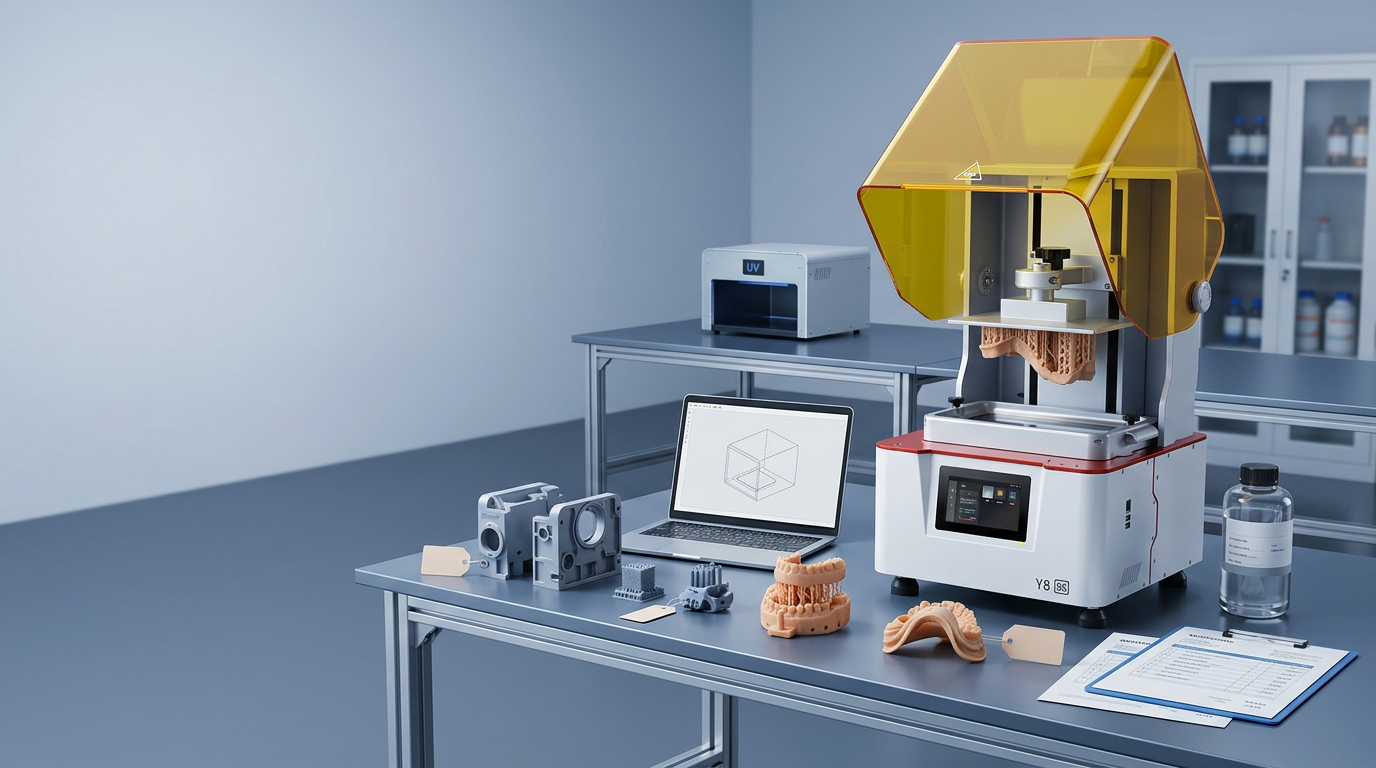
Yidimu focuses on professional resin-based equipment and workflow support, including industrial resin 3D printers, dental 3D printers, flexible resin systems, UV curing boxes and 3D printing resins for production users.
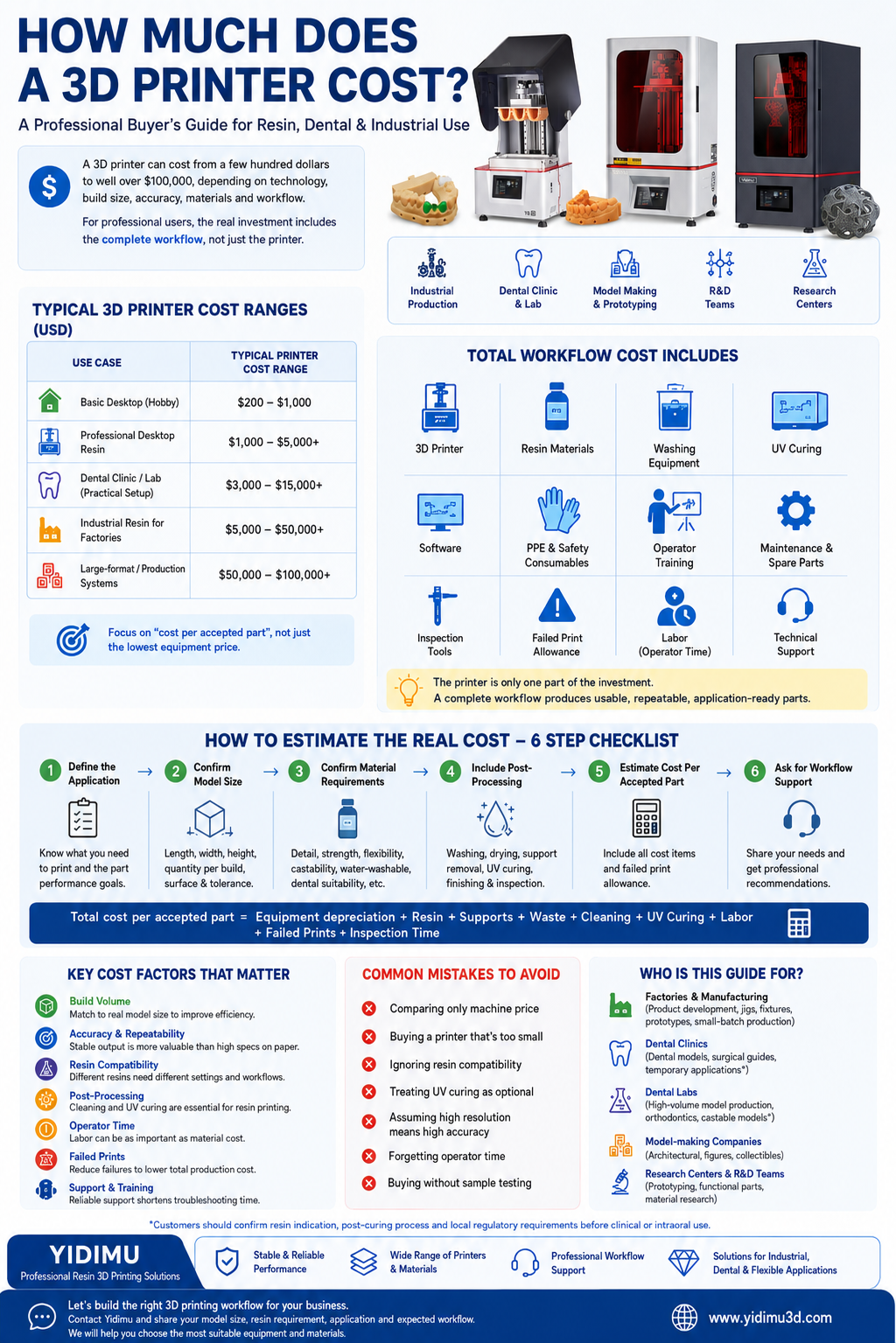
Typical 3D Printer Cost Ranges
The table below gives a practical cost view for professional buyers. These are general market ranges, not fixed quotations. Actual prices vary by configuration, build size, resolution, accessories, local service terms, shipping, taxes and application requirements.
Practical Table: 3D Printer Cost by Use Case
| Buyer Type / Use Case | Typical Printer Cost Range | What the Price Usually Covers | What to Check Before Buying |
|---|---|---|---|
| Basic desktop hobby printing | About $200–$1,000 | Small machine, basic features, limited workflow support | Not ideal for professional production, dental workflows or repeated factory sample output |
| Professional desktop resin printing | About $1,000–$5,000+ | Better detail, improved resin workflow, small-to-medium build volume | Resin compatibility, curing workflow, software, support, replacement parts |
| Dental clinic or dental lab resin printing | About $3,000–$15,000+ for a practical setup | Printer, dental model workflow, cleaning, UV curing, resin, support | Accuracy, resin indication, post-curing, local regulations, daily output capacity |
| Industrial resin 3D printing for factories | About $5,000–$50,000+ | Larger build size, stronger structure, workflow support, professional use | Build volume, part size, surface quality, resin type, repeatability, maintenance |
| Large-format or production-oriented systems | $50,000–$100,000+ | Larger capacity, higher automation, production support, advanced workflow | Whether the production volume justifies the investment |
| Complete professional resin workflow | Printer price plus materials, curing, washing, PPE, software and labor | A usable system for real parts, not only the printer | Total cost per accepted part |
For a factory, dental lab or product development team, the “cheap” option can become expensive if it causes failed prints, unstable dimensions, poor surface quality, unsuitable resin results or slow technical troubleshooting.
Printer Price vs. Total Workflow Cost
The printer is only one part of the investment. A professional resin 3D printing workflow usually includes:
- 3D printer
- Resin materials
- Build platform, resin tank or vat-related consumables
- Slicing software or compatible workflow software
- Cleaning process
- UV post-curing equipment
- PPE and safety consumables
- Ventilation or workspace preparation
- Operator training
- Maintenance and spare parts
- Inspection tools
- Failed print allowance
- Technical support
This is especially important for resin printing. After printing, the part is usually not ready immediately. It may need cleaning, support removal, drying, UV curing and final inspection. The FDA describes 3D printed medical device production as a multi-step process that can include design, software workflow, material controls, printing, post-processing, validation and testing; this is a useful reminder that professional 3D printing quality depends on the whole process, not only the machine.
For resin users, Yidimu UV curing boxes can support the post-curing stage after printing and cleaning. Post-curing may affect surface condition, handling stability, dimensional behavior and final usability depending on the resin and application.
How Much Does a Resin 3D Printer Cost?
A resin 3D printer usually costs more than the lowest-cost desktop FDM printer, but it can support finer surface detail and smoother model quality. For professional users, resin 3D printing is often selected for dental models, industrial prototypes, jewelry casting models, product appearance samples, precision models and flexible material applications.
A basic resin printer may be inexpensive, but professional resin printing requires more than a light source and a screen. Buyers should check:
- Build volume
- XY detail and real part accuracy
- Z-axis stability
- Light uniformity
- Resin tank design
- Resin compatibility
- Printing speed under practical settings
- Temperature and material behavior
- Cleaning and UV curing process
- Technical support availability
- Replacement consumable cost
For professional applications, a lower printer price does not always mean a lower production cost. If the printer has unstable output, poor resin compatibility or a weak post-processing workflow, the cost per usable part may increase.
Yidimu provides resin 3D printers for professional applications, including dental, flexible and industrial printer categories. This makes equipment selection easier when the buyer already knows the target part type, model size and resin requirement.
How Much Does a Dental 3D Printer Cost?
A dental 3D printer setup can range from a few thousand dollars to much higher depending on clinic or lab needs. The cost is influenced by accuracy requirements, daily output volume, resin type, post-processing equipment, and whether the workflow is used for dental models, surgical guide workflows, temporary dental applications or other dental-related production.
For dental buyers, the printer itself is only one part of the system. A practical dental 3D printing setup may include:
- Dental resin 3D printer
- Dental model resin or application-specific resin
- Washing equipment or cleaning workflow
- UV curing box
- Build platform tools
- PPE
- Slicing workflow
- Model inspection process
- Operator training
- Maintenance and technical support
Customers should confirm resin indication, post-curing process and local regulatory requirements before clinical or intraoral use. The FDA notes that materials used in 3D printed medical products are evaluated in the context of the finished device and intended use, and dental materials may be cleared for specific intended uses rather than for unlimited general use.
For clinics and labs comparing options, Yidimu’s dental 3D printers are designed for professional resin workflows where model quality, repeatability and post-processing control matter.
How Much Does an Industrial Resin 3D Printer Cost?
An industrial resin 3D printer generally costs more than a small desktop machine because it is built for larger parts, more stable output and professional workflow use. Factory buyers usually care about more than the machine price. They need to know whether the printer can support product development, sample making, design verification, engineering models, fixtures, flexible parts or small-batch production trials.
Industrial resin 3D printer cost depends on:
- Build volume
- Light-curing system
- Structural stability
- Print speed under real settings
- Resin compatibility
- Surface quality
- Accuracy and repeatability
- Ease of operation
- Maintenance design
- Technical support
- Ability to match the customer’s workflow
A factory may spend more upfront for a printer that reduces reprints, shortens sample development time and produces more consistent models. For professional users, the cost should be reviewed as “cost per accepted model” rather than “lowest equipment price.”
For factory prototyping and model production, Yidimu’s industrial 3D printing solutions can help buyers review model size, material requirements and expected workflow before choosing equipment.
Cost Factors That Matter More Than the Printer Price
1. Build Volume
Larger build volume usually increases machine cost, but it can reduce production bottlenecks if your team needs to print multiple models in one job or larger parts without splitting them. For factories and dental labs, build volume should be matched to real model dimensions, not selected only because “larger sounds better.”
2. Accuracy and Repeatability
Professional users should care about repeatability, not only advertised resolution. A printer that produces one good sample but cannot repeat the result reliably may not be suitable for production workflows. For dental models, product assembly checks and engineering samples, repeatability can affect fit review and downstream decision-making.
3. Resin Compatibility
Different resins behave differently. Dental model resin, castable resin, flexible resin, ABS-like resin and water-washable resin may require different exposure settings, support strategies, cleaning methods and curing conditions. Resin choice affects both material cost and failure risk.
Yidimu’s 3D printing materials and resin guides can help users understand how material selection affects printing workflow, post-processing and final model performance.
4. Post-Processing Equipment
In resin 3D printing, UV curing is not a minor accessory. It is part of the production workflow. Yidimu’s resin cost guide notes that UV curing may include electricity, curing box depreciation, curing trays, operator time and validation, and that dental and functional resin applications should not treat post-curing as optional.
5. Operator Time
A printer that looks inexpensive may require more manual adjustment, more troubleshooting and more reprints. Operator time should be included in the real cost calculation, especially for dental labs and factories with daily production tasks.
6. Failed Prints
Failed prints cost resin, machine time, cleaning time and operator time. Reducing failure rate can be more valuable than saving a small amount on the printer or material.
7. Support and Training
Professional buyers should ask whether the supplier can help with machine setup, resin matching, printing parameters, post-processing and troubleshooting. Standards organizations also emphasize terminology, performance measurement, product quality and calibration procedures in additive manufacturing, which reflects how process control matters in professional use.
Workflow or Checklist: How to Estimate the Real Cost Before Buying
Use this checklist before asking for a quotation.
Step 1: Define the Application
Write down what you need to print:
- Dental models
- Orthodontic models
- Surgical guide workflow models
- Product appearance samples
- Engineering prototypes
- Flexible parts
- Shoe samples
- Jewelry casting models
- Jigs or fixtures
- Small-batch production trial parts
Step 2: Confirm Model Size
Prepare the typical model dimensions:
- Length
- Width
- Height
- Number of parts per print job
- Required surface quality
- Required dimensional tolerance
This helps determine whether you need a compact dental printer, a larger industrial resin printer or a flexible resin system.
Step 3: Confirm Material Requirements
Ask what resin properties matter:
- High detail
- Smooth surface
- Dimensional stability
- Flexibility
- Castability
- Water-washable workflow
- Dental model suitability
- Heat resistance
- Strength or toughness
The resin can influence printer selection, curing process and cost per part.
Step 4: Include Post-Processing
Do not estimate only the printer price. Add:
- Washing method
- Solvent or water-washable workflow
- UV curing equipment
- Drying time
- Support removal
- Surface finishing
- Inspection process
Step 5: Estimate Cost Per Accepted Part
Use this simple formula:
Total cost per accepted part = equipment depreciation + resin used + supports + waste allowance + cleaning consumables + UV curing cost + labor + failed print allowance + inspection time
This is more useful than comparing only printer prices.
Step 6: Ask for Workflow Support
Before buying, send your supplier:
- Model size
- Resin requirement
- Application
- Expected production volume
- Accuracy requirement
- Post-processing expectation
- Current workflow problems
Yidimu’s service and technical support can help professional users review equipment selection, resin matching and workflow setup.
Example Cost Thinking for a Factory
A product development team needs to print 20–50 appearance and fit-check models per week. The lowest-cost printer may print small parts, but if it has limited build volume, unstable output or weak support, the team may lose time on failed builds and repeated parameter testing.
A better cost question is:
- Can the printer fit the full model?
- Can it print multiple parts in one job?
- Does it support the resin needed for the model?
- Is the surface good enough for design review?
- Can the operator repeat the same result next week?
- Is post-curing controlled enough for the application?
- Can the supplier help troubleshoot failures?
For factories, a higher-quality industrial resin printer may reduce development delay and reprint cost. The right investment depends on production frequency, model size and how important fast iteration is to the business.
Example Cost Thinking for a Dental Lab
A dental lab may care less about the lowest printer price and more about daily output stability. A practical dental workflow must consider:
- Number of models per day
- Model accuracy requirements
- Resin type
- Washing and UV curing process
- Support removal time
- Fit and surface inspection
- Operator training
- Local dental requirements
If the lab plans to print dental models only, the cost structure may be different from a lab that also wants surgical guide workflows or temporary dental applications. Customers should confirm resin indication, post-curing process and local regulatory requirements before clinical or intraoral use.
Common Mistakes to Avoid
Mistake 1: Comparing Only Machine Price
A low machine price does not guarantee low production cost. Resin, post-processing, failures, labor and support can change the real cost significantly.
Mistake 2: Buying Too Small a Printer
If the build volume is too small, large models must be split, reassembled or printed in multiple jobs. This can increase labor and reduce workflow efficiency.
Mistake 3: Ignoring Resin Compatibility
Not every printer works equally well with every resin. Resin behavior depends on exposure, viscosity, support design, cleaning and curing. Always check the resin and workflow together.
Mistake 4: Treating UV Curing as Optional
For resin printing, especially dental and functional parts, UV post-curing may affect final properties and usability depending on the resin. A printer without a practical curing workflow is not a complete production setup.
Mistake 5: Assuming High Resolution Means High Accuracy
Screen resolution is not the same as final part accuracy. Machine structure, light uniformity, resin shrinkage, support design, curing and inspection all affect the result.
Mistake 6: Forgetting Operator Time
Manual setup, support removal, cleaning, curing, inspection and troubleshooting all take time. For a professional team, labor cost may matter as much as resin cost.
Mistake 7: Buying Without Sample Testing
When possible, test sample models before purchasing. A sample print can reveal whether the printer, resin and workflow match your real application.
Conclusion
So, how much does a 3D printer cost? The broad answer is that prices can range from a few hundred dollars to more than $100,000, but professional buyers should focus on total workflow cost, not only printer price. A factory, dental clinic, dental lab or model-making company needs a system that can produce usable parts repeatedly. That means the real investment includes printer configuration, resin, build volume, cleaning, UV curing, safety consumables, operator training, maintenance, failed print allowance and technical support.
For professional resin 3D printing, the right printer should match your model size, resin requirement, application and expected workflow. Contact Yidimu with your part dimensions, target material, application scenario and daily or weekly printing needs. Yidimu can help you review a suitable printer, resin and post-processing solution for industrial, dental or flexible resin printing workflows.
FAQ
How much does a 3D printer cost for professional use?
A professional 3D printer may cost from a few thousand dollars to tens of thousands of dollars, depending on technology, build size, accuracy, material compatibility and workflow support. For resin printing, buyers should also budget for resin, washing, UV curing, PPE, software, maintenance and operator time.
How much does a dental 3D printer cost?
A practical dental 3D printing setup may cost several thousand dollars or more, depending on printer size, dental application, resin type, post-processing equipment and daily output needs. Customers should confirm resin indication, post-curing process and local regulatory requirements before clinical or intraoral use.
Is a resin 3D printer more expensive than an FDM printer?
Entry-level resin printers can be affordable, but a professional resin workflow can cost more because it usually requires resin handling, cleaning, UV curing, PPE and controlled post-processing. For dental models, high-detail prototypes and fine surface parts, resin printing may be more suitable than basic FDM printing.
What is the most important cost after buying the printer?
For resin 3D printing, ongoing costs usually include resin, failed print allowance, cleaning consumables, UV curing, PPE, replacement parts, operator time and maintenance. For professional users, cost per accepted part is more important than resin price alone.
Why do industrial 3D printers cost more?
Industrial 3D printers usually cost more because they may offer larger build volume, stronger structure, better repeatability, more stable workflow support, wider resin compatibility and better suitability for repeated production tasks.
Should I buy the cheapest 3D printer first?
For professional use, the cheapest option is not always the safest decision. If the printer cannot meet your part size, resin, accuracy or workflow requirements, it may create higher costs through failed prints, slow production and unstable results.
How can I reduce 3D printing cost per part?
You can reduce cost per accepted part by choosing the right build volume, using suitable resin, optimizing support design, controlling cleaning and curing, training operators, reducing failed prints and confirming the workflow before production.
Does UV curing affect 3D printing cost?
Yes. UV curing can add equipment cost, operator time and workflow time, but it is often necessary for resin printed parts. Depending on the resin and application, curing may affect surface condition, stability, handling and final usability.
Optional References
- Independent 3D printer pricing guide showing broad market cost ranges and ongoing cost categories.
- U.S. FDA overview of the 3D printed medical device process, including design, software workflow, material controls, post-processing, validation and testing.
- U.S. FDA explanation that materials for medical and dental 3D printed products are evaluated in relation to the finished device and intended use.
- ASTM overview of additive manufacturing standards, including terminology, performance, product quality and calibration procedures.