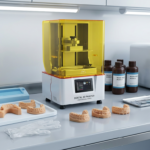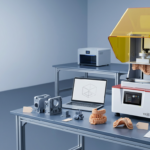
A large format resin 3D printer is not simply a bigger version of a desktop resin printer. For professional users, it is part of a production workflow that must balance size, surface quality, dimensional control, material performance and repeatability. A larger platform can improve batch capacity and reduce part splitting, but it also requires better exposure control, support strategy, resin management, washing, UV curing and maintenance.
For industrial and dental users, the real question is not only “How large can it print?” The better question is: Can this machine print my parts accurately, repeatedly and efficiently in my actual workflow?
Yidimu provides industrial resin 3D printers, dental 3D printers, flexible resin 3D printers, resins and post-processing equipment for professional applications where build size, material selection and workflow stability matter.
What Is a Large Format Resin 3D Printer?
A large format resin 3D printer is a resin-based additive manufacturing system with a larger build area than common small-format desktop resin printers. It may use SLA, LCD/MSLA or other light-curing technologies to solidify photosensitive resin layer by layer.
In professional use, “large format” usually means one or more of the following:
| Requirement | What It Means in Practice |
|---|---|
| Larger single-piece printing | Printing bigger housings, shells, prototypes or models without splitting them |
| Higher batch output | Printing many dental models, small parts or samples in one job |
| Industrial-size workflow | Supporting production departments, labs, workshops or model shops |
| Better stability requirement | Maintaining accuracy across a bigger platform |
| Larger post-processing demand | Requiring suitable washing, curing, inspection and handling procedures |
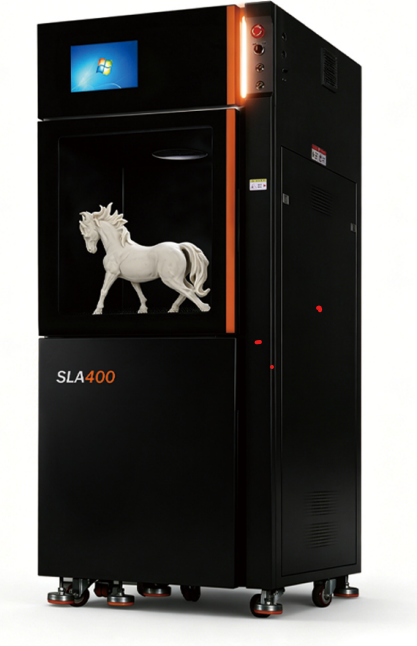
For example, the uploaded Yidimu SLA400 brochure page lists a 400 × 400 × 350 mm forming size, galvanometer scanning, 0.05–0.15 mm layer thickness, and 220 V / 50 Hz power specification for a large-format SLA system, which is directly relevant to buyers evaluating industrial-size resin printing capacity.
When Should You Choose a Large Format Resin 3D Printer?
A large format resin 3D printer is usually worth considering when your existing workflow has one of these problems:
You need to print parts that are too large for small machines.
You want to reduce manual assembly after splitting models.
You need to print many models in one production batch.
You need better surface quality than typical filament printing.
You need fine features, smooth surfaces or accurate model details.
You need professional resin options for dental, engineering, flexible or model applications.
You want a more controlled workflow for sample making, design verification or small-batch production.
Large-format resin printing can be especially useful for factories and labs that already have repeat demand for prototypes, fixtures, dental models, product shells, shoe components or model samples.
Common Applications of Large Format Resin 3D Printers
1. Industrial Prototyping
Factories often use large resin 3D printers for product housings, structural mockups, assembly verification, display models and design review parts. Compared with outsourcing every sample, in-house resin printing may shorten iteration cycles and give engineers more control over design changes.
Common industrial uses include:
Product appearance models
Functional assembly samples
Engineering prototypes
Automotive part mockups
Consumer electronics housings
Appliance component samples
Jigs, checking fixtures and test-fit parts
Pre-mold design verification
For teams comparing equipment, Yidimu’s Eternal M2 industrial resin 3D printer can be reviewed as part of an industrial resin printer selection process.
2. Dental Labs and Dental Clinics
Dental labs may use large-format resin printing to increase model output per batch. This can support workflows such as dental models, orthodontic models, study models, surgical guide workflows and other dental-related applications depending on the printer, resin and post-curing process.
For dental applications, accuracy is not only about the printer. It also depends on scan quality, CAD design, nesting, resin handling, washing, UV post-curing, storage and inspection.
Customers should confirm resin indication, post-curing process and local regulatory requirements before clinical or intraoral use.
Professional dental users can compare Yidimu’s dental 3D printer options when planning a lab or clinic workflow.
3. Model-Making and Display Samples
Model-making companies often need large resin printers for architectural models, product display models, cultural creative products, art models, figurines, design presentations and exhibition samples. Resin printing can provide fine details and smooth surfaces, which can reduce sanding and finishing work compared with rougher processes.
4. Shoe Mold and Footwear Development
Footwear teams may use large-format resin printing for sole prototypes, shoe last verification, tread pattern samples, mold development, soft material experiments and visual design review. Depending on the resin and printer setup, flexible resin workflows can also support elastic samples and comfort-related product development.
For elastic and soft-part applications, buyers can review Yidimu’s flexible resin 3D printer category.
5. Research and Engineering Validation
Research centers and engineering teams may use large resin printers for test specimens, experimental models, optical components, fixture parts, fluid channels, concept models and early-stage product verification. In these cases, material behavior and repeatable workflow control are often more important than maximum print size alone.
Practical Table: How to Choose a Large Format Resin 3D Printer
| Selection Factor | Why It Matters | What to Check Before Buying |
|---|---|---|
| Build volume | Determines maximum part size and batch capacity | Compare your largest part and typical batch layout |
| XY resolution | Affects fine details and edge definition | Check whether detail level matches your application |
| Z-axis stability | Important for tall prints and dimensional consistency | Look for rigid structure, stable motion and calibration support |
| Light source uniformity | Affects exposure consistency across a large platform | Ask about exposure control and platform uniformity |
| Resin compatibility | Determines application range | Confirm model resin, dental resin, flexible resin or engineering resin options |
| Print speed | Affects daily output | Evaluate real workflow speed, not only theoretical exposure speed |
| Washing capacity | Large parts need proper cleaning | Make sure cleaning equipment can handle part size |
| UV curing capacity | Post-curing affects final performance | Match curing box size, wavelength and process to resin requirements |
| Software workflow | Affects support, nesting and production efficiency | Check slicing, support tools and file compatibility |
| Technical support | Critical for professional users | Confirm setup support, parameter guidance and troubleshooting process |
Large Format Resin Printer vs Small Resin Printer
A small resin printer may be suitable for individual models, small prototypes or occasional testing. A large format resin 3D printer is better suited for professional workflows where size, batch production or production planning matters.
| Comparison Item | Small Resin Printer | Large Format Resin 3D Printer |
|---|---|---|
| Best use | Small parts, occasional testing | Large parts, batch output, professional production |
| Build area | Limited | Larger single-piece and batch capacity |
| Workflow demand | Lower | Higher cleaning, curing and resin management requirements |
| Operator skill | Basic to moderate | Moderate to professional |
| Typical user | Hobby, small testing, occasional model | Factory, dental lab, model shop, R&D team |
| Main advantage | Lower entry cost | Larger capacity and better production flexibility |
| Main challenge | Limited size | Needs controlled workflow and support setup |
A large printer is not automatically better for every user. It makes sense when the larger platform solves a real production problem.
Workflow: How to Use a Large Format Resin 3D Printer Professionally
A reliable large-format resin printing workflow should be planned before the machine arrives. The workflow below is suitable for factories, labs and professional model shops.
Step 1: Define the Application
Start by identifying the main use case:
Industrial prototype
Dental model batch
Product shell
Flexible sample
Shoe mold development
Engineering fixture
Model-making or display part
Each application may need a different printer size, resin type and post-curing process.
Step 2: Confirm the Required Build Size
Measure your largest real part, not only the ideal design size. Include supports, orientation space and batch spacing. A printer that barely fits the part may not be practical for regular production.
Step 3: Select the Right Resin
Choose resin according to the end use:
Model resin for appearance models
Dental model resin for dental workflows
Flexible resin for elastic parts
Engineering resin for functional samples
Castable resin for jewelry or casting workflows, depending on the process
Yidimu’s 3D printing resins can be considered when matching materials to printer and application.
Step 4: Prepare the File
Check wall thickness, hollowing, drainage holes, supports, orientation and contact points. Large resin parts can fail if resin flow, suction force and support strength are not properly controlled.
Step 5: Print a Controlled Test
Before printing a full production job, run a smaller validation test. Check exposure, support marks, fit, surface quality, shrinkage and post-curing response.
Step 6: Wash Properly
Large resin prints may trap uncured resin inside cavities, channels or support-dense areas. Washing should be long enough to remove residue but not so aggressive that it damages details or surface quality.
Step 7: UV Post-Cure According to Resin Requirements
Post-curing can affect hardness, strength, dimensional stability and biocompatibility-related requirements depending on the resin. For dental or clinical workflows, customers should confirm resin indication, post-curing process and local regulatory requirements before clinical or intraoral use.
A matched UV curing box can help standardize post-processing for professional resin printing.
Step 8: Inspect and Record Results
Measure critical dimensions, inspect surface defects and record resin batch, exposure settings, curing time and operator notes. This helps improve repeatability over time.
Large Format Resin 3D Printer Checklist
Use this checklist before purchasing a large resin printer:
- Confirm the largest part size you need to print.
- Confirm whether you need single large parts, batch production, or both.
- Check whether the printer supports your required resin types.
- Ask whether post-curing equipment is large enough for your parts.
- Review Z-axis stability and platform calibration process.
- Check slicing software, support generation and nesting workflow.
- Confirm resin storage, handling and safety requirements.
- Plan washing, drying, curing and inspection space.
- Ask about technical support for print parameters.
- Calculate total workflow cost, not only printer price.
Common Mistakes to Avoid
Mistake 1: Choosing Only by Build Volume
A large build size is useful, but it does not guarantee stable printing. For large-format resin printing, buyers should also evaluate light uniformity, Z-axis stability, motion system quality, resin compatibility and post-processing capacity.
Mistake 2: Ignoring Post-Processing Size
Many users focus on the printer and forget washing and curing. If your UV curing box is too small, large prints may cure unevenly or require inefficient manual handling.
Mistake 3: Using the Wrong Resin for the Application
Model resin, dental resin, flexible resin and engineering resin are not interchangeable. A resin that works for a visual model may not be suitable for dental or mechanical use. Customers should confirm resin indication and workflow requirements before production.
Mistake 4: Printing Large Parts Without Test Validation
Large prints consume more resin and time. A failed large job is expensive. Always validate exposure, supports and orientation with smaller tests before running full-size production.
Mistake 5: Overlooking Resin Flow and Suction Force
Large flat parts can create high suction forces during printing. Poor orientation or weak support design may cause warping, layer separation or surface defects.
Mistake 6: Treating Dental Printing as a Generic Model Workflow
Dental applications may require specific resin indications, validated post-curing and local compliance. Customers should confirm resin indication, post-curing process and local regulatory requirements before clinical or intraoral use.
Mistake 7: Comparing Printer Price Without Workflow Cost
The real cost includes resin consumption, cleaning liquid, curing equipment, operator time, failed prints, maintenance and technical support. A cheaper machine may not be lower cost if it causes unstable output.
How Large Format Resin Printing Supports Production Efficiency
A large format resin 3D printer can improve production efficiency in several ways, depending on workflow:
First, it can reduce part splitting. Large prototypes often need to be divided when printed on smaller machines. A larger printer can reduce bonding, sanding and alignment work.
Second, it can increase batch output. Dental labs, model shops and factories can print more parts per job, which may reduce machine scheduling pressure.
Third, it can shorten design iteration cycles. Engineers can test and revise large models faster instead of waiting for outsourced samples.
Fourth, it can support more application types in one facility. With the right printer and resin system, a professional user may handle appearance models, dental models, flexible samples and engineering prototypes in a more flexible workflow.
However, efficiency depends on good parameter setup, resin selection and post-processing control. A large machine without a stable process can create larger failures, not better output.
Conclusion
A large format resin 3D printer is a practical choice for professional users who need larger part capacity, batch production, smooth surfaces and fine detail in industrial, dental, model-making, footwear or research workflows. The right machine should be selected by build volume, accuracy, resin compatibility, Z-axis stability, exposure consistency, post-processing capacity and technical support—not by size alone.
For factories, dental labs, model-making companies and product development teams, Yidimu can help evaluate printer size, resin requirement, application type and expected workflow before equipment selection. To get a more accurate recommendation, prepare your model size, target material, required accuracy, daily output and post-processing plan, then contact Yidimu for a suitable resin 3D printing solution.
FAQ
What is a large format resin 3D printer used for?
A large format resin 3D printer is used for larger prototypes, batch dental models, product housings, model-making, shoe mold development, fixtures, engineering samples and professional small-batch production. The exact application depends on printer size, resin type and post-processing workflow.
Is a large format resin 3D printer suitable for factories?
Yes, it can be suitable for factories that need design verification, prototype production, appearance models, assembly checks, tooling samples or small-batch resin parts. Buyers should confirm build size, material requirements, workflow speed and post-processing capacity before purchase.
Can large resin printers print accurate dental models?
Large resin printers can support dental model workflows if the printer, resin, slicing parameters, washing and post-curing process are suitable. Customers should confirm resin indication, post-curing process and local regulatory requirements before clinical or intraoral use.
What build size should I choose?
Choose a build size based on your largest real part, batch quantity and support layout. Do not choose based only on the part’s CAD dimensions. You also need space for supports, orientation, drainage and batch spacing.
Is large format resin printing better than FDM printing?
It depends on the application. Resin printing may provide smoother surfaces and finer details, while FDM may be more suitable for some rough functional parts or larger low-detail components. For professional prototypes, dental models and high-detail samples, resin printing can be a strong choice.
What resin should I use for large resin 3D printing?
The resin should match the application. Model resin may be used for visual models, dental model resin for dental workflows, flexible resin for elastic parts, and engineering resin for specific functional samples. Always confirm compatibility with the printer and post-curing process.
Do large resin prints need UV curing?
Most resin prints require post-curing after washing. UV curing may affect hardness, strength, stability and final material properties depending on the resin. Follow the resin supplier’s process guidance and use suitable curing equipment.
Why do large resin prints fail?
Common causes include poor support design, weak orientation, high suction force, incorrect exposure, resin contamination, insufficient cleaning, uneven curing or unstable platform calibration. Large prints require more controlled preparation than small parts.
How much does a large format resin 3D printer cost?
The cost depends on build volume, technology, light source, mechanical structure, control system, resin compatibility and support package. Professional buyers should compare total workflow cost, including resin, washing, curing, maintenance and failed print risk.
How do I choose between industrial, dental and flexible resin printers?
Start with the application. Industrial users should focus on part size, structural stability and material options. Dental users should focus on dental workflow compatibility and resin indication. Flexible-part users should confirm elastic resin support, print settings and post-processing requirements.
Optional References
- Yidimu SLA400 product brochure page, showing large-format SLA specifications including build size, layer thickness and scanning-related parameters.
- ISO/ASTM 52900 terminology can be used as a general reference for additive manufacturing terms.
- Resin material safety data sheets should be checked for handling, storage, PPE and post-processing requirements.
- Local dental and medical device regulations should be checked before clinical or intraoral use.