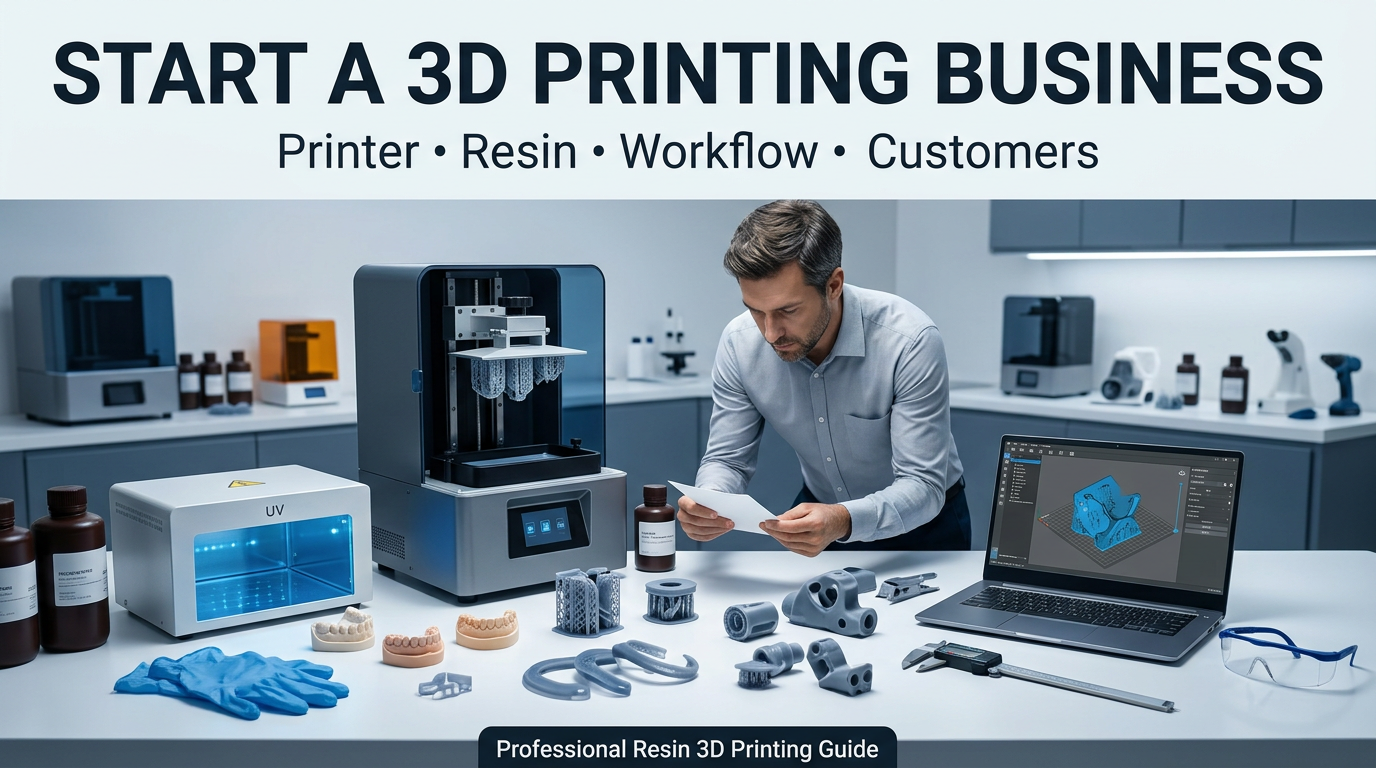
To start a 3D printing business, first choose a clear application niche, such as industrial prototypes, dental models, flexible samples, product development parts or small-batch resin components. Then confirm customer demand, select the right resin 3D printer, build a controlled workflow for slicing, printing, washing, UV curing and inspection, and create a pricing system based on material, machine time, labor, post-processing and delivery. A professional 3D printing business should not begin with “buying any printer.” It should begin with understanding what customers need, what accuracy and material performance they expect, and whether your workflow can repeatedly deliver usable parts.
Introduction
Many people search for how to start a 3D printing business because they see demand for prototypes, dental models, custom parts, product samples or small-batch production. The opportunity can be real, but the business only works when the printer, material, workflow and customer application match.
For professional resin 3D printing, the key is not only print speed or machine size. You also need reliable exposure settings, proper support strategy, stable resin handling, cleaning control, UV post-curing, inspection standards and clear communication with customers.
A serious 3D printing business also needs a business plan, market research and financial projections. The U.S. Small Business Administration notes that a business plan helps guide how a company is structured, run and grown, and should include market, sales and financial planning when funding or long-term growth is involved.
Start With a Business Niche, Not Just a Printer
A common mistake is buying a printer first and then looking for customers later. A better approach is to define the business model first.
Ask:
- Who will buy the printed parts?
- Are they buying visual models, test parts, dental models, functional samples or flexible parts?
- Do they need one-off samples, repeated batches or urgent turnaround?
- What surface quality, detail, size and material properties do they expect?
- Will you only print, or will you also offer file checking, support design, cleaning, curing and inspection?
For a professional resin printing service, suitable niches may include factory prototyping, dental model production, engineering samples, jewelry casting models, product design validation, small-batch customized parts and flexible resin applications.
If your customers are factories or product development teams, review industrial resin 3D printer options and match the printer to prototype size, batch volume and accuracy needs. If your customers are dental labs or clinics, start with dental 3D printers for labs and clinics and confirm the required resin indications, post-curing process and local regulatory requirements.
Possible 3D Printing Business Models
| Business Model | Typical Customers | Suitable Resin Printing Focus | What to Control |
|---|---|---|---|
| Industrial prototyping service | Factories, engineers, product developers | Housings, brackets, fixtures, test assemblies, design samples | Dimensional stability, surface quality, repeatability, part orientation |
| Dental model printing | Dental labs, clinics, orthodontic teams | Dental models, surgical guide models, temporary model workflows depending on resin indication | Resin indication, curing process, cleaning, local clinical requirements |
| Flexible part sampling | Shoe developers, product teams, elastic part designers | Flexible lattices, soft samples, cushioning structures, test pieces | Shore hardness, support removal, deformation control, curing condition |
| Model-making service | Model workshops, designers, display teams | High-detail visual models and presentation parts | Detail reproduction, surface finish, post-processing labor |
| Small-batch resin production | Product teams, factories, customization businesses | Short-run functional or semi-functional parts | Quality consistency, batch records, pricing, packing and delivery |
| Sample printing before printer purchase | Buyers evaluating equipment or resin | Test parts printed for decision-making | Customer requirement collection, print report, material recommendation |
For early-stage businesses, sample printing can be a practical entry point because it lets you test customer demand before investing in a full production setup. Yidimu’s sample printing service can also help customers evaluate model size, resin choice and workflow before choosing equipment.
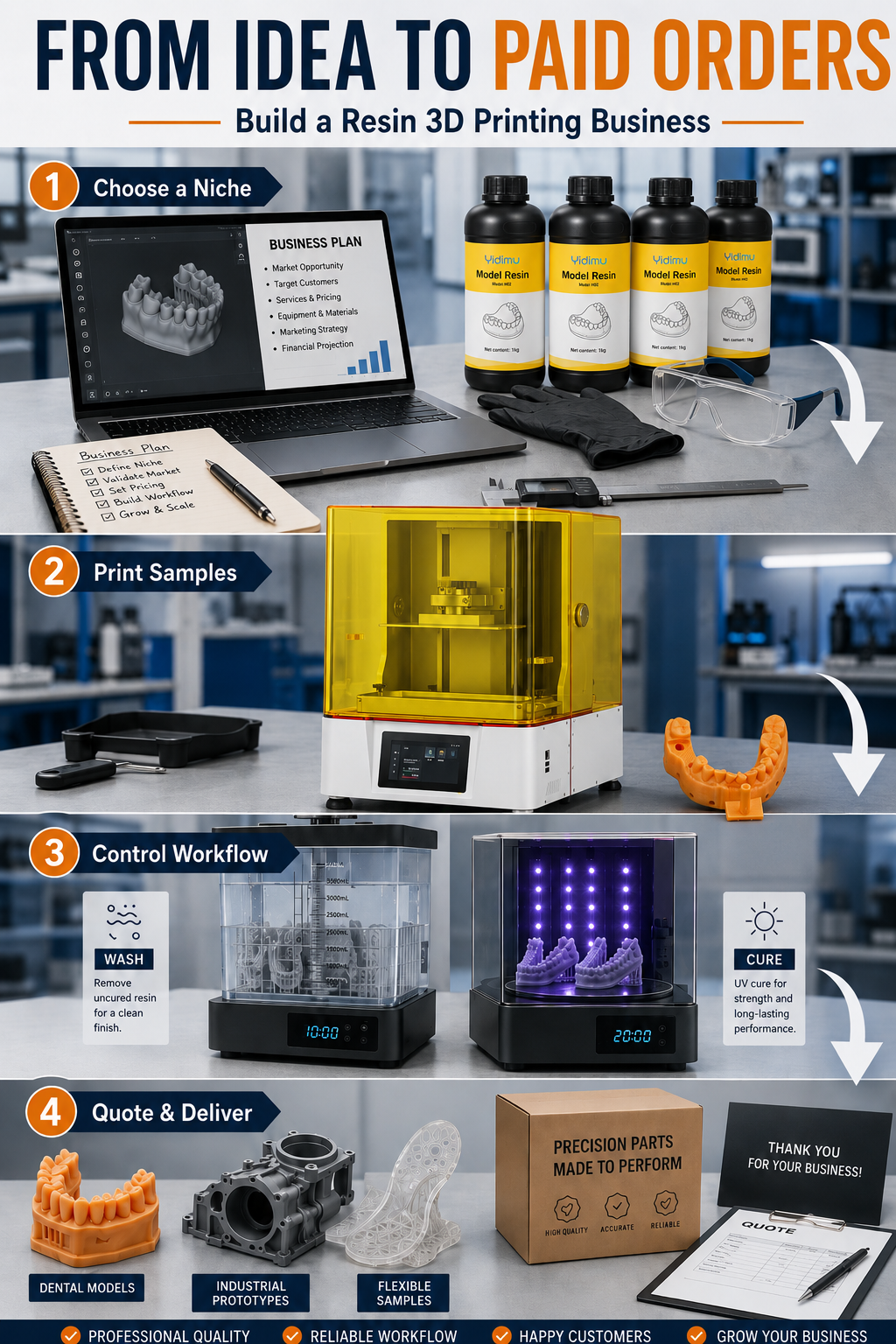
Step-by-Step Workflow: How to Start a 3D Printing Business
1. Choose Your Target Application
Do not target “everyone who needs 3D printing.” That is too broad. Choose one or two focused markets first.
Good starting points may include:
- Dental model printing for local dental labs
- Industrial prototype printing for nearby factories
- Product development samples for engineering teams
- Flexible resin samples for footwear or soft product development
- High-detail resin models for model-making companies
The more specific your offer, the easier it is to explain your value, price your service and select the right printer.
2. Validate Customer Demand
Before buying equipment, talk to potential customers. Ask what they currently use, what problems they face and what turnaround time they expect.
Useful questions:
- What parts do you need printed most often?
- What file formats do you usually provide?
- What material properties matter most?
- What size are your typical parts?
- Do you need one sample or repeated batches?
- What problems have you had with previous 3D printed parts?
- Do you need post-processing, polishing, assembly or inspection?
This step helps you avoid buying a printer that is too small, too slow or unsuitable for your real market.
3. Build a Simple Business Plan
A 3D printing business plan should cover your target customers, services, equipment, materials, pricing, marketing, quality control and cash flow. SBA guidance recommends using market analysis to understand industry outlook, target customers and competitor behavior, and using financial projections to explain expected income, cash flow and capital needs.
Your business plan does not need to be complicated at the beginning, but it should answer:
- What services will you sell?
- Who will buy them?
- What equipment and resin do you need?
- How will you price each job?
- How many jobs per month are needed to cover costs?
- What quality checks will you use?
- How will you handle failed prints, reprints and urgent orders?
4. Select the Right Resin 3D Printer
Printer selection should follow the application. For industrial samples, you may need a larger build volume and stable batch output. For dental models, you may need fine detail, repeatable accuracy and a workflow that fits dental resin requirements. For flexible parts, you need printer and resin compatibility that can support soft materials.
When comparing printers, look at:
- Build volume
- XY resolution
- Z-axis stability
- Light source uniformity
- Resin compatibility
- Print speed under real settings
- Ease of vat cleaning and platform handling
- Software workflow
- Maintenance requirements
- Supplier support
You can review Yidimu’s professional resin 3D printer options to compare equipment categories for dental, industrial and flexible resin workflows.
5. Choose Resin Based on the Application
Resin is not just a consumable. It determines surface finish, detail, strength, flexibility, cleaning method, curing behavior and final part suitability.
Common resin choices include:
| Application | Possible Resin Direction | Key Considerations |
|---|---|---|
| Dental models | Dental model resin or water-washable dental model resin depending on workflow | Confirm indication, cleaning, UV curing and local requirements |
| Industrial prototypes | Model resin, ABS-like resin or engineering resin depending on testing needs | Check strength, surface finish, dimensional stability and post-processing |
| Flexible samples | Flexible resin matched to target softness | Confirm deformation behavior, support removal and curing condition |
| Casting models | Casting model resin | Confirm burnout behavior and casting workflow compatibility |
| Visual models | Model resin | Focus on detail, surface quality and finishing process |
For material planning, review Yidimu resin materials and confirm the resin choice according to part function, size, surface requirement and post-processing conditions.
6. Set Up a Safe Resin Printing Area
Professional resin printing involves liquid resin, cleaning agents, UV curing and waste handling. The working area should have ventilation, gloves, eye protection, organized resin storage, labeled containers and a clear cleaning process.
OSHA’s Hazard Communication guidance states that employers with hazardous chemicals in the workplace must have labels and safety data sheets available for exposed workers and train them to handle chemicals appropriately. It also notes that safety data sheets use a specified 16-section format.
A resin printing workspace should include:
- Nitrile gloves
- Protective eyewear
- Ventilation or controlled airflow
- Covered resin containers
- Clean and dirty tool separation
- Spill handling materials
- Waste resin and cleaning liquid procedures
- UV curing equipment
- Clear signage for uncured resin handling
Do not treat resin printing like ordinary office equipment. Uncured resin should be handled carefully, and waste liquid should be processed according to local rules.
7. Build a Repeatable Print Workflow
A professional 3D printing business earns trust through repeatability. Customers do not only want one good print; they want the next batch to match the first one.
A basic resin workflow:
- Receive customer file and requirements.
- Check model size, wall thickness, holes, unsupported areas and part function.
- Confirm resin, color, surface requirement and delivery deadline.
- Prepare orientation and supports.
- Slice with suitable layer height and exposure settings.
- Print under controlled resin and machine conditions.
- Remove the part from the platform carefully.
- Wash according to resin and cleaning method.
- Remove supports at the correct stage.
- UV cure according to resin guidance.
- Inspect dimensions, surface quality and visible defects.
- Pack and deliver with notes if needed.
For post-processing consistency, professional users may also need UV curing equipment for resin prints to control curing time, exposure and repeatability.
Pricing a 3D Printing Business
Many new businesses only charge for resin volume. That usually underprices the job.
A better pricing structure includes:
- Resin cost
- Machine time
- Setup time
- File checking time
- Support design time
- Cleaning and curing labor
- Failed print risk
- Quality inspection
- Packaging
- Delivery
- Urgency
- Customer communication
- Equipment maintenance
For example, a small dental model may use limited resin but still require careful cleaning, curing and batch organization. A large industrial prototype may use more resin and machine time, but the file preparation and support strategy may be the real cost driver.
You can create three quote levels:
| Quote Type | Suitable For | Pricing Logic |
|---|---|---|
| Basic print only | Customers with ready-to-print files | Resin + machine time + standard post-processing |
| Professional print review | Engineering, dental or model customers | File check + print + cleaning + curing + inspection |
| Full workflow support | Customers needing material and process guidance | Application review + resin selection + test print + reporting |
Quality Control for a 3D Printing Business
Quality control does not need to be complex at the beginning, but it should be consistent.
Check:
- Part dimensions
- Surface defects
- Warping or deformation
- Support marks
- Cracks or delamination
- Undercured areas
- Fit with mating parts
- Resin residue after cleaning
- Batch consistency
- Packaging damage risk
For professional applications, keep simple records of printer, resin batch, layer height, exposure setting, curing time and inspection result. This helps you troubleshoot failures and explain your workflow to serious customers.
If your customers are factories, you can refer them to industrial 3D printing solutions when they need a broader workflow for prototyping, sample validation or small-batch production.
Dental 3D Printing Business Considerations
Dental 3D printing can be a strong business direction, but it requires careful material and workflow control. Dental models, surgical guide models and other dental-related parts may have different resin requirements.
Customers should confirm resin indication, post-curing process and local regulatory requirements before clinical or intraoral use. The FDA notes that 3D printed medical devices may include dental restorations and other regulated applications, and manufacturers should refer to FDA guidance and quality system regulations for specific medical device applications.
For dental business planning, consider:
- Which dental applications you will support
- Whether the resin is intended for the specific use
- Cleaning and curing requirements
- Model accuracy needs
- Batch traceability
- Customer file workflow
- Local dental or medical regulations
- Whether the customer needs models only or clinical-use parts
Yidimu’s dental 3D printing workflow page can help dental labs and clinics understand how printer, resin, software and post-processing connect in a professional workflow.
Common Mistakes to Avoid
Buying a printer before choosing a market
A printer is only useful when it fits the customer’s application. Start with market demand, then choose equipment.
Competing only on low price
Low pricing can attract difficult jobs without enough margin for failures, labor or support. Professional customers usually care about reliability, communication and repeatability.
Ignoring post-processing
Cleaning, support removal and UV curing can affect surface quality, mechanical behavior and final usability. A poor post-processing workflow can ruin a good print.
Using one resin for every job
Different parts need different resin properties. A dental model, flexible sample and industrial bracket should not be treated as the same material problem.
Overpromising accuracy or performance
Accuracy depends on printer, resin, model geometry, orientation, supports, exposure, curing and inspection method. Avoid absolute promises.
Forgetting safety and waste handling
Uncured resin and cleaning liquid require careful handling. Gloves, eyewear, ventilation, labeling and waste procedures should be part of the business from day one.
Not recording print settings
Without records, it is difficult to repeat successful jobs or troubleshoot failures.
Accepting every file without review
Some customer files may be too thin, unsupported, oversized or unsuitable for the selected resin. File checking protects both the customer and your business.
Startup Checklist for a Professional Resin 3D Printing Business
Use this checklist before launching:
- Define your target market.
- Choose 2–3 core applications.
- Interview potential customers.
- Collect sample files and part requirements.
- Select printer size and resin compatibility.
- Choose initial resin types.
- Set up washing and UV curing workflow.
- Prepare safety equipment and resin storage.
- Create a quote template.
- Create a print intake form.
- Define quality inspection standards.
- Print test samples.
- Photograph sample parts for marketing.
- Build a simple website or service page.
- Prepare customer communication templates.
- Track cost per job.
- Record failed prints and causes.
- Review workflow after the first 10–20 paid jobs.
Marketing a 3D Printing Business
Professional 3D printing marketing should show real applications, not only machine photos. Customers want to know whether you can solve their problem.
Useful marketing content includes:
- Before-and-after product development examples
- Dental model workflow photos
- Industrial prototype sample galleries
- Flexible resin test samples
- Short videos of printing, washing and curing
- FAQ pages explaining materials and turnaround time
- Case-style explanations without fake customer claims
- Blog posts answering real customer questions
Good service pages should explain:
- What files you accept
- What materials you support
- What applications you recommend
- What limitations customers should know
- How quotes are calculated
- What information customers should send
What Information Should Customers Send for a Quote?
Ask customers to send:
- 3D file
- Part dimensions
- Application
- Quantity
- Resin or material requirement
- Surface finish requirement
- Accuracy requirement
- Mechanical requirement
- Color requirement
- Deadline
- Whether the part is for visual review, fitting, testing or production use
This prevents misunderstandings and helps you recommend a realistic workflow.
FAQ
Is a 3D printing business profitable?
A 3D printing business can be profitable when it serves a clear market, controls material and labor costs, prices jobs correctly and delivers consistent results. Profit depends on customer demand, printer utilization, failure rate, workflow efficiency and the type of parts you produce.
What is the best 3D printing business to start?
There is no single best option for every operator. For resin printing, practical starting points include industrial prototyping, dental model printing, product sample making, flexible resin testing and model-making services. The best choice depends on your local customer base and technical capability.
How much money do I need to start a 3D printing business?
Startup cost depends on printer type, resin inventory, washing and curing equipment, workspace, safety supplies, software, packaging and marketing. Instead of estimating only printer price, calculate the full workflow cost and expected monthly job volume.
Should I start with resin or filament 3D printing?
Resin printing is often suitable for detailed models, dental models, smooth surfaces, small precision parts and certain professional prototypes. Filament printing may be suitable for larger rough prototypes or simple functional parts. Choose based on customer applications, not only machine cost.
Can I start a dental 3D printing business?
Yes, but dental printing requires careful control of resin indication, post-curing and local requirements. Customers should confirm resin indication, post-curing process and local regulatory requirements before clinical or intraoral use.
What equipment do I need besides a resin 3D printer?
You may need resin, build platforms, resin vats, cleaning containers, washing tools, UV curing equipment, gloves, eyewear, ventilation, measuring tools, packing materials and maintenance supplies.
How do I price 3D printed parts?
Price should include resin cost, machine time, labor, file preparation, support work, cleaning, curing, inspection, packaging, failure risk and urgency. For professional customers, do not price only by resin volume.
How do I get customers for a 3D printing business?
Start with a focused niche. Contact local factories, dental labs, product designers, model-making companies or engineering teams. Show real sample parts, explain your workflow and offer test prints when appropriate.
Do I need technical knowledge to start?
Yes. A professional 3D printing business needs knowledge of file preparation, slicing, supports, resin behavior, cleaning, UV curing, troubleshooting and quality inspection. Equipment alone is not enough.
What should I do before buying a printer?
Collect sample part requirements, confirm typical model size, understand customer accuracy expectations, identify suitable resin types and compare printer categories. You can also request a test print before making a purchase decision.
Conclusion
Learning how to start a 3D printing business is not only about buying a machine and offering print jobs. A sustainable professional business starts with a clear application niche, reliable equipment, suitable resin, controlled post-processing, realistic pricing and strong customer communication.
For resin 3D printing, workflow control is especially important. The same printer and resin can produce different results depending on file preparation, supports, exposure, layer height, washing, curing and inspection. Professional customers need predictable output, not just a successful first print.
If you are planning a resin 3D printing business, send Yidimu your model size, resin requirement, application, expected workflow and production or sample-making needs. Yidimu can help review whether your project is more suitable for dental, industrial, flexible resin or sample printing workflows, and recommend printer selection support based on practical requirements.