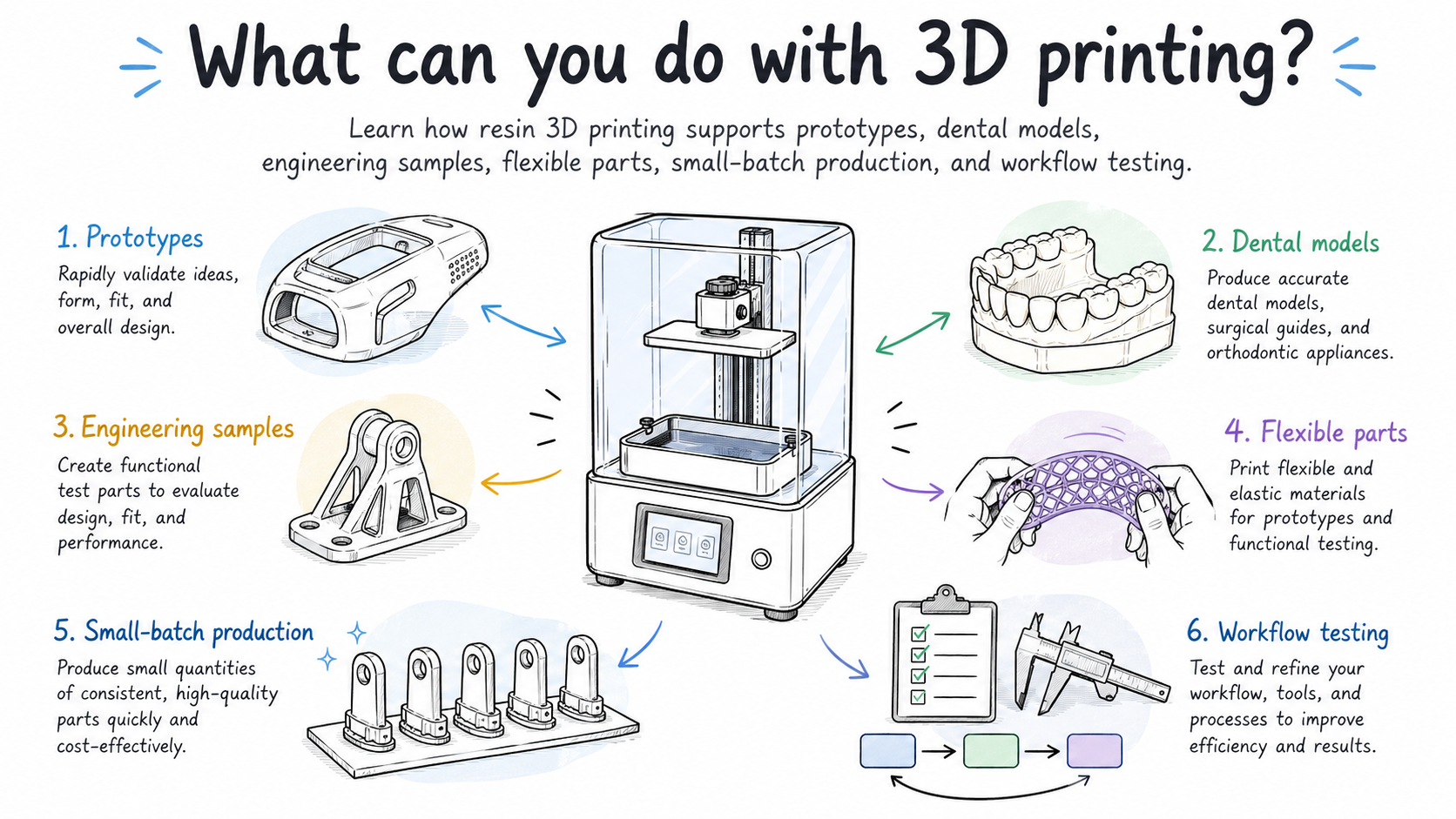
You can use 3D printing to turn digital 3D designs into physical parts for prototyping, dental models, engineering samples, product testing, tooling support, flexible parts, visual models, research projects, and limited production. In professional resin 3D printing, the most common uses include high-detail models, dental applications, small functional parts, appearance prototypes, casting patterns, flexible samples, and design verification before mold making. The final result depends on the printer, resin, part design, print settings, cleaning, UV curing, and quality control workflow.
Introduction
Many people ask, “what can you do with 3D printing?” The simple answer is that 3D printing can help teams move from a digital idea to a physical object faster than many traditional manufacturing methods. Instead of waiting for mold tooling or machining every early prototype, designers and engineers can print test parts, check dimensions, review appearance, verify assembly, and adjust the design before committing to larger production.
In professional environments, 3D printing is not only about making interesting objects. It is a practical workflow tool. Factories use it for product development and sample testing. Dental labs use it for models and workflow support. Engineers use it for design validation. Model-making companies use it for detailed visual parts. Flexible resin printing can support soft samples, lattice structures, shoe-related parts, and elastic prototypes when the resin and design are suitable.
Yidimu focuses on professional resin 3D printing systems, including industrial resin 3D printer options, dental 3D printers for labs and clinics, flexible resin 3D printing systems, UV curing equipment, and resin materials for professional workflows.
What 3D Printing Actually Does
3D printing, also called additive manufacturing in technical contexts, builds physical three-dimensional parts by adding material layer by layer. ISO/ASTM 52900:2021 defines additive manufacturing terminology and describes AM as building 3D geometries through successive addition of material.
In a resin 3D printing workflow, the basic process usually includes:
- Create or receive a 3D model.
- Check the model for printability.
- Choose the resin based on the application.
- Slice the model into printable layers.
- Print the part.
- Wash or clean uncured resin.
- Remove supports.
- UV cure the printed part.
- Inspect dimensions, surface quality, and fit.
- Adjust the design or workflow if needed.
The FDA also describes 3D printing as a process that creates a three-dimensional object by building successive layers from a digital 3D file, such as CAD data or medical imaging data.
For professional users, the important point is this: 3D printing is not just a machine. It is a complete workflow involving design, resin, printing, cleaning, curing, inspection, and application testing.
What Can You Do With 3D Printing in Professional Work?
3D printing can support many professional applications, but the correct use depends on the required size, detail, surface finish, strength, flexibility, accuracy, resin type, and post-processing process.
| Application | What You Can Print | Why It Is Useful | Key Considerations |
|---|---|---|---|
| Product prototyping | Housings, brackets, covers, small components, appearance models | Helps teams check shape, fit, and design before tooling | Confirm size, wall thickness, surface finish, and assembly needs |
| Industrial samples | Engineering samples, test parts, fixture-like aids, small-batch trial parts | Supports design verification and internal testing | Mechanical performance depends on resin and part structure |
| Dental workflow | Dental models, temporary models, surgical guide-related models, workflow samples | Supports digital dental production and lab workflow planning | Confirm resin indication, post-curing process, and local regulations |
| Flexible parts | Soft samples, lattice structures, elastic prototypes, shoe-related samples | Useful for testing shape, flexibility, and structure | Flexibility depends on resin, geometry, thickness, and curing |
| Casting patterns | Jewelry patterns, casting model samples, detailed forms | Helps create detailed patterns for casting workflows | Resin burnout behavior and casting process must be tested |
| Visual models | Display models, architectural-style models, product appearance samples | Helps communication with clients and internal teams | Surface finishing and painting may be needed |
| Research and education | Concept models, test structures, experimental samples | Helps researchers quickly test ideas | Material performance should be validated for each project |
| Small-batch production support | Limited runs, custom samples, low-volume parts | Useful before mold investment or for custom work | Not every resin print is suitable for end-use production |
3D Printing for Product Development
One of the most practical things you can do with 3D printing is shorten the product development cycle. Before a factory opens a mold or orders CNC machining, resin 3D printing can help produce a physical sample for discussion and testing.
Typical uses include:
- Checking whether the design looks correct in real size.
- Testing whether parts fit together.
- Reviewing holes, slots, edges, and connection points.
- Comparing several design versions.
- Making samples for internal meetings or customer review.
- Finding design problems before expensive tooling.
This is especially useful when the design may change several times. A printed sample does not replace final production validation, but it can reduce uncertainty in the early stage.
For factories and engineering teams, industrial 3D printing solutions can be used as part of a broader product development workflow, especially when high-detail resin samples are needed for shape, appearance, and fit review.
3D Printing for Industrial Resin Applications
Industrial resin 3D printing is often used when customers need detail, surface quality, and faster sample iteration. Depending on the resin and workflow, it may support appearance prototypes, engineering models, test components, and limited production evaluation.
Common industrial resin applications include:
- Product shell prototypes
- Structural design samples
- Assembly check parts
- Transparent or semi-transparent functional samples
- Fixtures or positioning aids for internal review
- Small parts used in design verification
- Model-making and presentation samples
- Pre-mold sample testing
However, resin printed parts should not automatically be treated like injection-molded plastic. Mechanical strength, temperature resistance, flexibility, long-term durability, chemical resistance, and outdoor performance vary by resin and post-curing condition. Customers should test printed parts under real use conditions before using them in demanding production environments.
3D Printing for Dental Labs and Clinics
Dental 3D printing is one of the most important professional applications of resin 3D printing. Dental labs and clinics may use 3D printing to support digital workflows, model production, surgical guide-related workflows, temporary model work, and other dental applications depending on the printer, resin, software, and post-processing process.
Examples include:
- Dental models
- Orthodontic models
- Study models
- Surgical guide-related models
- Temporary model applications
- Try-in and workflow samples
- Lab communication models
Customers should confirm resin indication, post-curing process and local regulatory requirements before clinical or intraoral use. For medical and dental-related applications, the FDA notes that 3D printing is used in medical devices and that manufacturers should refer to guidance documents and quality system regulations for specific applications.
Yidimu provides dental 3D printing workflow support and dental printer options for labs and clinics that need stable resin printing, repeatable workflow control, and suitable material selection.
3D Printing for Flexible and Elastic Parts
Flexible resin 3D printing can be useful when the part needs softness, bendability, compression, or elastic structure testing. This is not the same as printing ordinary rigid resin. Flexible resin performance is strongly affected by resin type, model geometry, wall thickness, lattice design, curing time, and actual use conditions.
Professional users may use flexible resin printing for:
- Shoe-related prototypes
- Soft pads
- Elastic lattice structures
- Cushioning samples
- Soft industrial samples
- Flexible appearance prototypes
- Fit and feel testing
- Design comparison before mold making
A key point is that the question should not only be “Can 3D printing make soft parts?” A better question is: “What softness, rebound, wall thickness, force direction, surface quality, and service environment does the part require?”
For customers working on soft parts or elastic samples, Yidimu offers flexible resin 3D printing systems and resin workflow guidance to help evaluate printability and material suitability.
3D Printing for Casting Patterns and Detailed Models
Another useful application is printing detailed patterns for casting workflows. Resin 3D printing can produce fine details that are difficult to make quickly by hand. This can be useful for jewelry, small decorative parts, model-making, and detailed design samples.
Casting-related printing requires careful workflow testing. The pattern resin, support design, cleaning, curing, investment material, burnout process, and casting parameters can all affect the result. A printed pattern may look good but still need process validation before it works reliably in casting.
For this reason, buyers should not select resin only by appearance. They should confirm whether the resin is intended for casting workflows and test the entire process before regular production.
3D Printing for Sample Printing Before Buying Equipment
If you are not sure whether your part is suitable for resin 3D printing, sample printing is often a practical first step. A sample can show whether the model size, detail, surface finish, support marks, flexibility, or assembly fit meets your expectations.
A sample printing test can help answer:
- Is the model printable in the required size?
- Does the printed surface meet the project requirement?
- Are small details visible enough?
- Does the part deform after cleaning or curing?
- Is the resin suitable for the intended application?
- Do support marks affect the final appearance?
- Should the model be redesigned before printing?
For uncertain projects, Yidimu’s sample printing service can help customers review printability before choosing a printer, resin, or production workflow.
Resin Selection: What Material Should You Use?
The resin determines many important properties of the final printed part. Printer performance matters, but resin selection and post-processing are equally important.
| Resin Type | Suitable Applications | Main Benefits | Points to Confirm |
| Model resin | Dental models, display models, general visual samples | Good detail and surface appearance | Confirm color, curing process, and dimensional needs |
| ABS-like resin | Engineering prototypes, shells, rigid sample parts | Better toughness than basic model resin in some workflows | Confirm impact needs and real load conditions |
| Flexible resin | Soft samples, elastic structures, shoe-related parts | Bendability and compression behavior | Confirm hardness, rebound, thickness, and curing process |
| Casting resin | Jewelry and casting pattern workflows | Detailed patterns for casting preparation | Confirm burnout process and casting compatibility |
| Water-washable dental model resin | Dental model workflows where water-washing is preferred | Easier cleaning workflow in suitable setups | Confirm resin indication and post-curing process |
| Surgical guide-related resin | Surgical guide-related workflows | Designed for guide-related applications depending on resin indication | Confirm clinical indication, curing, sterilization, and local regulatory requirements |
You can review Yidimu resin materials when planning material selection. For professional use, always match the resin to the part function, not only to the printer.
Professional Resin 3D Printing Workflow Checklist
A successful 3D printing result depends on workflow control. Use this checklist before starting a project.
1. Confirm the application
Define what the printed part is for. Is it a visual sample, dental model, flexible test piece, engineering prototype, casting pattern, or production support part?
2. Check the 3D model
Review wall thickness, unsupported areas, tiny details, hollow structures, drain holes, sharp corners, and assembly points. A model that looks good on screen may still need adjustment for printing.
3. Choose the resin
Select resin based on function, not only color or price. Confirm hardness, strength, flexibility, surface finish, curing process, and intended application.
4. Set the print orientation
Orientation affects support marks, surface finish, dimensional behavior, strength direction, and printing success.
5. Add supports correctly
Support design should balance stability and surface quality. Too few supports may cause print failure. Too many supports may damage appearance after removal.
6. Print with controlled parameters
Exposure, layer height, lift speed, temperature, platform condition, and resin condition may affect results. Parameters should be adjusted according to resin, printer, and model.
7. Clean the part properly
Uncured resin must be removed. Cleaning time and cleaning method should match resin type and part geometry.
8. UV cure the part
UV curing affects final hardness, strength, stability, and surface feel. Under-curing or over-curing may cause problems depending on resin and application.
9. Inspect the result
Check dimensions, fit, surface quality, deformation, cracks, support marks, and functional performance.
10. Record the process
For repeatable production, record resin batch, print settings, orientation, cleaning time, curing time, and inspection results.
For customers building a repeatable workflow, UV curing equipment for resin prints should be considered as part of the full printing system, not as an optional afterthought.
What 3D Printing Cannot Do Well
3D printing is powerful, but it is not the correct solution for every job. Professional buyers should understand its limits.
3D printing may not be ideal when:
- The part requires very high-volume production at the lowest unit cost.
- The material must exactly match injection-molded plastic.
- The part must meet strict mechanical standards without testing.
- The application requires certified medical use without validated materials and process control.
- The part has large unsupported flat surfaces that may warp.
- The design has features too thin for the selected resin and printer.
- The user expects final production quality without post-processing.
A professional 3D printing workflow is most valuable when the goal is speed, design freedom, customization, detail, iteration, or small-batch flexibility.
How to Decide Whether 3D Printing Fits Your Project
Use this buyer decision table to evaluate your project.
| Question | If Your Answer Is Yes | What to Do Next |
| Do you need a sample before mold making? | 3D printing may be useful | Print a prototype and review design |
| Do you need high detail or complex geometry? | Resin 3D printing may be suitable | Check printer size and resin type |
| Do you need dental models or lab workflow support? | Dental resin printing may fit | Confirm resin indication and workflow |
| Do you need flexible or soft parts? | Flexible resin may help | Test resin hardness and part geometry |
| Do you need large-volume mass production? | 3D printing may not be the lowest-cost method | Use printing for sample validation first |
| Do you need certified end-use medical parts? | Extra validation is required | Confirm regulations, material indication, and process control |
| Are you unsure about printability? | Sample testing is recommended | Send model size, use case, and resin requirements |
Common Mistakes to Avoid
Mistake 1: Choosing a printer only by build size
Build size is important, but it is not the only factor. Accuracy, light uniformity, Z-axis stability, resin compatibility, curing workflow, service support, and repeatability also matter.
Mistake 2: Assuming every resin works for every part
Different resins behave differently. A resin that works well for a visual model may not be suitable for a flexible part, dental application, casting pattern, or functional sample.
Mistake 3: Ignoring post-processing
Cleaning and UV curing can strongly affect surface quality, final hardness, odor, dimensional stability, and part performance.
Mistake 4: Printing without checking wall thickness
Thin walls, unsupported structures, and heavy solid blocks may cause failure, deformation, or poor surface quality.
Mistake 5: Treating prototypes as final production parts
A prototype is useful for testing, but final production suitability should be validated under real conditions.
Mistake 6: Using dental prints without confirming resin indication
Dental applications require careful material selection and workflow control. Customers should confirm resin indication, post-curing process and local regulatory requirements before clinical or intraoral use.
Mistake 7: Not recording settings
If a team does not record orientation, exposure, layer height, cleaning, and curing conditions, it becomes difficult to repeat successful results.
What Information Should You Prepare Before Asking for a 3D Printing Solution?
To get useful printer or material advice, prepare the following information:
- Model file or product image
- Overall dimensions
- Required quantity
- Application purpose
- Rigid or flexible requirement
- Surface finish requirement
- Accuracy or tolerance expectation
- Whether the part is for dental, industrial, display, casting, or testing use
- Expected production workflow
- Cleaning and curing conditions
- Whether sample printing is needed first
This information helps the supplier recommend a suitable printer, resin, and workflow instead of giving a general answer.
FAQ
What can you do with 3D printing in a factory?
In a factory, 3D printing can be used for product prototypes, engineering samples, assembly checks, visual models, fixture-like aids, small-batch testing, and design verification before mold making. Resin 3D printing is especially useful when detail, surface quality, and fast design iteration are important.
Can 3D printing make functional parts?
Yes, 3D printing can make some functional parts, depending on the resin, printer, geometry, curing process, and working conditions. However, not every printed part is suitable for final use. Mechanical performance should be tested under real application conditions.
Can 3D printing be used for dental models?
Yes, resin 3D printing is widely used for dental models and digital dental workflow support. For clinical or intraoral applications, customers should confirm resin indication, post-curing process, sterilization requirements if applicable, and local regulatory requirements.
Can 3D printing make flexible parts?
Yes, flexible resin 3D printing can produce soft samples, elastic structures, lattice designs, cushioning parts, and shoe-related prototypes. The final softness and rebound depend on resin type, wall thickness, geometry, print settings, and UV curing.
Is 3D printing good for mass production?
3D printing can support small-batch production and custom parts, but it is not always the best choice for high-volume production. For large quantities, injection molding or other traditional processes may offer lower unit cost after tooling. 3D printing is often most useful before tooling, during product development, or for custom and limited runs.
What is the most important part of resin 3D printing?
The most important part is workflow control. Printer quality matters, but resin selection, model design, orientation, support strategy, cleaning, UV curing, and inspection all affect the final result.
Should I buy a 3D printer or use sample printing first?
If you are unsure whether your parts are printable, sample printing is a practical first step. It helps confirm size, detail, surface quality, resin behavior, and workflow before investing in equipment.
What files are needed for 3D printing?
Most 3D printing workflows start with a 3D model file such as STL, OBJ, or other CAD-exported formats. The file should be checked for wall thickness, closed geometry, scale, and printability before slicing.
Does 3D printing replace CNC machining or injection molding?
Not completely. 3D printing is better seen as a complementary manufacturing tool. It is useful for prototypes, complex shapes, fast design changes, custom parts, and small batches. CNC machining and injection molding may still be better for certain materials, tolerances, and high-volume production.
Conclusion
So, what can you do with 3D printing? In professional resin workflows, you can create prototypes, dental models, industrial samples, flexible parts, casting patterns, visual models, research parts, and small-batch trial components. The real value is not only the printed object, but the ability to test ideas, improve designs, reduce uncertainty, and build a more controlled product development workflow.
For the best results, choose the printer, resin, post-processing method, and inspection process according to the actual application. A dental model, flexible sample, engineering prototype, and casting pattern all require different decisions.
If you are planning a resin 3D printing project, you can contact Yidimu for workflow review with your model size, resin requirement, application, expected workflow, and sample-making or production needs. Yidimu can help review whether resin 3D printing is suitable and suggest a practical equipment and material direction.