A resin 3D printer is a 3D printing machine that uses liquid photopolymer resin and controlled light exposure to build solid parts layer by layer. Instead of melting plastic filament, it cures photosensitive resin using UV light, LCD masking, DLP projection or laser-based exposure. Resin 3D printers are commonly used when users need fine detail, smooth surfaces, accurate small features and application-specific materials. For professional users, the real question is not only “what is a resin 3D printer,” but also whether the printer, resin, software, post-curing process and quality control workflow match the final application.
Direct Answer: What Is a Resin 3D Printer?
A resin 3D printer is a type of additive manufacturing equipment that turns a digital 3D model into a physical object by curing liquid resin with light. The most common professional resin printing category is vat photopolymerization, where a build platform moves layer by layer while UV light selectively hardens the resin. ISO/ASTM 52900 defines additive manufacturing as building physical 3D geometry by successive addition of material, and resin 3D printing is one important process family within that broader field.
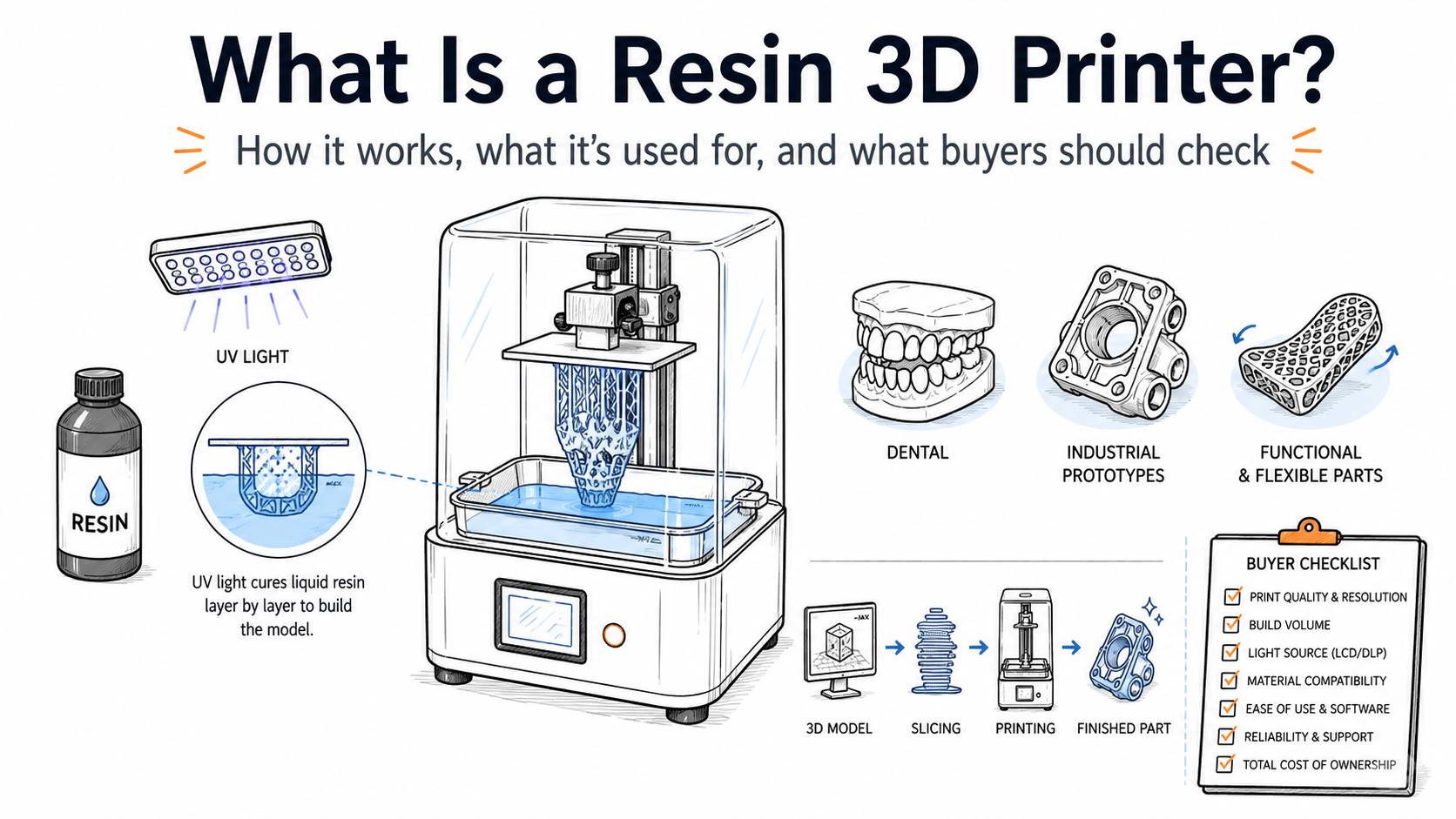
In practical terms, a resin 3D printer needs four things to produce a useful part: a printable 3D file, a suitable resin, controlled printing parameters and correct post-processing. The printed part usually requires cleaning and UV post-curing before it reaches stable final properties.
How Does a Resin 3D Printer Work?
A resin 3D printer works by exposing liquid resin to a controlled light source. The resin contains photoinitiators that react when exposed to UV or specific wavelength light. This reaction causes the resin to solidify in the exposed area. NIOSH describes vat photopolymerization as a process that uses liquid photopolymer resin cured by UV or laser light, building an object layer by layer through repeated exposure.
A typical resin 3D printing workflow includes:
- 3D model preparation
The user creates or imports a CAD, dental scan or 3D model file. - Slicing and support generation
Slicing software divides the model into thin layers and adds supports where needed. - Resin selection
The user chooses a resin based on the application, such as model resin, engineering resin, dental model resin, castable resin or flexible resin. - Printing
The printer cures the resin layer by layer until the object is complete. - Cleaning
The printed part is washed to remove uncured surface resin. - UV post-curing
The part is cured again under controlled UV light to help improve final stability and material performance. - Support removal and inspection
Supports are removed, surfaces are checked, and dimensions may be measured before use.
For professional applications, each step affects the final result. A good resin printer alone is not enough. The resin, exposure settings, support strategy, washing method, UV curing time and operator workflow all matter.
Resin 3D Printer vs Filament 3D Printer
Many beginners compare resin 3D printers with filament 3D printers. Both are 3D printers, but they use different materials and workflows.
| Comparison Point | Resin 3D Printer | Filament 3D Printer |
|---|---|---|
| Material form | Liquid photopolymer resin | Solid plastic filament |
| Curing / forming method | Light cures resin layer by layer | Heated nozzle melts and deposits plastic |
| Surface finish | Usually smoother | Usually visible layer lines |
| Detail capability | Strong for fine details and small features | Better for larger rough prototypes |
| Post-processing | Cleaning and UV curing usually required | Support removal may be enough for basic parts |
| Common professional uses | Dental models, precise prototypes, jewelry masters, small detailed parts, flexible samples | Large concept models, fixtures, simple functional parts |
| Workflow sensitivity | Resin, exposure, cleaning and curing are critical | Temperature, bed adhesion and filament settings are critical |
| Safety focus | Resin handling, gloves, ventilation, UV curing and waste handling | Heated nozzle, fumes, ventilation and moving parts |
A resin 3D printer is usually preferred when detail, surface quality and small-feature reproduction are important. A filament printer may be more suitable for large, low-detail, low-cost concept parts. For factories and dental labs, the best choice depends on part size, accuracy requirement, material property, post-processing capacity and production volume.
Main Types of Resin 3D Printers
The phrase “resin 3D printer” can refer to several light-curing technologies. The most common types include SLA, DLP and LCD/MSLA systems.
SLA Resin 3D Printers
SLA systems use a laser to cure resin. They are part of vat photopolymerization technology. SLA is often associated with fine details and controlled exposure, but actual performance depends on the machine structure, optical system, resin and calibration.
DLP Resin 3D Printers
DLP systems use a projector to expose an entire layer or large exposure area at once. They can be efficient for certain workflows, especially when printing multiple small parts. However, pixel structure, projection uniformity and build area design must be considered.
LCD / MSLA Resin 3D Printers
LCD resin 3D printers use an LCD masking screen and UV light source. They are widely used in dental, engineering and professional resin workflows because they can offer a balance of detail, build size and productivity. In professional purchasing, buyers should evaluate screen resolution, light uniformity, Z-axis stability, resin compatibility, maintenance cost and service support.
What Is a Resin 3D Printer Used For?
Resin 3D printers are used when users need detailed, accurate and smooth parts. Applications vary depending on the printer size, resin type and post-processing workflow.
| Application Area | Typical Printed Parts | Why Resin Printing Is Used | Key Workflow Notes |
|---|---|---|---|
| Dental labs and clinics | Dental models, surgical guide models, temporary model work, orthodontic models | Fine detail, repeatable model production, digital dentistry workflow support | Customers should confirm resin indication, post-curing process and local regulatory requirements before clinical or intraoral use |
| Industrial prototyping | Housings, brackets, functional appearance models, product development samples | Smooth surface, design verification, small-feature testing | Resin choice should match strength, heat, flexibility or appearance needs |
| Engineering and R&D | Test samples, assembly verification, jigs, small precision parts | Fast iteration before tooling or mold making | Dimensional tolerance should be confirmed through sample testing |
| Jewelry and casting | Ring masters, jewelry prototypes, castable models | Fine details and smooth surfaces | Burnout and casting workflow depend on the resin |
| Flexible part testing | Soft samples, lattice structures, shoe-related prototypes, elastic parts | Allows testing of flexible geometry and feel | Shore hardness, rebound and wall thickness should be confirmed |
| Model-making | Display models, miniatures, product appearance samples | High detail and clean surface quality | Painting and finishing workflow may be required |
Yidimu provides professional industrial resin 3D printer options for factory prototyping and production-oriented sample work, as well as dental 3D printers for labs and clinics for digital dental workflows.
Why Do Professional Users Choose Resin 3D Printing?
Professional users usually choose resin 3D printing for practical reasons rather than novelty.
The first reason is detail reproduction. Resin printing can support fine surfaces, small textures and complex geometry. This is important for dental models, jewelry masters, small engineering components and product appearance samples.
The second reason is workflow speed during development. A design team can revise a CAD model, print a sample, inspect the result and adjust the design before committing to tooling. FDA also notes that 3D printing allows designers to make changes without additional tooling and can create complex internal structures or patient-matched medical devices in regulated contexts.
The third reason is material specialization. Resin materials can be formulated for model printing, casting, flexible testing, engineering appearance, water-washable workflows or dental model production. The buyer should not assume one resin can handle all applications. Material properties vary by formulation, exposure, curing and post-processing.
Professional users can review Yidimu resin materials when comparing model resin, dental resin, flexible resin and other application-specific options.
Resin Selection: The Printer Is Only One Part of the Workflow
A resin 3D printer does not determine the final result by itself. Resin selection is one of the most important decisions in the workflow.
| Resin Type | Common Use | What to Confirm Before Use |
|---|---|---|
| Model resin | General models, dental models, appearance prototypes | Surface quality, color, detail, dimensional stability |
| ABS-like resin | Engineering prototypes, brackets, functional appearance samples | Toughness, impact resistance, fit testing requirements |
| Flexible resin | Soft samples, lattice structures, shoe prototypes, elastic parts | Shore hardness, rebound, wall thickness, support strategy |
| Castable resin | Jewelry masters, casting patterns | Burnout behavior, ash residue, casting workflow compatibility |
| Dental model resin | Dental models, orthodontic models, lab workflow models | Resin indication, curing process, local regulatory requirements |
| Water-washable resin | Cleaner washing workflow for model production | Water handling, waste disposal, final curing process |
For dental applications, customers should confirm resin indication, post-curing process and local regulatory requirements before clinical or intraoral use. A resin that is suitable for a dental model is not automatically suitable for intraoral use.
Professional Resin 3D Printing Workflow Checklist
Before buying or using a resin 3D printer, professional users should check the complete workflow.
Pre-Printing Checklist
- Confirm the application: dental model, industrial prototype, flexible part, casting model or sample production.
- Confirm part size and build volume.
- Check the required surface finish and dimensional tolerance.
- Select the correct resin for the intended use.
- Confirm the resin is compatible with the printer wavelength and exposure system.
- Prepare the 3D file and check wall thickness, holes, overhangs and support areas.
- Set layer thickness, exposure time, lifting speed and support parameters carefully.
Printing Checklist
- Level or calibrate the build platform according to the machine workflow.
- Confirm resin tank condition and film surface condition.
- Avoid mixing resins without a controlled reason.
- Monitor the first layers and early adhesion.
- Keep the printer in a stable environment with suitable temperature and ventilation.
Post-Processing Checklist
- Wear suitable gloves and eye protection when handling liquid resin or freshly printed parts.
- Wash the part thoroughly according to resin requirements.
- Dry the part before UV post-curing.
- Cure the part using the correct time, wavelength and intensity.
- Remove supports carefully.
- Inspect dimensions, fit, surface quality and functional areas.
- Record parameters if the result will be repeated for production.
NIOSH notes that some chemicals in liquid resins used for vat photopolymerization may cause skin irritation or sensitization, and that post-printing exposure can be reduced through containment, suitable PPE and process controls.
For users who need a controlled curing process, UV curing equipment for resin prints should be considered as part of the complete resin workflow, not as an optional accessory.
What Should Buyers Check Before Choosing a Resin 3D Printer?
A professional buyer should avoid choosing a resin 3D printer only by price, screen resolution or advertised speed. The better approach is to match the printer to the application.
1. Build Volume
Part size determines whether the printer can handle the intended workload. Dental labs may need batch model printing. Industrial users may need larger prototypes or multiple samples per print. A larger printer is useful only when the optical system, platform stability and curing uniformity are also suitable.
2. Accuracy and Repeatability
Accuracy is not only a number on a specification sheet. It depends on optical resolution, Z-axis movement, resin shrinkage, exposure control, support design, post-curing and operator consistency. Buyers should request sample testing when tolerance matters.
3. Resin Compatibility
A professional printer should support the materials required by the workflow. For example, a dental lab, industrial prototyping team and flexible sample team may need very different resins.
4. Post-Processing Requirements
Cleaning and curing affect final part performance. NIOSH describes typical vat photopolymerization post-processing as chemical washing to remove excess resin followed by UV post-curing to improve strength and stability.
5. Maintenance and Consumables
Buyers should check resin tank film, LCD screen life, build platform maintenance, spare parts, resin storage and cleaning supplies.
6. Technical Support
Professional users need parameter support, resin selection guidance, troubleshooting and workflow training. For buyers unsure about application fit, Yidimu’s sample printing service can help test model size, resin suitability and post-processing before equipment selection.
Common Mistakes to Avoid
Mistake 1: Thinking All Resin Printers Are the Same
A small desktop resin printer and a professional resin printer may both cure resin, but workflow reliability, build size, light uniformity, mechanical stability and support options may be very different.
Mistake 2: Choosing by Resolution Alone
High resolution does not automatically mean better parts. The final result also depends on exposure, resin shrinkage, support placement, Z-axis stability, cleaning and curing.
Mistake 3: Ignoring Post-Curing
Some users focus only on printing and forget that curing can affect final strength, surface feel and dimensional stability. For dental and engineering use, the curing process should be controlled and repeatable.
Mistake 4: Using the Wrong Resin for the Application
A model resin may print beautifully but may not have the required toughness, flexibility, heat resistance or clinical indication. Always choose resin based on the final use.
Mistake 5: Expecting One Printer to Solve Every Production Need
A resin printer is part of a workflow. File preparation, support strategy, resin handling, cleaning, curing, inspection and operator training are also important.
Mistake 6: Skipping Safety Procedures
Liquid resin should be handled carefully. Users should follow resin safety data sheets, wear suitable gloves, keep the workspace ventilated and manage waste according to local rules. NIOSH identifies potential exposure to ultrafine particles, chemicals and safety hazards in 3D printing environments and recommends risk management controls.
Is a Resin 3D Printer Suitable for Dental Applications?
Yes, a resin 3D printer can support dental applications when the machine, resin and workflow are suitable. Common dental uses include dental models, orthodontic models, surgical guide models and digital dentistry workflow samples.
However, dental use requires careful material and process confirmation. Customers should confirm resin indication, post-curing process and local regulatory requirements before clinical or intraoral use. FDA states that medical device manufacturers should refer to FDA guidance documents and quality system regulations for specific applications involving medical devices.
Dental users can review Yidimu’s dental 3D printing workflow or compare specific dental printer models such as the Eternal D1 dental 3D printer depending on lab size, model volume and application requirements.
Is a Resin 3D Printer Suitable for Industrial Prototyping?
Yes, resin 3D printers are widely used for industrial prototyping, especially when the part needs a clean surface, fine detail or accurate small features. They can support product development, appearance verification, fit testing, small-batch sample production and engineering design review.
However, resin printing is not always the right choice for every industrial part. Large load-bearing parts, high-temperature functional parts or parts exposed to harsh environments may require specific engineering resins or another manufacturing process. The best approach is to define the application first, then test the material and workflow.
Industrial users can explore Yidimu’s industrial 3D printing solutions when planning a workflow for factory sample making, product development or small-batch validation.
FAQ
What is a resin 3D printer in simple words?
A resin 3D printer is a machine that uses light to harden liquid resin into a solid object layer by layer. It is often used for detailed models, dental models, prototypes, jewelry masters and small precise parts.
What is the difference between a resin 3D printer and a normal 3D printer?
Many people use “normal 3D printer” to mean a filament printer. A filament printer melts plastic filament, while a resin 3D printer cures liquid resin with light. Resin printers usually provide smoother surfaces and finer details, but they require washing, curing and careful resin handling.
Are resin 3D printers good for professional use?
Yes, resin 3D printers can be suitable for professional use when the printer, resin and post-processing workflow match the application. Factories, dental labs, clinics, model-making companies and R&D teams often use resin printing for detailed parts and fast sample production.
Do resin 3D prints need UV curing?
In most professional workflows, yes. Resin prints are usually cleaned first and then UV post-cured to help improve final stability and material properties. The exact curing time and process depend on the resin and application.
Is resin 3D printing safe?
Resin 3D printing can be managed safely when users follow proper handling procedures. Liquid resin and solvents should be handled with suitable gloves, eye protection, ventilation and waste control. Users should also follow the resin safety data sheet and local workplace rules.
Can resin 3D printers print flexible parts?
Yes, some resin 3D printers can print flexible parts if they are compatible with flexible resin. The final softness, rebound and durability depend on the resin formulation, wall thickness, part design, exposure settings and curing process.
Can a resin 3D printer be used for dental models?
Yes, resin 3D printers are commonly used for dental models. However, dental users should confirm resin indication, post-curing process and local regulatory requirements before clinical or intraoral use.
Is resin 3D printing better than filament printing?
It depends on the application. Resin printing is often better for fine detail, smooth surfaces and small precise parts. Filament printing may be better for larger, simpler and lower-cost concept models. Professional buyers should compare part size, material needs, tolerance, post-processing and production volume.
Conclusion
So, what is a resin 3D printer? It is a light-curing 3D printing system that uses liquid photopolymer resin to create detailed solid parts layer by layer. For professional users, resin 3D printing is not just about the printer. It is a complete workflow involving model preparation, resin selection, exposure control, washing, UV curing, support removal, inspection and repeatable process management.
For factories, dental labs, clinics, engineering teams and model-making companies, the right resin 3D printer can support faster design verification, smoother sample production and more controlled small-batch workflows. Before choosing a machine, users should confirm model size, resin requirement, application, expected workflow and production or sample-making needs.
To review a suitable workflow, compare printer types or test a sample before purchasing, you can contact Yidimu for workflow review.
Optional References
- ISO/ASTM 52900:2021, Additive manufacturing — General principles — Fundamentals and vocabulary.
- NIOSH, Approaches to Safe 3D Printing: A Guide for Makerspace Users, Schools, Libraries, and Small Businesses.
- FDA, 3D Printing of Medical Devices.
- FDA, Technical Considerations for Additive Manufactured Medical Devices.