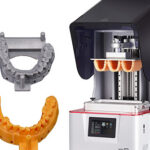
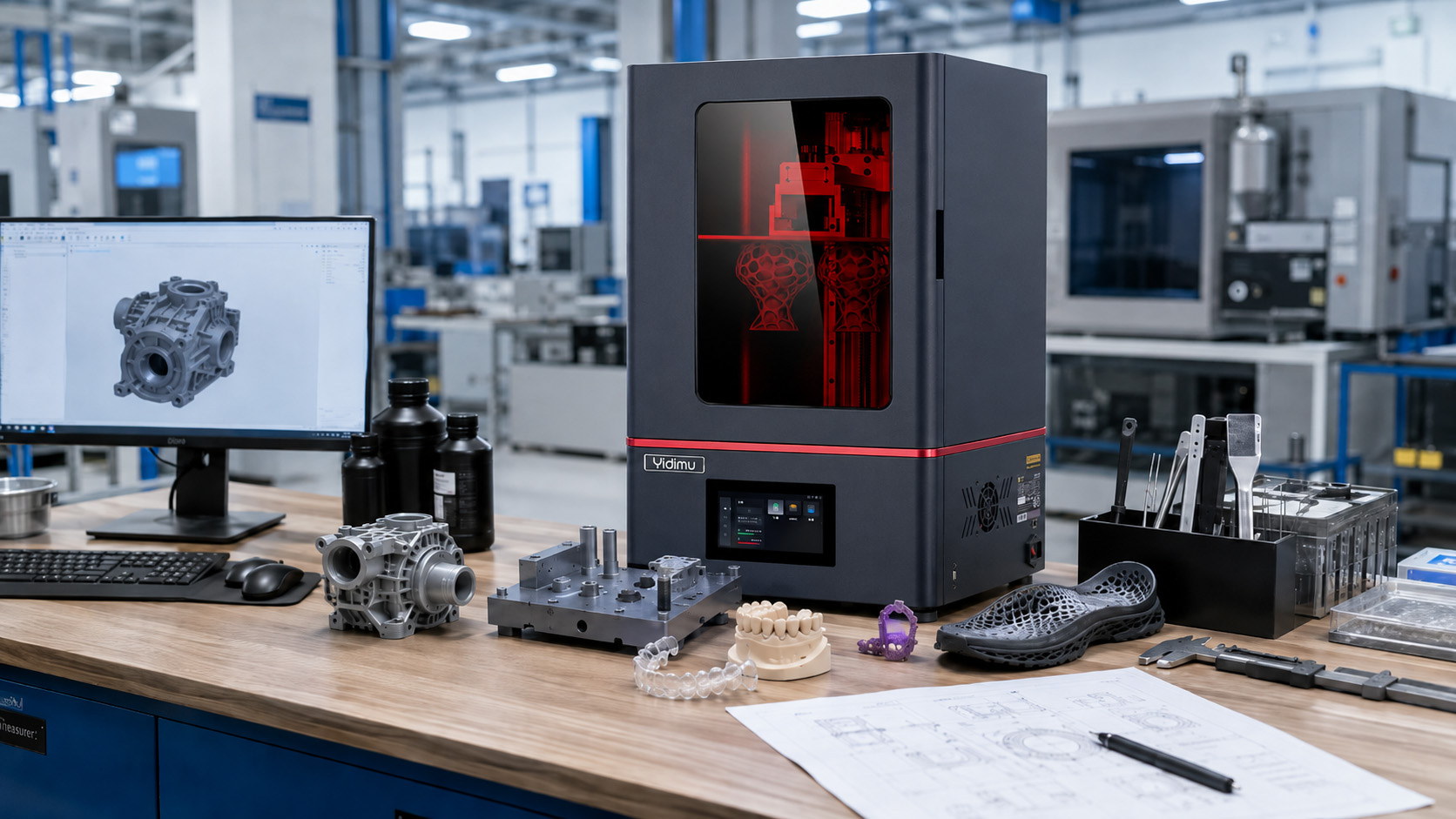
Build volume is one of the first specifications buyers check when comparing industrial resin 3D printers. A larger build area can help factories print bigger parts, arrange more models on a single platform, and reduce the need to split designs into multiple sections.
However, bigger is not automatically better. In resin 3D printing, a large build volume must be supported by stable mechanics, consistent light exposure, suitable resin, reliable slicing settings, and controlled post-processing. Without these elements working together, a large printer may increase resin waste, print failure risk, and operator workload.
For professional users, the real question is not simply “How large is the printer?” The more useful question is:
Can this printer produce the part size, surface quality, dimensional consistency, and material behavior required by my actual workflow?
That is why factories should evaluate build volume together with application requirements, part geometry, resin type, curing process, and production rhythm.
What Is a Large Resin 3D Printer?
A large resin 3D printer is a light-curing 3D printer with a build volume larger than typical desktop resin machines. It uses UV light to cure liquid photopolymer resin layer by layer. Depending on the printer design, the light source may use LCD, MSLA, SLA, DLP, or another vat photopolymerization approach.
For factory users, “large” generally means the printer can handle one or more of the following:
- Larger single-piece prototypes
- Multiple dental models in one batch
- Long shoe mold or footwear sample parts
- Industrial appearance models
- Engineering samples for fit and assembly review
- Product development parts that exceed desktop printer capacity
- Small-batch production layouts with higher platform utilization
A large resin 3D printer should be selected based on its workflow value, not machine size alone.
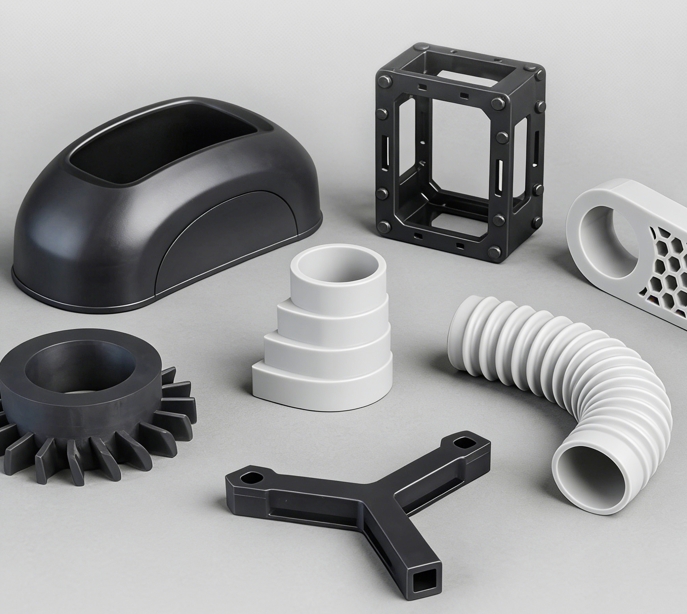
When Bigger Build Volume Actually Matters
A larger printer is useful when it solves a clear production problem. The following situations are common in factories, dental labs, and model-making workflows.
1. When the Part Is Too Large for a Desktop Resin Printer
If your current printer requires cutting models into sections, gluing them after printing, and manually finishing visible seams, a larger build volume may improve both quality and efficiency.
This applies to:
- Industrial appearance prototypes
- Product housings
- Shoe mold samples
- Large dental model batches
- Automotive or appliance model components
- Display models
- Engineering samples for assembly review
Printing a part in one piece can eliminate bonding marks, reduce dimensional mismatch, and cut finishing time.
2. When Batch Production Matters More Than Single-Part Size
A large build volume is not only for large parts. Many factories invest in large resin printers to print more small parts per job.
For example:
- A dental lab may print multiple model cases overnight.
- A product development team may print several design revisions in one batch.
- A model shop may arrange multiple client samples on one platform.
- A factory may print fixture samples, test parts, and appearance models together.
Batch printing can support better machine utilization, but users should confirm support placement, resin drainage, cleaning capacity, and curing space before committing to a layout.
3. When Part Splitting Creates Excess Labor
If a prototype must be divided into many pieces because the printer is too small, the team may spend considerable time on alignment, bonding, sanding, filling, and repainting. In some workflows, finishing time costs more than printing time.
A larger resin printer can reduce manual assembly steps, particularly for visual prototypes, presentation models, and product samples.
4. When the Factory Needs Faster Iteration
Large-format resin printing can accelerate design iteration when multiple versions need to be reviewed at the same time. Instead of printing one part, waiting, revising the file, and printing again, teams can arrange several versions in a single build.
This is useful for:
- Product design review
- Engineering validation
- Shoe sample development
- Dental model planning
- Packaging structure testing
- Industrial model comparison
5. When Outsourcing Large Resin Prints Is Slowing Projects Down
Many factories outsource large resin models because their in-house printer lacks the capacity. Outsourcing may work for occasional projects, but it can introduce delays when design changes are frequent.
Bringing large-format resin printing in-house may help when the team needs tighter control over timing, file confidentiality, material selection, and iteration speed.
When a Larger Printer May Not Be the Right Choice
A large resin printer is not always the right investment. In some cases, several medium-sized printers may offer better flexibility than a single large machine.
A larger printer may not be the best fit when:
- Most parts are small and produced in high volume.
- The team needs to run different resins simultaneously.
- Operators cannot manage larger resin vats and post-processing volumes.
- The workshop lacks space for washing, drying, and UV curing.
- The project requires material properties better suited to another printing process.
- The required accuracy depends more on calibration and workflow discipline than platform size.
- The budget covers only the printer itself, without accounting for cleaning, curing, resin storage, and operator training.
Before selecting a large printer, factories should compare machine size against actual part dimensions, print frequency, and total workflow capacity.
Practical Table
Large Resin 3D Printer Selection Table for Factory Users
| Evaluation Factor | Why It Matters | What Factory Buyers Should Check |
|---|---|---|
| Build volume | Determines maximum part size and batch capacity | Largest part dimensions, number of parts per batch, required orientation |
| XY resolution | Affects surface detail and fine feature reproduction | Pixel size, optical system, expected visible detail |
| Z-axis stability | Important for tall models and repeatability | Guide rail structure, platform stability, lifting motion, layer consistency |
| Light uniformity | Helps maintain consistent curing across a large platform | Exposure consistency, edge-to-center performance, calibration process |
| Resin compatibility | Determines application range and final part behavior | Dental model resin, engineering resin, flexible resin, casting resin, water-washable resin |
| Printing speed | Affects delivery time and production rhythm | Layer height, exposure settings, batch size, resin behavior |
| Post-processing capacity | Large prints require larger cleaning and curing setups | Wash containers, UV curing box size, drying area, operator handling |
| Software workflow | Impacts preparation time and print reliability | Slicing, support generation, hollowing, drainage, file repair |
| Material cost control | Large prints consume more resin | Resin volume estimate, failed print risk, support strategy, vat management |
| Maintenance | Larger systems require consistent routine care | Film replacement, vat cleaning, platform leveling, LCD/light source maintenance |
| Application support | Reduces selection risk | Sample printing, resin matching, technical guidance, workflow review |
Key Applications for Large Resin 3D Printers in Factories
Industrial Prototypes
Large resin 3D printers can support product housings, assembly models, design validation parts, and presentation prototypes. The primary value is surface detail and model realism. For many factory teams, resin printing is well suited to prototypes that require a smooth finish, fine detail, or a professional appearance before tooling begins.
Product Development Samples
Product design teams often go through several iterations before committing to mold making or production tooling. A large resin 3D printer can print multiple design options in one build, allowing engineers and designers to compare shape, fit, and ergonomics more efficiently.
Shoe Mold and Footwear Sample Development
Footwear development often involves curved surfaces, texture details, and repeated design revisions. A large resin printer can support shoe mold prototypes, sole samples, and design review parts, depending on the resin selected and part structure.
For flexible or elastic sample parts, customers should confirm resin flexibility, tear behavior, cleaning method, and curing process before production use.
Dental Models and Dental Lab Workflows
Dental labs and clinics may need to print multiple models per batch, particularly for study models, orthodontic models, or workflow preparation. A larger build area can improve daily throughput when the lab handles consistent case volume.
Dental users should note that not all dental resin applications are equivalent. Dental model resin differs from surgical guide resin, temporary dental resin, and other clinical materials in both formulation and workflow requirements. Customers should confirm resin indication, post-curing process, and local regulatory requirements before clinical or intraoral use.
Model-Making and Display Models
Model-making companies often require smooth surfaces, sharp details, and large visual models. Large resin printers may support architectural models, industrial models, display samples, and exhibition parts where appearance quality is the primary criterion.
Small-Batch Trial Production
For small-batch production trials, a large resin printer can support repeated part batches before tooling decisions are made. This may help teams evaluate shape, assembly, ergonomics, and market fit. That said, resin-printed parts should not automatically be treated as production-ready. Material properties, aging behavior, heat resistance, mechanical loading, and post-curing performance should all be reviewed before any end-use commitment.
Large Build Volume vs. Accuracy: What Buyers Should Understand
A common misconception is that a larger machine automatically produces better parts. Build volume and accuracy are related, but they are not the same thing.
A large printer must maintain consistency across the entire platform. Buyers should ask about:
- Light uniformity across the full build area
- Z-axis motion stability
- Platform leveling method
- Resin behavior during long print jobs
- Exposure settings for the selected resin
- Support strategy for large or heavy models
- Shrinkage and deformation after curing
- Cleaning and drying process
- UV curing uniformity for large parts
Accuracy in resin printing depends on the complete workflow. Printer mechanics, resin formulation, slicing parameters, part orientation, support design, washing, and post-curing all contribute to the final result.
For factories, sample testing with real project files is generally more informative than evaluating specification sheets alone.
Workflow
Step-by-Step Workflow for Evaluating a Large Resin 3D Printer
Step 1: Define the Real Application
Start with the parts you actually need to print—not with machine size.
Prepare:
- Main application
- Largest model size
- Typical model size
- Required surface finish
- Required detail level
- Expected printing frequency
- Resin type or material requirement
- Whether the part is intended for visual review, fit testing, dental use, or functional testing
Step 2: Check Whether the Part Must Be Printed in One Piece
Determine whether printing in one piece will improve the final result. If splitting the model causes visible seams, alignment errors, or extra finishing work, larger build volume may be worthwhile.
If the part can be split without affecting function or appearance, a smaller machine may still be a practical option.
Step 3: Review Batch Layout Requirements
For batch production, estimate how many parts need to fit on the platform at once. Consider spacing, supports, resin drainage, and cleaning access. Avoid filling the platform too aggressively if it increases failure risk.
Step 4: Match Resin to Application
Choose resin based on the final purpose, not price alone.
Common resin considerations:
- Surface finish
- Detail reproduction
- Flexibility
- Toughness
- Heat resistance
- Castability
- Water-washable cleaning
- Dental model indication
- Curing requirements
- Storage and handling conditions
For dental or regulated applications, confirm the resin’s intended use, supplier documentation, and local requirements before clinical or intraoral use.
Step 5: Confirm Post-Processing Capacity
Large prints require a practical post-processing setup. Verify that your team has sufficient space and equipment for:
- Resin draining
- Part removal
- Washing
- Drying
- Support removal
- UV curing
- Final inspection
- Waste handling
- Operator protection
A large printer without adequate post-processing capacity will create bottlenecks rather than solve them.
Step 6: Test With Real Files
Before purchasing equipment for a factory workflow, test with real parts whenever possible. A generic sample print may look good but fail to represent your actual model geometry, wall thickness, support needs, or resin requirement.
Step 7: Review Total Workflow Cost
Evaluate the complete workflow, not the printer price alone. Factor in resin, vats, release film, cleaning supplies, UV curing equipment, PPE, failed print risk, operator time, and maintenance.
Buyer Checklist Before Requesting a Quotation
Use this checklist before contacting Yidimu or comparing printer options:
- What is the maximum model size you need to print?
- What is the typical batch quantity?
- What application will the parts be used for?
- Do the parts require fine detail, smooth surface, or functional strength?
- Which resin type do you expect to use?
- Do you need dental model, flexible, engineering, casting, or water-washable resin?
- What layer height and surface finish do you expect?
- Do you need a matching UV curing box?
- How much space is available for printing and post-processing?
- Will one large printer or several smaller printers suit the workflow better?
- Do operators have resin handling and cleaning experience?
- Can you provide STL, OBJ, STEP files, or sample images for review?
How to Choose Between One Large Printer and Multiple Smaller Printers
Factories often weigh one large resin printer against several smaller machines. The better choice depends on how production is structured.
Choose one larger printer when:
- Large single-piece models are common.
- Batch printing is predictable and consistent.
- One resin type covers most jobs.
- The team prefers fewer machines to maintain.
- Large prototypes are frequently outsourced.
- Post-processing equipment can handle large parts.
Choose multiple smaller printers when:
- Different resins must run simultaneously.
- Small parts dominate daily production.
- Parallel printing adds more value than maximum size.
- Redundancy matters—if one machine is under maintenance, others can continue.
- Operators need flexible scheduling across departments.
Many professional users eventually adopt both: one large machine for oversized models and batch jobs, alongside smaller machines for quick tests and specialized resin workflows.
Resin Considerations for Large-Format Printing
Larger resin prints introduce material challenges that are less common with small desktop models. Greater resin volume, longer print times, and larger surface areas all affect how resin behaves during and after printing.
Viscosity
Higher-viscosity resins may require more careful settings, particularly for large cross-sections or dense batch layouts.
Shrinkage
All photopolymer resins can exhibit some dimensional change during printing and post-curing. This effect tends to be more noticeable on large parts and should be factored into design tolerances.
Flexibility and Toughness
If a part needs to flex, absorb impact, or withstand handling, confirm whether a flexible or engineering resin is more appropriate than a standard model resin.
Dental Indication
For dental use, different resins serve different purposes. Dental model resin, surgical guide resin, denture resin, and temporary dental resin each have distinct intended uses and workflow requirements. Do not assume that one resin can cover all dental applications.
Cleaning Method
Large parts can trap uncured resin in holes, channels, and internal cavities. Hollow models should include suitable drainage openings and cleaning access points.
UV Curing
Large prints require thorough, consistent post-curing. Uneven curing can affect surface feel, mechanical strength, dimensional stability, and overall part performance.
Post-Processing Requirements for Large Resin Prints
Large resin printing does not end when the printer finishes. Post-processing is a significant part of the workflow and should be planned accordingly.
A professional post-processing sequence typically includes:
- Allowing resin to drain from the part.
- Removing the model carefully from the build platform.
- Washing the part according to the resin manufacturer’s instructions.
- Drying the model completely before UV curing.
- Removing supports at the appropriate stage.
- UV curing with suitable wavelength, time, and part orientation.
- Inspecting dimensions, surface quality, and fit.
- Disposing of resin waste, wash liquid, and cleaning materials responsibly.
For large parts, handling weight and preventing deformation are practical concerns. Operators should take care not to bend thin structures during removal and cleaning.
Common Mistakes to Avoid
Mistake 1: Choosing the Largest Printer Without Checking Workflow
A large printer may look appealing, but the workshop also needs adequate washing, drying, curing, and inspection capacity. If post-processing is insufficient, the printer will not resolve the actual bottleneck.
Mistake 2: Comparing Only Build Volume
Build volume matters, but buyers should also compare light uniformity, Z-axis stability, resin compatibility, software workflow, and technical support before making a decision.
Mistake 3: Ignoring Resin Drainage on Large Hollow Parts
Large hollow models can trap uncured resin. Poor drainage leads to messy handling, curing problems, or part failure. Hollow models should be designed with appropriate wall thickness and drainage holes.
Mistake 4: Filling the Entire Platform Too Aggressively
Batch printing is efficient, but overcrowding the platform makes supports harder to manage and increases failure risk. Leave adequate spacing for resin flow, support structure, and safe part removal.
Mistake 5: Treating All Dental Applications as Equivalent
Dental model printing and intraoral dental applications are not interchangeable. Customers should confirm resin indication, post-curing process, and local regulatory requirements before clinical or intraoral use.
Mistake 6: Underestimating the Cost of Failed Large Prints
A failed large resin print wastes significantly more resin, time, and cleaning effort than a failed small print. Factories should build a test process before committing to full-size production runs.
Mistake 7: Assuming Resin Parts Can Directly Replace Molded Parts
Resin 3D printing can support prototypes, samples, models, and certain production trials, but it does not automatically replace injection molding, machining, or final production materials. The right approach depends on part function, load requirements, heat and chemical exposure, quantity, and end-use conditions.
Where Yidimu Fits in the Factory Workflow
Yidimu provides industrial resin 3D printers, dental 3D printers, flexible resin 3D printers, UV curing boxes, 3D printing resins, and workflow support for professional users.
For customers evaluating a large resin 3D printer, Yidimu can help review:
- Model size and geometry
- Application type
- Resin requirements
- Expected surface finish
- Batch quantity
- Accuracy expectations
- Dental or industrial workflow
- UV curing requirements
- Sample printing needs
- Operator and post-processing setup
The goal is not simply to match a printer to a build volume specification. The goal is to match the printer, resin, and post-processing workflow to the customer’s actual production process.
Conclusion
A large resin 3D printer is valuable when greater build volume solves a real workflow problem—printing larger models in one piece, producing more parts per batch, reducing assembly labor, accelerating product development, or bringing outsourced sample printing in-house.
For factories, dental labs, model-making companies, and R&D teams, the right choice depends on more than size. Buyers should also evaluate accuracy expectations, resin compatibility, light uniformity, Z-axis stability, cleaning process, UV curing capacity, and operator workflow.
Yidimu can help professional users identify suitable resin 3D printing equipment, materials, and post-processing options based on actual project needs. To discuss the right setup, contact Yidimu with your model size, resin requirement, application, expected workflow, and any available 3D file, drawing, or sample image.
FAQ
What is the main benefit of a large resin 3D printer for factories?
The main benefit is the ability to print larger parts, or more small parts, in a single build. This can reduce model splitting, assembly work, outsourcing delays, and repeated setup time.
Is a large resin 3D printer more accurate than a small one?
Not automatically. Accuracy depends on the printer structure, light system, resin, exposure settings, part orientation, support design, cleaning, and UV curing process. A larger printer should be evaluated for consistency across the entire build area, not just peak specification.
What applications are suitable for large resin 3D printing?
Large resin 3D printing may support industrial prototypes, product design samples, dental models, shoe mold samples, display models, engineering fit-check parts, and small-batch production trials, depending on resin type and workflow.
Can factories use large resin printers for final production parts?
In some cases, resin printing can support small-batch or end-use trial parts, but this depends on material properties, part design, mechanical load, heat exposure, chemical exposure, and post-curing. Customers should test real parts thoroughly before committing to final production use.
Is large resin 3D printing suitable for dental labs?
Yes, it can support dental model batch printing and other dental-related workflows when the printer, resin, and curing process are appropriate. Customers should confirm resin indication, post-curing process, and local regulatory requirements before clinical or intraoral use.
Should I choose one large printer or several smaller printers?
Choose one large printer if you regularly print oversized parts or large batches using similar resin. Choose several smaller printers if you need parallel printing, multiple resin types, or flexible scheduling for smaller parts.
What should I prepare before asking Yidimu for a printer recommendation?
Prepare your maximum model size, typical batch quantity, application, resin requirement, surface finish expectation, accuracy requirement, post-processing setup, and any available 3D file or sample image.
Optional References
- ISO/ASTM 52900: Additive manufacturing fundamentals and vocabulary
- U.S. FDA: Technical Considerations for Additive Manufactured Medical Devices
- NIOSH: Safe 3D Printing guidance and workplace safety considerations
- Yidimu product and technical pages for industrial resin 3D printers, dental 3D printers, resins, UV curing, and workflow support