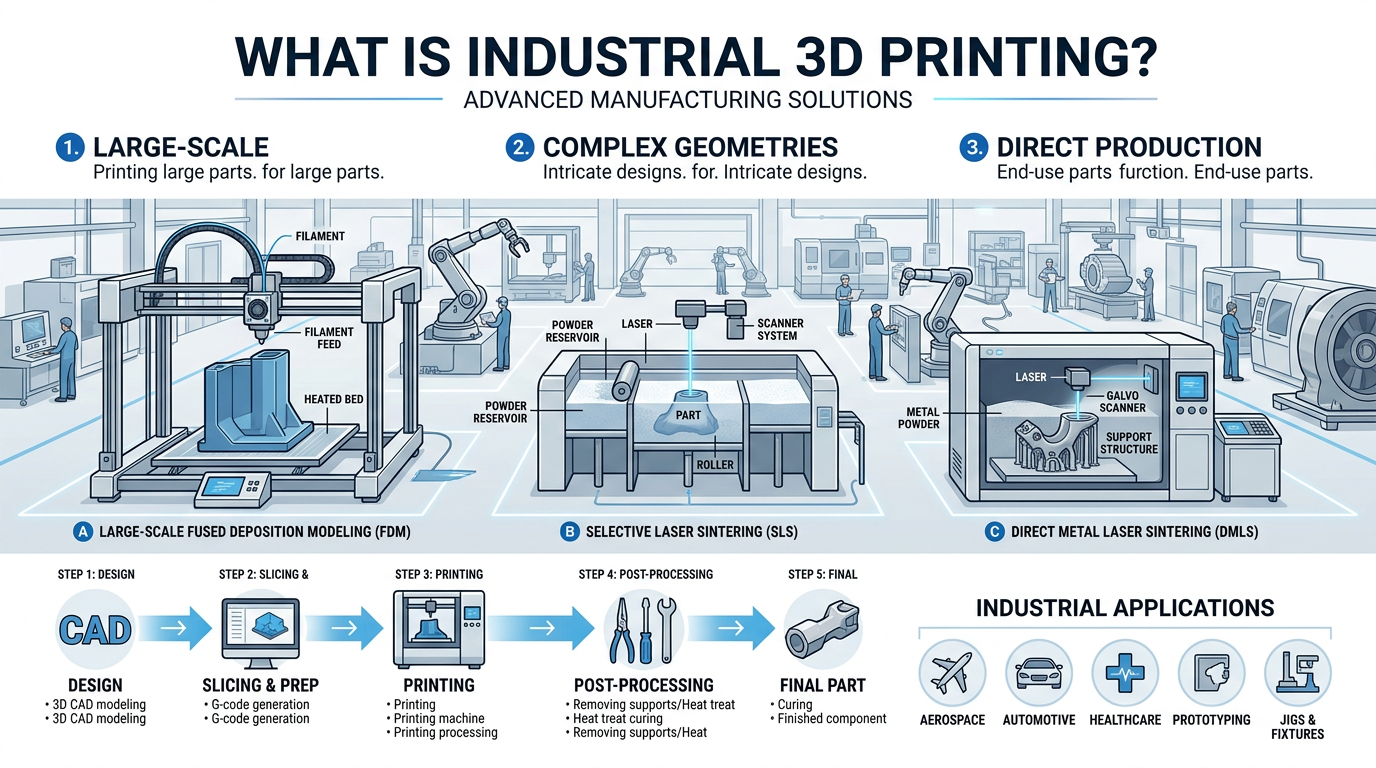
Industrial 3D printing is the use of additive manufacturing equipment, materials and controlled workflows to produce prototypes, functional samples, models, tooling aids or small-batch parts for professional applications. Instead of removing material from a block, industrial 3D printing builds parts layer by layer from a digital file. In practical terms, it helps factories, dental labs, engineering teams and model-making companies shorten development cycles, test designs before tooling, produce complex geometries and prepare application-specific parts depending on the printer, resin, material properties and post-processing workflow. This definition follows the broader additive manufacturing principle described by NIST and ISO/ASTM terminology.
Industrial 3D Printing Is More Than a Bigger Desktop Printer
Many people hear “industrial 3D printing” and think it simply means a larger machine. Build size matters, but it is only one part of the answer.
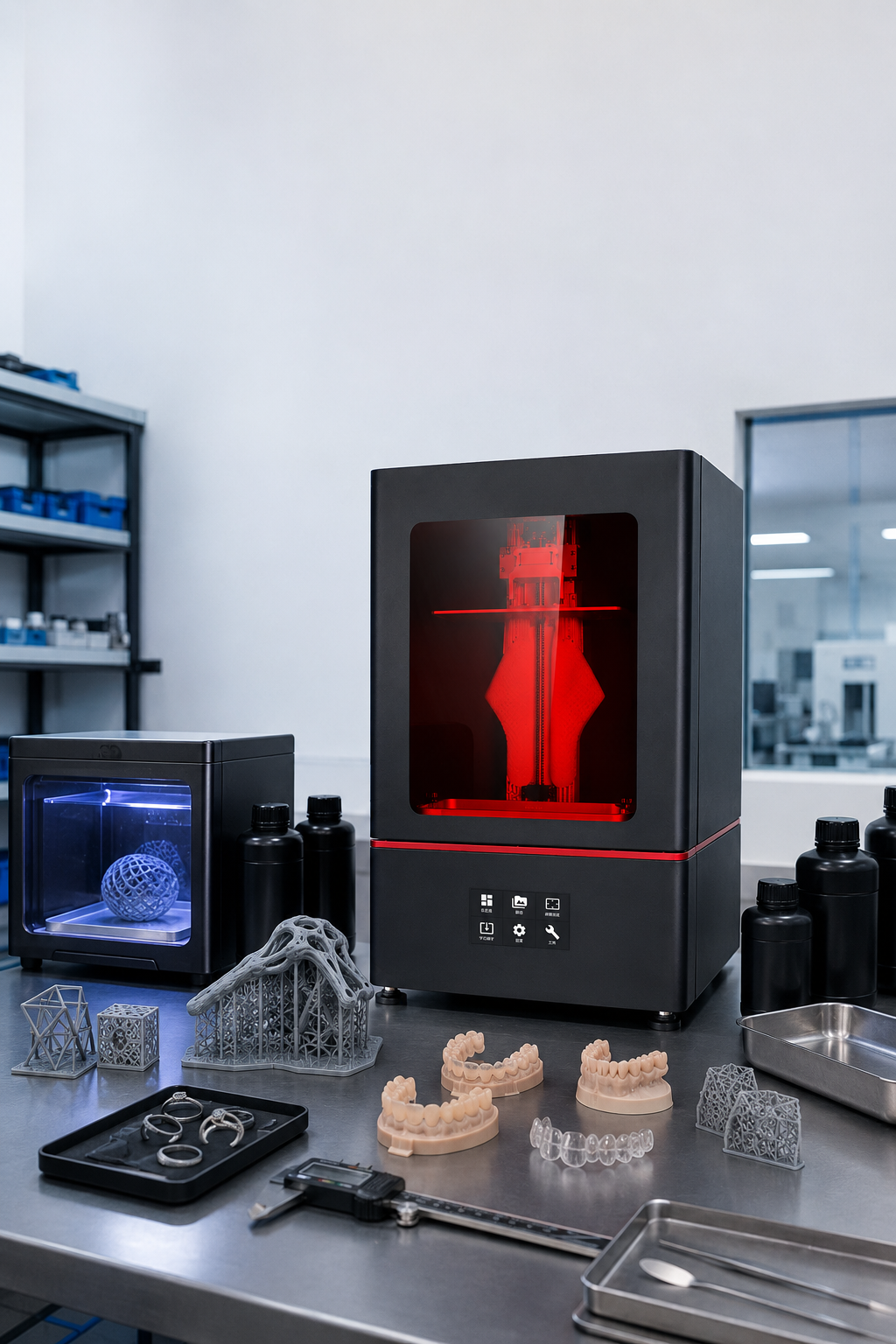
In professional use, industrial 3D printing usually means:
- A printer selected for a specific application, not general hobby use.
- Materials matched to the required surface, strength, flexibility, heat resistance or dental workflow.
- Repeatable file preparation, support strategy, cleaning, curing and inspection.
- Stable output for multiple operators, repeated jobs or production planning.
- Technical support for resin selection, parameter adjustment and workflow troubleshooting.
For Yidimu customers, industrial 3D printing often refers to professional resin 3D printing used for factory samples, engineering models, dental models, flexible prototypes, shoe-related samples, jewelry casting patterns and model production. You can review Yidimu’s professional printer options on the Yidimu resin 3D printer product page.
How Industrial 3D Printing Works
Industrial 3D printing starts with a digital 3D model. The model is prepared in slicing software, divided into layers, printed on a machine and then finished through post-processing.
The basic process is:
- Create or receive a 3D model file, usually from CAD, dental scanning software or 3D design software.
- Check the model for wall thickness, orientation, drainage, support areas and printability.
- Slice the file into layers according to printer, resin and accuracy requirements.
- Print the part using a suitable 3D printing technology.
- Clean the printed part to remove uncured resin, powder, support material or residue.
- Post-cure, heat treat or finish the part if required by the material workflow.
- Inspect size, surface quality, fit, strength and application suitability.
For resin-based systems, the cleaning and UV post-curing steps are especially important. A printed resin part is not complete when it leaves the build platform. Its final performance depends on resin type, exposure settings, washing method, post-curing time, part thickness and intended application.
Yidimu provides resin printers, materials and post-processing workflow support for professional users who need the full process, not just the machine. For workflow-related support, see Yidimu service and technical support.
Main Types of Industrial 3D Printing Technologies
Industrial 3D printing includes several process families. ISO/ASTM terminology classifies additive manufacturing into process categories such as vat photopolymerization, material extrusion, powder bed fusion, binder jetting, material jetting, directed energy deposition and sheet lamination.
For professional buyers, the practical question is not “Which technology is the most advanced?” The better question is: “Which process fits my part size, material, accuracy, surface finish, production volume and post-processing conditions?”
Vat Photopolymerization and Resin 3D Printing
Vat photopolymerization uses light to cure liquid photopolymer resin layer by layer. Resin 3D printing is widely used when buyers need fine details, smooth surfaces and complex geometries.
It can support applications such as:
- Dental models and dental workflow support
- Engineering prototypes
- Industrial model making
- Jewelry casting models
- Product appearance samples
- Flexible prototypes, depending on resin and printer compatibility
- Small-batch trial parts
For larger industrial resin models, Yidimu offers the Eternal M2 industrial resin 3D printer, designed for prototypes, factory samples, engineering models and professional model production.
Material Extrusion
Material extrusion builds parts by depositing melted thermoplastic filament. It is common for early prototyping, fixtures and simple functional parts. It may be suitable when cost and basic mechanical use matter more than fine surface detail. However, for applications requiring smoother surfaces, small features or detailed model output, resin printing may be more appropriate.
Powder Bed Fusion and Metal 3D Printing
Powder bed fusion is often used for metal and polymer powder applications. It may support complex industrial parts, lightweight structures and high-performance components, but it typically requires more demanding powder handling, safety management, equipment investment and post-processing.
Material Jetting and Binder Jetting
Material jetting deposits material droplets, while binder jetting uses a bonding agent to bind powder. These technologies may be used in specific industrial environments, depending on part requirements, materials and finishing needs.
What Is Industrial Resin 3D Printing?
Industrial resin 3D printing is a professional 3D printing workflow that uses light-curing resin to produce detailed parts, models or samples for industrial, dental, engineering and production-support applications.
Compared with many general-purpose 3D printing methods, resin printing is often selected when users need:
- Fine surface detail
- Clear model edges
- Smooth appearance
- Small features
- Complex geometry
- Dental model detail
- Casting patterns
- High visual quality for customer review
- Flexible resin applications, depending on resin type
Resin selection is critical. A rigid model resin, castable resin, dental model resin and flexible elastomer resin are not interchangeable. Buyers should confirm resin wavelength compatibility, mechanical properties, cleaning method, post-curing requirements and application suitability before using a material in a real workflow.
For material-related learning, see Yidimu’s 3D printing materials and resin guides.
Practical Table: Industrial 3D Printing Applications by User Type
| User Type | Common Application | Why Industrial 3D Printing Helps | What to Check Before Buying |
|---|---|---|---|
| Factory product team | Appearance prototypes, assembly samples, product design review | Shortens the time between design change and physical sample | Build volume, surface finish, resin type, repeatability, post-processing |
| Engineering team | Functional prototypes, fit checks, structural mockups | Helps test geometry before tooling or machining | Material properties, tolerances, part orientation, support marks |
| Dental lab | Dental models, orthodontic models, workflow review models | Supports digital dental production and repeatable model output | Dental resin indication, accuracy, curing process, regulatory requirements |
| Dental clinic | Chairside model review, case communication, selected dental workflows | Can support faster internal workflow depending on indication and process | Resin approval, workflow validation, operator training, local rules |
| Model-making company | High-detail display models, industrial models, architectural-style parts | Produces smooth surfaces and complex details | Model size, finishing method, batch consistency, resin cost |
| Footwear or soft product team | Flexible prototypes, lattice structures, shoe sample parts | Helps test shape, texture, fit and flexibility before mold preparation | Flexible resin hardness, rebound behavior, print orientation, curing workflow |
| Jewelry workshop | Castable patterns, design verification | Supports detailed pattern production before casting | Burnout behavior, resin compatibility, detail resolution, casting process |
| Research center | Experimental parts, test models, custom fixtures | Allows rapid iteration and controlled small-batch testing | Material documentation, repeatability, safety procedures, data recording |
Key Benefits of Industrial 3D Printing
Faster Product Development
Industrial 3D printing can reduce the time needed to move from a digital file to a physical sample. This is especially valuable before mold making, CNC machining or supplier approval.
A factory team may use resin 3D printing to check:
- Overall shape
- Assembly fit
- Surface texture
- Ergonomics
- Part size
- Customer approval samples
- Internal design changes
This does not mean every printed part replaces a final production part. In many cases, the value is faster design verification before committing to more expensive production steps.
Complex Geometry and Design Freedom
Industrial 3D printing can produce shapes that may be difficult or costly with traditional manufacturing. Examples include lattice structures, internal channels, hollow models, organic forms and complex dental or engineering geometries.
However, design freedom still has limits. Wall thickness, support placement, resin drainage, curing depth, shrinkage and part orientation all affect results.
Lower Tooling Dependency in Early Development
For early prototypes and small-batch samples, industrial 3D printing can reduce dependence on molds. This can be useful for factories testing new product concepts, footwear teams developing shoe structures or dental labs producing model batches.
For flexible part development, the Yidimu Flex G2 flexible resin 3D printer can support elastomer parts, shoe samples, soft prototypes and flexible material workflows, depending on resin and process requirements.
Professional Workflow Control
Industrial users usually need more than one successful print. They need repeatability. That means the workflow must be controlled:
- Consistent file preparation
- Stable resin storage and handling
- Correct exposure settings
- Suitable support structures
- Controlled washing
- Proper UV curing
- Final inspection
- Documentation for repeated jobs
This is why industrial 3D printing should be evaluated as a full process, not as a machine-only purchase.
Industrial 3D Printing for Dental Applications
Dental 3D printing is one of the most common professional applications of resin 3D printing. It can support dental models, orthodontic models, surgical guide workflow review models, temporary dental applications and lab production support depending on printer, resin, indication and process validation.
Dental buyers should avoid choosing equipment only by resolution numbers. A practical dental workflow should evaluate:
- Accuracy and repeatability
- Dental model size
- Resin indication
- Washing and UV curing process
- Software compatibility
- Operator training
- Production volume
- Local regulatory requirements
- Final inspection method
Yidimu provides dental 3D printing solutions for clinics, laboratories and professional dental production users. For printer selection, buyers can also review the Yidimu Eternal Y8 dental 3D printer and Yidimu Eternal D1 dental 3D printer.
Customers should confirm resin indication, post-curing process and local regulatory requirements before clinical or intraoral use. FDA guidance on additive manufactured medical devices also emphasizes technical considerations, testing and characterization for medical device workflows.
Industrial 3D Printing Selection Checklist
Before buying an industrial 3D printer, professional users should define the workflow first.
1. Define the Main Application
Choose one primary use case first:
- Factory sample making
- Engineering prototyping
- Dental model printing
- Flexible resin printing
- Jewelry casting patterns
- Model production
- Research testing
- Small-batch trial production
A printer that is good for dental models may not be the best choice for large industrial prototypes. A flexible resin printer may not be the right machine for rigid high-detail dental workflows.
2. Confirm the Required Build Volume
Measure the largest part you need to print. Also consider whether you need to print one large model or multiple smaller models in one batch.
Check:
- Maximum part length
- Maximum part height
- Batch layout
- Platform utilization
- Support space
- Drainage angle
- Post-processing space
For large resin prototypes and factory samples, the Eternal M2 industrial resin 3D printer may be more suitable than a compact dental-focused system.
3. Match the Resin to the Application
Material selection affects nearly every result.
Ask:
- Does the resin match the printer wavelength?
- Is the resin rigid, flexible, castable or dental-focused?
- What cleaning method is required?
- What UV curing process is required?
- What mechanical behavior is needed?
- Is the part for visual review, fit checking or functional testing?
- Does the workflow require regulatory confirmation?
For dental model materials, buyers can review examples such as Yidimu H02 dental model resin or Yidimu X01 water washable dental model resin, depending on workflow requirements.
4. Evaluate Accuracy as a Workflow Result
Accuracy is not only a printer specification. It depends on:
- Machine stability
- Screen or light engine performance
- Resin shrinkage
- Slicing settings
- Part orientation
- Support design
- Washing process
- UV curing process
- Inspection method
For dental and engineering users, the repeatability of the full workflow is often more important than one impressive sample.
5. Check Post-Processing Capacity
Industrial resin printing requires cleaning and curing capacity that matches print volume. If a printer can produce many parts but the washing and curing system is too small, the workflow becomes slow.
Check:
- Cleaning container size
- UV curing chamber size
- Curing wavelength and power
- Part rotation or exposure uniformity
- Safety procedures
- Waste resin and cleaning liquid handling
- Operator protection
NIOSH notes that additive manufacturing can involve exposure concerns such as volatile organic compounds, dermal exposure to materials, combustible substances and mechanical or ergonomic risks, depending on material and process. Professional users should manage ventilation, material handling and operator protection accordingly.
Step-by-Step Industrial Resin 3D Printing Workflow
Use this workflow for factory samples, dental models, engineering prototypes and professional resin printing jobs.
Step 1: Review the Application
Define whether the part is for visual review, assembly testing, dental model production, flexible performance review, casting or research use.
Step 2: Check the 3D File
Inspect the file for wall thickness, non-manifold geometry, unsupported areas, hollow sections, sharp details and scale.
Step 3: Choose the Printer and Resin
Match printer size, resolution, wavelength and material compatibility to the part. Do not assume one resin can cover every application.
Step 4: Prepare Orientation and Supports
Orient the model to reduce failure risk, improve surface quality and control support marks. For hollow resin parts, consider drainage and trapped resin.
Step 5: Slice With Suitable Parameters
Use layer thickness, exposure settings and lift parameters suitable for the resin, part size and printer.
Step 6: Print and Monitor the Job
Check resin level, platform condition, temperature range and print stability. For repeated jobs, record settings.
Step 7: Wash the Part
Remove uncured resin according to the resin workflow. Avoid under-washing or over-washing, because both may affect surface quality.
Step 8: Remove Supports Carefully
Support removal should protect critical surfaces, edges and fitting areas.
Step 9: UV Post-Cure
Cure the part according to resin requirements. Post-curing can affect final hardness, stability, biocompatibility-related workflow requirements and mechanical behavior, depending on resin type.
Step 10: Inspect and Record
Check dimensions, surface quality, fit, deformation, cracks and curing result. For production workflows, record file version, resin batch, print settings and post-processing conditions.
Common Mistakes to Avoid
Mistake 1: Choosing by Resolution Only
High resolution does not automatically mean the best industrial result. Build volume, resin compatibility, machine stability, post-processing and operator workflow also matter.
Mistake 2: Treating Resin Parts as Finished Immediately After Printing
Resin parts usually need washing and UV post-curing. Skipping these steps may cause tacky surfaces, weak parts, dimensional changes or unsuitable final performance.
Mistake 3: Using the Wrong Resin for the Application
A dental model resin, flexible resin, castable resin and engineering resin serve different purposes. Buyers should confirm material properties and workflow requirements before use.
Mistake 4: Ignoring Support Marks
Support marks can affect visible surfaces, fitting areas and final appearance. Professional users should plan orientation and support placement before printing.
Mistake 5: Underestimating Post-Processing Space
Large print capacity requires matching cleaning, curing and inspection capacity. Otherwise, the printer may be fast but the full workflow remains slow.
Mistake 6: Assuming Industrial 3D Printing Replaces Every Manufacturing Method
Industrial 3D printing is powerful for prototyping, customization, complex geometry and small-batch workflows. It does not replace injection molding, CNC machining or casting in every situation.
Mistake 7: Forgetting Safety Procedures
Liquid resins, powders, solvents and printed parts may require ventilation, gloves, eye protection, waste handling and operator training depending on the material and process. Safety should be part of the buying decision, not an afterthought.
How to Decide Whether Industrial 3D Printing Is Right for Your Company
Industrial 3D printing may be a good fit if your team frequently needs:
- Fast prototypes before tooling
- High-detail resin models
- Dental model workflows
- Customer approval samples
- Small-batch trial parts
- Complex geometry
- Flexible sample testing
- Model production
- Product design iteration
- Reduced mold dependency in early development
It may not be the first choice if your main requirement is extremely high-volume production of simple parts at the lowest unit cost. In that case, traditional manufacturing may still be more efficient after the design is finalized.
The practical approach is to compare total workflow cost, not just printer cost. Consider design time, sample lead time, mold cost, failed iterations, material cost, labor, post-processing and inspection.
What Information Should You Send Before Asking for a Printer Recommendation?
To recommend the right industrial 3D printing solution, a supplier needs real application details.
Prepare the following:
- Part size or model dimensions
- Intended application
- Required resin type
- Surface detail requirement
- Accuracy or fit requirement
- Flexible or rigid material requirement
- Expected daily or weekly print volume
- Need for dental workflow support
- Need for UV curing equipment
- File type and software workflow
- Photos or CAD screenshots if available
- Current problem with existing production method
For industrial users, Yidimu can review these details and help match the printer, resin and post-processing workflow. For factory applications, start with industrial resin 3D printer applications or contact Yidimu with your real model requirements.
Conclusion: What Is Industrial 3D Printing?
Industrial 3D printing is a professional additive manufacturing workflow used to turn digital designs into physical parts, prototypes, models or production-support tools. For factories, dental labs, clinics, model-making companies and product development teams, it can support faster design review, detailed resin model production, flexible sample development, dental workflows and small-batch trial production depending on the printer, resin and post-processing process.
The best industrial 3D printing solution is not chosen by one specification. Buyers should review application, build volume, resin requirement, accuracy expectations, post-processing capacity, safety procedures and long-term workflow support.
If you are evaluating industrial resin 3D printing for your company, contact Yidimu with your model size, resin requirement, application and expected workflow. Yidimu can help review suitable printer options, resin choices and UV curing workflows for your professional printing needs.
FAQ
What is industrial 3D printing in simple terms?
Industrial 3D printing means using professional additive manufacturing equipment and controlled workflows to produce prototypes, models, samples, tools or small-batch parts for real business, factory, dental or engineering applications.
How is industrial 3D printing different from normal 3D printing?
The main difference is workflow requirement. Industrial 3D printing usually focuses on repeatability, material selection, application fit, post-processing, safety, inspection and production efficiency. Hobby printing is often more focused on personal projects and general experimentation.
Is resin 3D printing used in industrial applications?
Yes. Resin 3D printing can support industrial prototypes, factory samples, dental models, jewelry casting patterns, flexible sample development and high-detail model making depending on printer size, resin type and post-processing workflow.
What industries use industrial 3D printing?
Industrial 3D printing is used by factories, product development teams, dental laboratories, dental clinics, model-making companies, research centers, jewelry workshops, footwear development teams and engineering departments.
Can industrial 3D printing replace injection molding?
It can reduce the need for molds during early design, prototyping and small-batch sample production. However, for very high-volume production of simple parts, injection molding may still be more efficient after the design is finalized.
What materials are used in industrial 3D printing?
Materials may include photopolymer resins, flexible resins, castable resins, engineering polymers, thermoplastics, metal powders and other specialized materials depending on the printing technology. For Yidimu users, 405 nm UV-curable resin materials are especially relevant.
What should factories check before buying an industrial 3D printer?
Factories should check part size, build volume, material compatibility, surface detail, accuracy requirements, production volume, post-processing equipment, operator training, maintenance needs and supplier support.
Is industrial 3D printing suitable for dental clinics and labs?
It can support dental models and selected dental workflows depending on printer, resin, indication, curing process and local requirements. Customers should confirm resin indication, post-curing process and local regulatory requirements before clinical or intraoral use.
Why is post-curing important in resin 3D printing?
Post-curing helps the printed resin part reach its intended final properties depending on the resin. Without proper curing, a part may have tacky surfaces, reduced strength, dimensional instability or unsuitable performance.
What information should I provide to Yidimu for printer selection?
Send your model size, application, resin requirement, expected workflow, production volume, accuracy needs and sample photos or files if available. This helps Yidimu recommend a suitable printer, resin and post-processing solution.