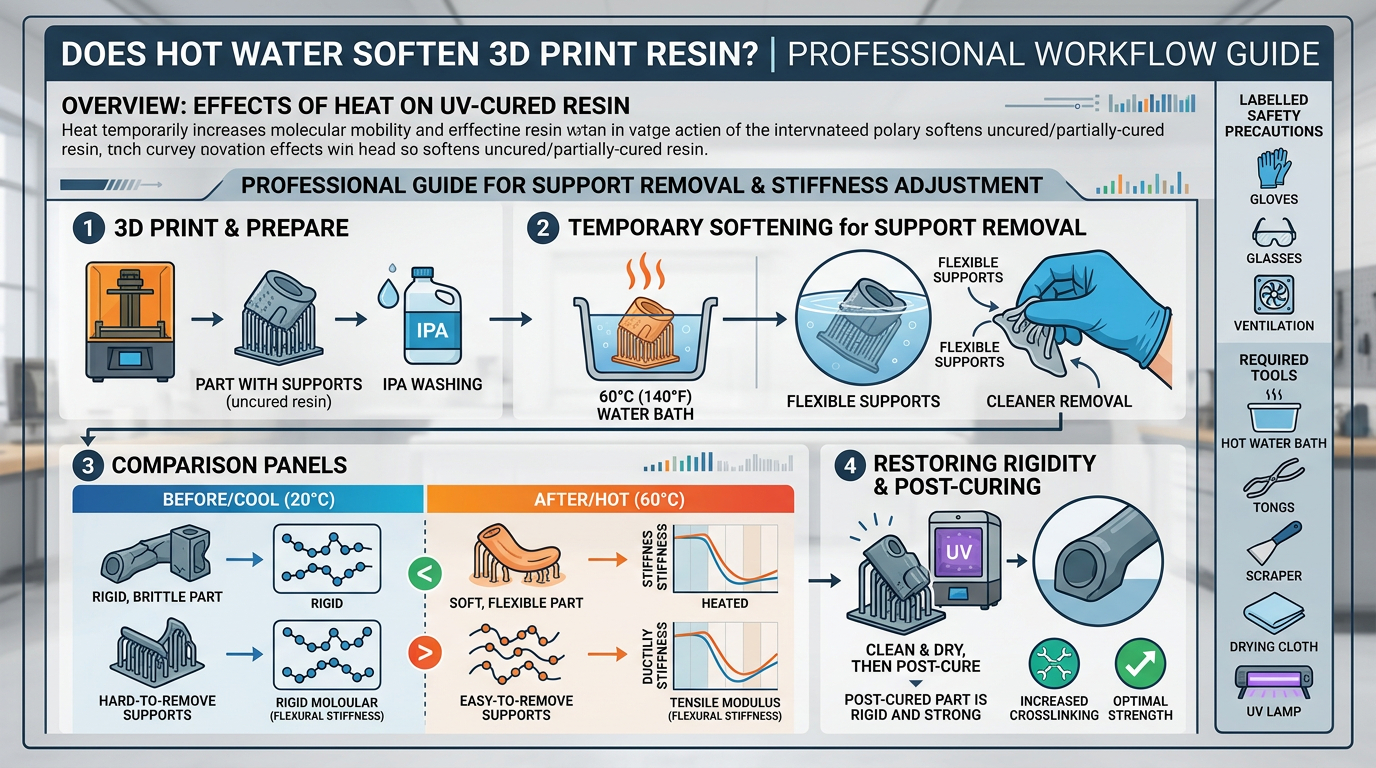
Yes, hot water may soften some 3D print resin parts, but the result depends on the resin formulation, curing condition, water temperature, exposure time, part thickness, and load on the part. Fully cured photopolymer resin is not like a thermoplastic that can be repeatedly melted and reshaped in a controlled way. However, when hot water approaches the resin’s heat resistance limit, the printed part may become more flexible, easier to deform, or more likely to warp.
For factories, dental labs, and professional model workshops, hot water should not be used as a casual reshaping method unless the resin supplier’s workflow allows it. Use controlled washing, drying, UV post-curing, and inspection instead. Heat deflection temperature is commonly used to evaluate when plastics begin to deform under load, and ISO 75 describes temperature deflection testing under three-point loading.
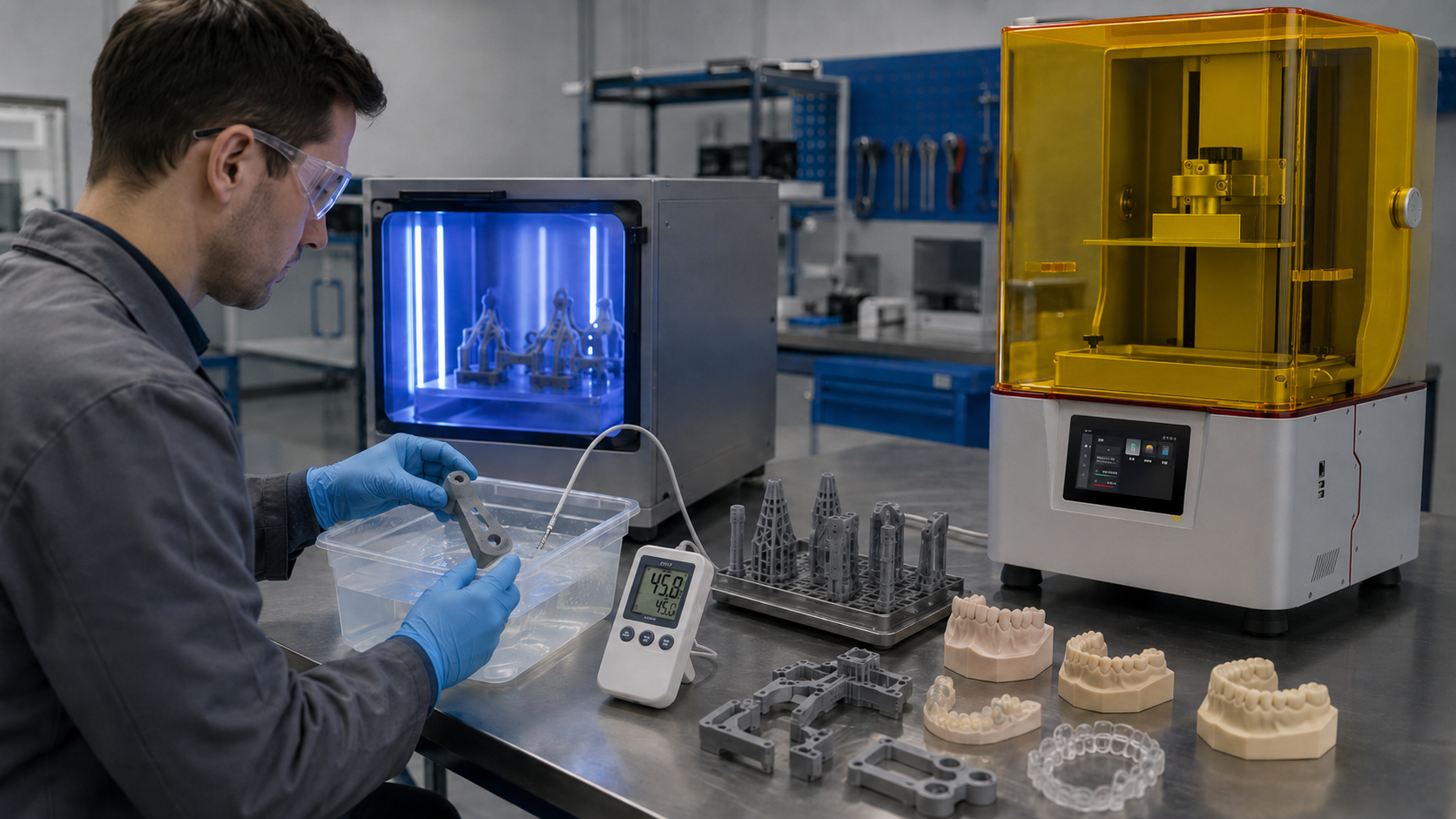
What Happens When Resin 3D Prints Meet Hot Water?
Resin 3D printed parts are usually made by vat photopolymerization. Liquid photopolymer resin is cured layer by layer using light, then the printed part is cleaned and post-cured to improve handling stability and final properties. Yidimu’s own professional workflow pages also describe resin printing as a complete process that includes printing, cleaning, drying, support removal, UV curing, and inspection, not just the printer output itself.
When a resin print is placed in hot water, several things may happen:
- The part may become temporarily more flexible.
- Thin walls, unsupported features, and long flat sections may bend.
- Supports may become easier to remove, depending on the resin and curing stage.
- Internal stress may be released, causing warping.
- The surface may become slightly dull, sticky, or unstable if the part was not fully cleaned and cured.
- Dental or precision models may lose fit accuracy if the temperature is too high or exposure is too long.
The most important point is this: hot water does not “soften resin” in a universal, predictable way. It may soften, relax, swell, warp, or damage the part depending on the actual material and workflow.
Professional users should treat hot water as a controlled process variable, not a quick trick.
Why Hot Water Can Soften or Deform Resin Prints
Most resin 3D prints are crosslinked photopolymer materials after curing. They do not behave like PLA, ABS, or other common thermoplastics that soften and melt in a more familiar way. However, cured resin still has thermal limits.
The two practical concepts to understand are:
Heat Deflection Temperature
Heat deflection temperature, often shortened to HDT, describes the temperature at which a plastic specimen begins to deform under a specified load. ISO 75 defines the general method for determining temperature of deflection under load using flexural stress under three-point loading.
For a resin print, HDT does not mean the part suddenly melts at that temperature. It means the material may no longer hold shape reliably under load when heat, stress, and geometry combine.
For example, a thin dental model wall, a long engineering sample, or a flexible lattice may deform earlier than a thick solid block made from the same resin.
Post-Curing Condition
Post-curing affects the final properties of a resin print. Dental resin studies have shown that post-curing time and curing equipment can influence degree of conversion, microhardness, and related material behavior.
In practical terms, an under-cured part may be more sensitive to heat, water, solvents, pressure, and handling. A properly cleaned and post-cured part is usually more stable, but it still has a temperature limit.
That is why professional workflows should not ask only, “Does hot water soften 3D print resin?” A better question is:
“Has this resin been printed, cleaned, dried, UV post-cured, and inspected according to the intended application?”
Practical Table: When Hot Water Is Helpful, Risky, or Not Recommended
| Situation | Can Hot Water Help? | Main Risk | Professional Recommendation |
|---|---|---|---|
| Removing supports from general model resin | Sometimes | Warping, surface marks, broken fine details | Use warm water only if the resin workflow allows it. Test on a non-critical part first. |
| Adjusting a warped engineering prototype | Usually not reliable | Permanent deformation, inaccurate assembly fit | Reprint with better orientation, support, curing, and inspection instead of reshaping by heat. |
| Softening flexible resin samples | Possibly, depending on resin | Misleading feel test, dimensional change | Test at controlled temperature and record exposure time. Compare with actual use conditions. |
| Dental model cleaning | Usually not the main method | Accuracy loss, surface instability, contamination | Follow the resin cleaning and curing instructions. Confirm dental workflow requirements before use. |
| Surgical guide or intraoral-related workflow | Not recommended without validation | Clinical fit risk, regulatory risk | Customers should confirm resin indication, post-curing process and local regulatory requirements before clinical or intraoral use. |
| Transparent resin parts | Risky | Clouding, internal stress, cracks, distortion | Use controlled post-processing and avoid thermal shock. |
| Thin-wall industrial parts | Risky | Curling, bending, edge deformation | Review resin HDT, wall thickness, support strategy, and curing process. |
| Large flat models | Risky | Warping and uneven stress release | Improve print orientation, hollowing, drainage, and post-curing support. |
| Fully cured heat-resistant resin | Sometimes more stable | Still may deform under load | Check the resin data sheet and test under real service conditions. |
| Uncured or partially cured resin print | Unsafe and unstable | Skin exposure risk, surface tackiness, deformation | Clean, dry, and post-cure before handling or testing. |
Does Hot Water Work for Support Removal?
Hot water is sometimes used by resin printing users to make support removal easier, especially before final post-curing. The idea is simple: warm the part slightly, reduce brittleness, and remove supports with less cracking.
This may work for some non-critical model parts, but it needs caution in professional production.
For factories and model-making companies, support removal should be part of a repeatable workflow:
- Print with correct exposure settings.
- Drain excess resin.
- Wash according to resin requirements.
- Dry completely.
- Remove supports at the recommended stage.
- Post-cure under controlled UV exposure.
- Inspect dimensions and surface quality.
Yidimu’s UV curing equipment page explains that resin 3D printing does not end when the model leaves the printer; printed parts usually require cleaning, drying, and UV post-curing before handling, inspection, assembly, or presentation.
For small display models, a little warm water may be acceptable if the resin supplier allows it. For dental models, industrial fit-check parts, jigs, fixtures, and production samples, uncontrolled hot water can create more problems than it solves.
Can Hot Water Fix a Warped Resin Print?
In most professional workflows, hot water should not be treated as a reliable method to fix warped resin prints.
It may allow a part to bend temporarily, but the final shape may not remain stable. The part can spring back, deform further during cooling, or develop internal stress. For precision applications, a “fixed” resin print may look better but still fail dimensional inspection.
If a resin part warps, the better solution is to identify the cause:
- Was the part oriented correctly?
- Were supports strong enough?
- Was the wall thickness too thin?
- Was the model hollowed without proper drainage?
- Was washing too aggressive?
- Was UV post-curing uneven?
- Was the part removed from the platform too early?
- Was the resin temperature stable during printing?
- Was the model exposed to heat after curing?
For industrial users, Yidimu’s industrial resin 3D printer applications page emphasizes that resin printing results depend on the system, resin, exposure settings, support design, cleaning, UV curing, and inspection. That is the correct way to think about warping: solve the workflow, not only the symptom.
Hot Water and Dental Resin Prints
Dental applications need extra caution. Dental labs and clinics may print dental models, surgical guide model workflows, temporary dental applications, orthodontic models, and other professional parts. Some parts are only for model review, while others may relate to clinical or intraoral use.
Hot water should not be used casually in dental resin workflows because it may affect:
- Dimensional accuracy
- Surface finish
- Fit between model and appliance
- Final hardness
- Water absorption behavior
- Cleaning consistency
- Post-curing reliability
Dental research shows that post-processing parameters can affect properties such as mechanical strength, stability, dimensional accuracy, durability, and biocompatibility-related performance. Another study on 3D printed dental materials reported that post-curing duration can reduce water solubility and that curing conditions influence material behavior.
Customers should confirm resin indication, post-curing process and local regulatory requirements before clinical or intraoral use.
For dental buyers evaluating printer and workflow options, Yidimu’s dental 3D printer for clinics and labs guide is a better starting point than relying on hot water tricks. Dental users should review printer stability, resin compatibility, washing, curing, model inspection, and application requirements together.
Hot Water and Flexible Resin Prints
Flexible resin is a different case. Some users print elastic parts, shoe samples, soft fixtures, cushioning structures, wearable components, or rehabilitation prototypes. In these applications, heat may change the feel of the part temporarily.
However, that does not mean hot water is a proper test for flexibility.
For flexible resin projects, professional users should define the real application first:
- Is the part used for touch and feel review?
- Does it need rebound?
- Does it need bending fatigue resistance?
- Will it contact skin?
- Will it work in warm environments?
- Will it be used only as a prototype?
- Does the customer require a specific hardness range?
- Does the part need dimensional stability after repeated bending?
The Yidimu Flex G2 flexible resin 3D printer is positioned for elastomer resin printing workflows such as shoe sample development, cushioning lattice structures, wearable soft parts, and industrial soft models. For these applications, hot water should be used only as a controlled test condition if it represents the real use case.
If the real product will be used at room temperature, testing it in hot water may give misleading feedback.
Recommended Workflow: How to Handle Resin Prints Without Causing Heat Damage
Step 1: Confirm the Resin Type
Before using hot water, check whether the resin is:
- General model resin
- Dental model resin
- Surgical guide model resin
- Temporary dental resin
- Castable resin
- Flexible resin
- Transparent resin
- Heat-resistant resin
- Water-washable resin
- Engineering resin
Each resin type behaves differently. Do not assume one successful hot water method applies to another resin.
Step 2: Check the Resin Data Sheet
Look for:
- Recommended washing method
- Recommended post-curing time
- Recommended post-curing wavelength
- Heat resistance information
- HDT or thermal performance data
- Water exposure limitations
- Dental or application indication
- Safety instructions
If thermal data is not provided, test carefully before applying hot water to production parts.
Step 3: Clean the Print Properly
Uncured resin residue can make parts sticky, unsafe to handle, and unstable. NIOSH guidance notes that chemicals in liquid resins used for vat photopolymerization may cause skin irritation or sensitization, so users should manage exposure during printing and post-processing.
Use suitable gloves, eye protection, ventilation, and cleaning methods based on the resin safety data sheet.
Step 4: Dry Before UV Post-Curing
After washing, dry the part fully. Residual liquid in holes, lattice structures, hollow parts, or model grooves can affect surface quality and post-curing consistency.
Step 5: UV Post-Cure Under Controlled Conditions
Use a curing box that matches the resin requirements. Yidimu’s UV curing box uses a 405nm UVA light source and rotating curing platform to support more even exposure during post-processing. The actual curing process should still match the resin and part geometry.
Step 6: Inspect Before Any Heat Exposure
Check:
- Fit
- Flatness
- Edge definition
- Surface tackiness
- Cracks
- Support scars
- Warping
- Dimensional accuracy
If the part is already distorted before hot water exposure, heat may make the problem worse.
Step 7: Test Hot Water Only on Non-Critical Samples
If hot water must be tested, use a controlled sample:
- Record water temperature.
- Record exposure time.
- Avoid boiling water unless specifically allowed.
- Do not apply load during heating unless testing load deformation.
- Cool the part naturally.
- Measure before and after.
- Repeat the test with the same resin and geometry.
Step 8: Decide Whether the Workflow Is Acceptable
For a one-off visual model, small deformation may be acceptable. For dental models, engineering prototypes, fit-check parts, production fixtures, or customer approval samples, even small deformation may be unacceptable.
Checklist: Before Using Hot Water on Resin 3D Prints
Use this checklist before trying hot water on any resin part:
- Confirm the resin type and application.
- Check the resin supplier’s post-processing instructions.
- Confirm whether the part is fully cleaned.
- Confirm whether the part is fully dried.
- Confirm whether UV post-curing is complete.
- Check whether the part has thin walls or long unsupported sections.
- Avoid hot water for dental or clinical-related parts unless validated.
- Avoid hot water for precision fit-check parts unless testing requires it.
- Measure the part before and after exposure.
- Record water temperature and exposure time.
- Test on a non-critical sample first.
- Do not use boiling water as a default method.
- Do not handle uncured resin with bare hands.
- Do not treat hot water reshaping as a substitute for correct printing workflow.
Common Mistakes to Avoid
Mistake 1: Thinking All Resin Prints React the Same Way
Different resins have different chemistry, filler content, curing behavior, and thermal performance. A method that works for one model resin may damage a dental resin or transparent resin.
Mistake 2: Using Boiling Water Without Testing
Boiling water can cause warping, cracks, surface dullness, or sudden deformation. It can also make thin details bend before the user notices.
Mistake 3: Trying to Fix Poor Printing With Heat
If the root problem is weak supports, wrong orientation, overexposure, underexposure, uneven curing, or poor washing, hot water will not solve the workflow issue.
Mistake 4: Heating Parts Before Complete Cleaning
Heating a part with uncured resin residue may increase handling risk and surface problems. Liquid resin exposure should be managed carefully because some resin chemicals may irritate or sensitize skin.
Mistake 5: Using Hot Water on Dental Parts Without Validation
Dental workflows require higher caution. Customers should confirm resin indication, post-curing process and local regulatory requirements before clinical or intraoral use.
Mistake 6: Ignoring Geometry
A thick block and a thin dental arch will not behave the same way in hot water. Thin edges, hollow shells, flat plates, and lattice structures are more likely to deform.
Mistake 7: Skipping Measurement
If the part is used for engineering review, assembly, or dental work, visual inspection is not enough. Measure critical dimensions before and after any heat exposure.
How Professional Buyers Should Evaluate Resin Heat Resistance
When buying resin 3D printing equipment or resin materials, professional users should not ask only whether hot water softens resin. They should review the full operating environment.
For factories, ask:
- Will the part be used near machines, motors, lamps, ovens, or warm fixtures?
- Will it be loaded during use?
- Is the part only for visual review, or will it be assembled?
- Does the prototype need screw holes, clips, or snap-fit features?
- Will the customer test it in warm water or outdoor conditions?
For dental labs and clinics, ask:
- Is the part only a dental model?
- Is it related to surgical guide workflow?
- Is it related to temporary dental application?
- What resin indication applies?
- What post-curing process is required?
- What local regulatory requirement applies?
- How will the final part be inspected?
For flexible resin users, ask:
- Is hot water exposure part of the real use environment?
- Does the part need stable rebound after heating?
- Does it need repeated bending?
- Does it need skin-contact suitability?
- Is the required hardness specified?
Yidimu provides professional resin 3D printers, dental printers, flexible resin printers, UV curing boxes, and technical support for workflow review. Users comparing equipment can start from Yidimu’s professional resin 3D printer product page and then confirm the application with the technical team.
Conclusion
So, does hot water soften 3D print resin? It can, depending on the resin, curing condition, temperature, exposure time, geometry, and load. Hot water may make some resin prints more flexible, easier to deform, or easier to damage. It should not be treated as a universal method for support removal, reshaping, dental post-processing, or industrial part correction.
For professional users, the safer approach is to control the full workflow: resin selection, print orientation, support design, washing, drying, UV post-curing, measurement, and application testing. If heat exposure is part of the real use case, test it with recorded temperature, time, and dimensional inspection.
For factories, dental labs, dental clinics, model-making companies, and R&D teams, Yidimu can help review printer selection, resin requirements, UV curing workflow, model size, application needs, and expected production process. Contact Yidimu with your model size, resin requirement, application, and expected workflow so the team can recommend a suitable resin 3D printer, material, and post-processing solution.
FAQ
Does hot water soften 3D print resin?
Yes, hot water may soften or deform some 3D print resin parts, especially if the temperature approaches the resin’s heat resistance limit or if the part is thin, under-cured, or under load. The effect depends on resin type, curing condition, geometry, and exposure time.
Is resin 3D print material waterproof after curing?
Some cured resin prints can tolerate limited water exposure, but that does not mean all resin parts are waterproof or dimensionally stable in hot water. Water exposure, temperature, resin formulation, and post-curing all matter.
Can I use hot water to remove supports from resin prints?
Sometimes, warm water may help with support removal for non-critical models. However, it should be tested first and should not replace correct support design, washing, drying, and UV curing. For precision parts, uncontrolled hot water can cause deformation.
Can boiling water damage resin 3D prints?
Yes. Boiling water may warp, crack, soften, or distort resin prints, especially thin-wall parts, dental arches, transparent parts, and large flat models. Do not use boiling water unless the resin workflow specifically allows it.
Can hot water fix a warped resin print?
Usually not in a reliable way. Hot water may allow temporary reshaping, but it can also create new deformation or internal stress. For professional parts, it is better to correct print orientation, supports, exposure, washing, and curing.
Does UV post-curing make resin more heat resistant?
UV post-curing can improve final part properties depending on resin and curing conditions. However, it does not make every resin heat-resistant. Users should still check the resin data sheet and test the part under actual application conditions.
Should dental resin prints be placed in hot water?
Dental resin prints should not be placed in hot water casually. Dental users should follow resin-specific cleaning and curing instructions. Customers should confirm resin indication, post-curing process and local regulatory requirements before clinical or intraoral use.
Why did my resin print bend after hot water cleaning?
The part may have been thin, under-cured, internally stressed, or exposed to water that was too hot for the resin. Geometry and load also matter. Long flat parts, hollow parts, and thin arches are more likely to bend.
Is warm water safer than alcohol for water-washable resin?
Water-washable resin should be cleaned according to its resin instructions. Warm water may not automatically be safer if the temperature causes deformation or if uncured resin is not handled properly. Use PPE and follow the material safety data sheet.
What should I send to Yidimu for workflow advice?
Send the model size, resin type, required application, accuracy requirement, expected production quantity, post-processing method, and whether the part will face heat, water, bending, or load during use.
Author Bio
Article by Alice Zhang
Alice Zhang writes about industrial resin 3D printing, dental 3D printing workflows, flexible resin applications, resin post-processing, and professional additive manufacturing solutions for Yidimu users.
Optional References
- ISO 75: Plastics — Determination of temperature of deflection under load.
- NIOSH guidance on 3D printing safety and resin exposure considerations.
- Review of post-processing parameters and their effect on 3D printed dental devices.
- Study on post-curing conditions, degree of conversion, microhardness, and stainability of 3D printed dental materials.
Recommended Yidimu Internal Links
- Industrial resin 3D printer applications
- Resin 3D printers for dental, flexible and industrial use
- Yidimu UV curing box for resin 3D printed models
- Dental 3D printer for clinics and labs
- Yidimu Flex G2 flexible resin 3D printer
- Dental 3D printer accuracy requirements
- Contact Yidimu
- Yidimu service and technical support