Factories should use resin 3D printing when they need detailed prototypes, smooth surface quality, small or medium-sized precision models, dental models, visual samples, flexible resin samples, fit-check parts, tooling aids or low-volume validation parts faster than traditional machining or mold production. It is especially useful before opening a mold, during product development, for design verification, for dental and model-making workflows, and for short-run sample production. However, resin 3D printing is not always the best choice for large structural parts, high-temperature end-use components, mass production, or parts that require certified mechanical, medical or regulatory performance without proper validation.
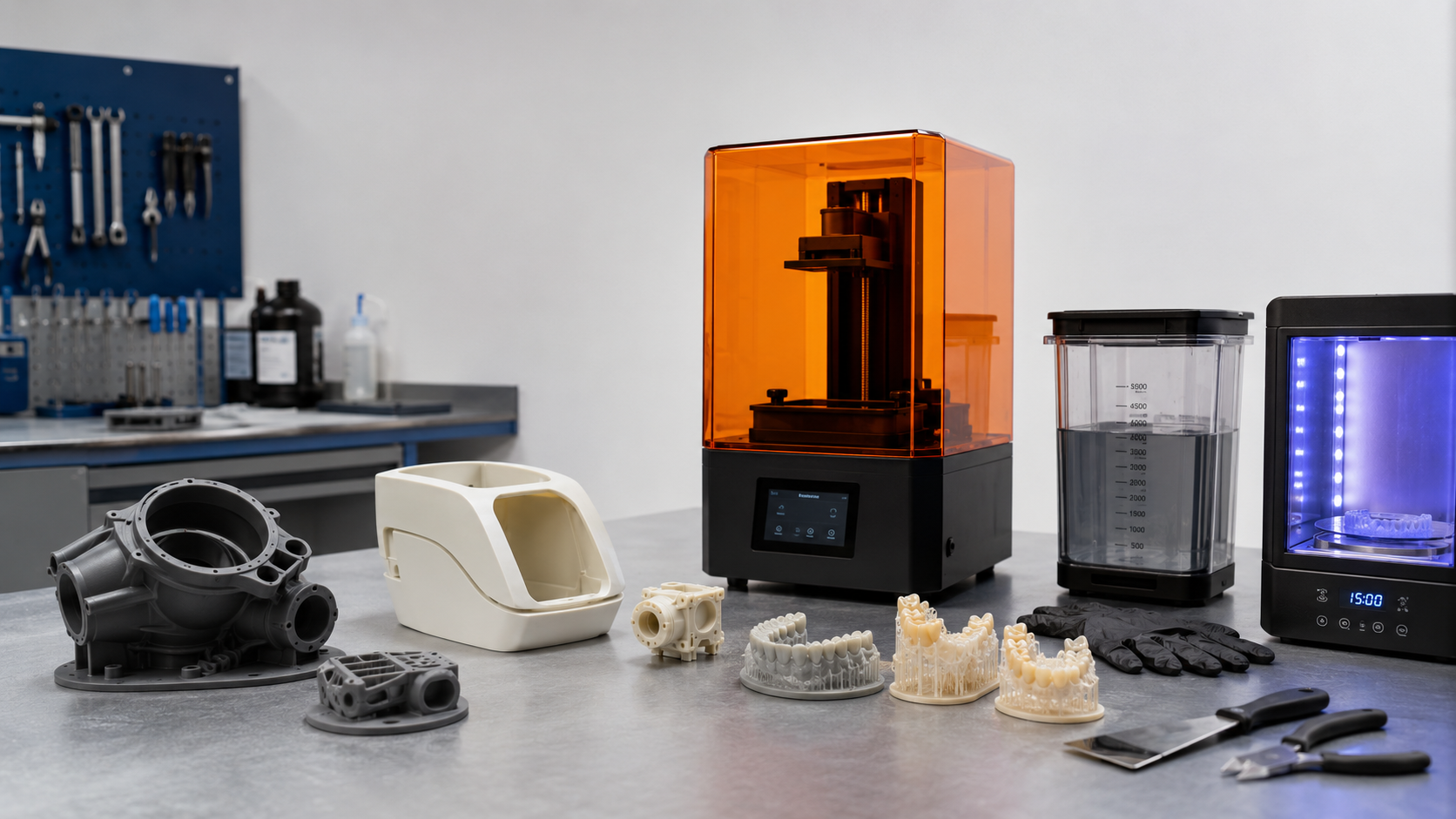
Resin 3D printing is useful in a factory when the main problem is not mass production, but speed, detail, iteration and workflow control. In professional environments, the question is rarely “Can this part be printed?” A better question is: “Will resin 3D printing reduce development time, improve sample quality, support better validation or help us make a better decision before investing in tooling?”
Technically, resin 3D printing belongs to the wider category of additive manufacturing, where objects are built by adding material layer by layer. ISO/ASTM 52900 defines additive manufacturing as the additive shaping of 3D geometry through successive material addition, while NIST describes vat photopolymerization as a process that cures liquid photopolymer resin with UV light to form solid structures.
For factories, this matters because resin 3D printing can provide fine detail, smooth surfaces and complex geometry without waiting for molds, CNC programming or outsourced sample making. But it also requires suitable resin, controlled printing parameters, washing, drying, UV post-curing, PPE, ventilation and inspection. PAMA and NIOSH both emphasize that UV-curable resins should be handled as chemical materials, with safety data sheets, gloves, eye protection, clean work areas and proper disposal procedures.
Yidimu positions resin 3D printing as a professional workflow for dental labs, clinics, factories, model workshops and product development teams, combining printers, resins, UV curing equipment and application support rather than treating the printer as a standalone machine.
When Resin 3D Printing Makes the Most Sense for Factories
1. Use resin 3D printing before opening a mold
One of the strongest factory use cases is pre-mold validation. Before spending money on injection molds, silicone molds, die-casting tools or shoe molds, teams can print a physical sample to check size, form, assembly, customer feedback and design direction.
Resin 3D printing can support:
- Product appearance samples
- Assembly mockups
- Ergonomic prototypes
- Shoe sole or upper development samples
- Consumer product shells
- Small mechanical housings
- Packaging or display models
- Dental model verification
- Jewelry and model-making masters
This is especially useful when the design is still changing. If a CAD model changes three times in one week, machining or mold preparation can become slow and expensive. Resin 3D printing allows the team to print, review, revise and print again with less delay.
2. Use it when surface detail matters
Factories should consider resin 3D printing when the part needs smooth surfaces, fine details, small features or clean visual presentation. Compared with many filament-based workflows, resin printing can often provide better visible detail and smoother surfaces, depending on the printer, resin, layer height, exposure settings and post-processing.
This is why resin 3D printing is widely used for:
- Dental models
- Jewelry patterns
- Miniature models
- Product appearance prototypes
- Industrial display models
- Consumer product samples
- Detailed engineering review models
- Model workshop production
For a procurement manager, this means the decision should not be based only on build size or printer price. Surface quality, light uniformity, resin stability, support removal, cleaning and curing control all affect the final result.
3. Use it for design verification and fit-check parts
Factories often need to know whether a design is close enough before moving to the next stage. Resin 3D printing can help teams check:
- Hole position
- Assembly clearance
- Surface shape
- Connector layout
- Part interference
- Visual proportions
- Customer approval samples
- Packaging fit
- Dental model fit and workflow compatibility
This does not mean every printed resin part can replace a final production part. Mechanical behavior depends on the resin and post-curing process. Some resins are brittle, some are more flexible, some are suitable for models only, and some may support specific engineering or dental workflows when used correctly. The safe approach is to define the test purpose first.
4. Use it for low-volume samples and pilot production
Resin 3D printing can support small-batch production when the parts are suitable for the material and workflow. This may include demonstration models, test samples, dental models, custom jigs, inspection aids, display models or short-run parts for internal validation.
It is usually more practical when:
- The quantity is low
- The design changes frequently
- Tooling cost is not justified
- Surface detail is important
- The part is small or medium-sized
- Post-processing time is acceptable
- The material requirement matches available resin
For repeat orders, factories should calculate the full workflow cost: printer time, resin use, support waste, washing, drying, curing, inspection, labor and reprint rate. Resin 3D printing can be fast at the development stage, but it is not automatically cheaper for every production quantity.
5. Use it for dental labs and clinics with controlled workflows
Dental labs and clinics may use resin 3D printing for model-based dental workflows, orthodontic models, study models, surgical guide workflows, splint workflows or temporary-related workflows depending on the resin, software and regulatory environment. The key point is that dental resin 3D printing is a system, not just a machine.
A controlled dental printing workflow usually includes:
- Intraoral scan or model scan
- Dental CAD design
- Slicing and support preparation
- Compatible dental resin
- Printer calibration and exposure settings
- Washing
- Drying
- UV post-curing
- Fit check and documentation
- Application-specific quality control
Customers should confirm resin indication, post-curing process and local regulatory requirements before clinical or intraoral use. The FDA notes that 3D printed medical devices are subject to regulatory requirements like devices made by other manufacturing processes, and additive-manufactured medical devices require design, manufacturing and testing considerations depending on classification and use.
6. Use it for flexible resin sample development
Factories working with shoes, wearable products, soft parts, cushioning samples or flexible structures may consider flexible resin 3D printing when they need to evaluate shape, softness, bending behavior or visual design before moving to final materials or tooling.
Flexible resin printing can support:
- Shoe sample development
- Soft touch prototypes
- Wearable product samples
- Flexible design studies
- Elastic model testing
- Product development reviews
However, printed flexible resin should not be assumed to behave exactly like rubber, TPU injection molding or final production elastomers. Performance depends on resin formulation, print orientation, wall thickness, curing and use conditions. Testing with the real model geometry is strongly recommended.
Practical Table: When Should Factories Use Resin 3D Printing?
| Factory Need | Resin 3D Printing Fit | Why It Helps | What to Confirm First |
|---|---|---|---|
| Appearance prototype | Strong fit | Smooth surface and fine detail can support product review | Model size, resin color, finishing requirement |
| Pre-mold validation | Strong fit | Reduces risk before tooling investment | Dimensional tolerance, assembly points, customer approval need |
| Dental model workflow | Strong fit when controlled | Supports digital dental model production | Resin indication, curing process, local regulations |
| Jewelry or detailed model | Strong fit | Captures small details and complex shapes | Resin type, surface finishing, burnout or casting workflow if needed |
| Flexible sample | Good fit depending on resin | Helps evaluate shape and softness before tooling | Resin elasticity, wall thickness, curing method |
| Fit-check part | Good fit | Useful for assembly and design verification | Tolerance requirement and load condition |
| Custom jig or inspection aid | Possible fit | Useful for low-load internal tools | Resin strength, wear, chemical exposure |
| High-load structural part | Limited fit | Resin may not match metal or engineering plastic performance | Mechanical testing and safety factor |
| High-temperature part | Limited fit | Many resins deform or weaken under heat | Heat resistance data and real-use test |
| Mass production | Usually limited | Post-processing and labor may reduce efficiency at high volume | Quantity, cycle time, labor cost, mold alternative |
| Regulated medical or intraoral use | Conditional | May be possible only with suitable material and validated workflow | Resin indication, regulatory requirements, documentation |
How to Decide: A Factory Selection Workflow
Step 1: Define the real purpose of the printed part
Before choosing a printer, define what the part is supposed to do. Is it for visual review, customer approval, assembly testing, dental modeling, flexible sample testing, mold decision-making or final use?
Do not start with printer size. Start with the application.
Ask:
- Is the part for appearance, fit, function or clinical workflow?
- Will the part be handled, loaded, heated, bent or exposed to chemicals?
- Does the customer need a smooth surface or only rough geometry?
- Is the part a prototype, internal tool, dental model or end-use component?
- Is documentation or regulatory review required?
Step 2: Check model size and build volume
Factories often underestimate build volume. A printer should fit the real workpiece, not only a demo cube. Check the longest dimension, height, number of parts per batch and whether the part can be tilted.
For production teams, batch planning matters. A larger printer may help if the team prints multiple models per day, but build size alone does not guarantee better output. Light uniformity, Z-axis stability, resin vat condition and slicing strategy also matter.
Step 3: Match resin to the application
Resin choice determines whether the printed part is useful. A dental model resin, flexible resin, water-washable resin, casting resin or industrial prototype resin may behave very differently.
Check:
- Printer wavelength compatibility
- Resin indication and application scope
- Mechanical properties
- Cleaning method
- Post-curing requirements
- Color and surface requirement
- Safety data sheet
- Shelf life and storage condition
- Waste handling rules
Water-washable resin, for example, can simplify cleaning for some workflows, but Yidimu notes that it remains a UV-curable photopolymer resin and should still be handled with PPE, SDS review and responsible wastewater control.
Step 4: Review post-processing before buying the printer
A resin printer is only one part of the workflow. Professional users also need:
- Washing containers or washing equipment
- UV curing box
- Drying area
- Gloves and eye protection
- Ventilation or exposure control
- Support removal tools
- Waste handling process
- Inspection method
- Operator training
NIOSH specifically highlights exposure risks during part cleaning, curing and sanding, and recommends reducing exposure with ventilation, PPE, clean work areas and careful handling of uncured resin and solvents.
Step 5: Print a real sample before scaling
Generic demo models are useful, but they do not prove that a printer fits your production. A factory should test its own model, with its own wall thickness, support needs, surface requirements and inspection method.
A practical sample test should include:
- One easy model
- One difficult model
- One real production-style part
- Required surface finishing
- Actual post-curing process
- Dimensional check after curing
- Operator feedback
- Reprint and failure record
Workflow or Checklist
Resin 3D Printing Readiness Checklist for Factories
Use this checklist before investing in a resin 3D printing workflow.
- Define the application: prototype, dental model, flexible sample, jig, display model or production trial.
- Confirm model size, height, batch quantity and expected print frequency.
- Decide whether surface finish, detail, speed, accuracy or material behavior is the priority.
- Match the resin to the application and printer wavelength.
- Review the resin SDS and handling requirements.
- Confirm washing, drying and UV post-curing steps.
- Plan PPE, ventilation, spill control and waste disposal.
- Test the real part file before making a purchase decision.
- Check whether the result needs dimensional measurement or only visual approval.
- For dental or regulated applications, confirm resin indication, post-curing process and local regulatory requirements.
- Estimate total workflow cost, not only printer price.
- Confirm who will operate, maintain and troubleshoot the system.
When Factories Should Not Use Resin 3D Printing
Resin 3D printing is powerful, but it is not a universal manufacturing method. Factories should be careful in the following situations.
Large structural parts
If the part is large, load-bearing and requires high impact strength, CNC machining, injection molding, casting, sheet metal or other manufacturing methods may be more suitable. Resin printing may still help during the prototype stage, but the final production process should be selected based on performance requirements.
High-temperature applications
Many standard photopolymer resins are not suitable for high-temperature service. Some specialty resins may support improved heat resistance, but users should confirm data, curing requirements and real working conditions before relying on printed parts.
Parts requiring certified end-use performance
If the part is safety-critical, medical, intraoral, food-contact, load-bearing or regulated, factories should not assume that a printed resin part is approved for use. Material indication, process validation, testing and local regulatory compliance must be reviewed.
High-volume production where tooling is already stable
If the design is final and the order volume is high, injection molding or other mass production processes may provide lower unit cost and better production efficiency. Resin 3D printing may still be useful for fixtures, replacement samples, test parts or design changes.
Workflows without post-processing control
If the factory cannot control washing, curing, waste handling, PPE or operator training, resin 3D printing may create quality and safety problems. A professional resin workflow needs disciplined operation.
Common Mistakes to Avoid
Mistake 1: Buying based only on printer size
A large build volume is useful, but it is not the whole decision. Factories should also check light uniformity, stability, resin compatibility, curing process, support strategy and service support.
Mistake 2: Treating printed resin parts as final production parts without testing
A printed resin prototype may look good but still fail under load, heat, bending, impact or chemical exposure. Use real testing before using resin prints as functional parts.
Mistake 3: Ignoring post-curing
Post-curing affects final part properties, surface feel and stability. Under-curing or inconsistent curing can lead to weak parts, tacky surfaces or dimensional changes depending on the resin and workflow.
Mistake 4: Using the wrong resin for dental applications
Dental applications require careful material selection and process control. Customers should confirm resin indication, post-curing process and local regulatory requirements before clinical or intraoral use.
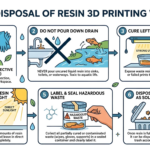
Mistake 5: Sending uncured resin waste into the drain
PAMA’s resin handling guidance states that partially cured or uncured resin waste may be hazardous waste and should not be poured into the sink or water system. Users should check local disposal rules and supplier documentation.
Mistake 6: Comparing printer price but not workflow cost
The real cost includes resin, failed prints, supports, washing, curing, labor, PPE, consumables, maintenance and operator training.
Mistake 7: Skipping sample testing
Factories should test real files before scaling. A machine that prints a standard demo model well may still need workflow adjustment for a complex dental arch, flexible shoe sample or industrial housing.
FAQ
When should factories use resin 3D printing?
Factories should use resin 3D printing when they need detailed prototypes, smooth surfaces, fast design iteration, dental models, flexible samples, fit-check parts, visual samples or low-volume validation before tooling. It is most useful when speed, detail and design flexibility matter more than mass production unit cost.
Is resin 3D printing suitable for factory prototyping?
Yes, resin 3D printing can support factory prototyping, especially for small and medium-sized parts with fine detail or smooth surface requirements. It is commonly useful for product development, pre-mold validation, assembly checking and customer approval samples.
Can resin 3D printing replace injection molding?
Usually not for high-volume final production. Resin 3D printing can help before injection molding by validating design, appearance and assembly. Once the design is stable and the quantity is high, injection molding may be more efficient.
What industries use resin 3D printing?
Resin 3D printing is used in dental labs, dental clinics, product development, model making, jewelry, consumer product design, shoe sample development, research, education, industrial prototyping and small-batch sample production.
Is resin 3D printing good for dental labs?
It can be useful for dental labs when the printer, resin, software, cleaning, curing and quality control process are properly matched. Customers should confirm resin indication, post-curing process and local regulatory requirements before clinical or intraoral use.
What should a factory check before buying a resin 3D printer?
A factory should check application type, model size, resin requirement, surface quality, expected print volume, post-processing workflow, operator training, PPE, ventilation, maintenance and technical support. The printer should be selected as part of a complete workflow.
Is resin 3D printing safe in a factory?
It can be managed safely when proper procedures are followed. Operators should review the resin SDS, wear suitable gloves and eye protection, control ventilation, avoid skin contact with uncured resin, clean spills properly and dispose of resin waste according to local rules.
Can resin 3D printed parts be used as functional parts?
Sometimes, depending on the resin, design, load, curing process and working environment. Resin printed parts should be tested before functional use, especially if they will face heat, impact, bending, chemicals or safety-related conditions.
What is the biggest advantage of resin 3D printing for factories?
The biggest advantage is fast, detailed physical validation before committing to tooling or production. It helps teams see, touch, test and revise designs earlier in the development process.
What information should I send to Yidimu for printer selection?
Send the model size, resin requirement, application, expected workflow, daily print volume, surface requirement and any available 3D file, drawing or sample image. This helps Yidimu review suitable printer, resin, UV curing and post-processing options.
Optional References
- NIST: Vat photopolymerization forms structures by curing liquid photopolymer resin with UV light.
- ISO/ASTM 52900:2021: Additive manufacturing terminology and fundamentals.
- PAMA / RadTech: Proper handling guidance for UV-curable 3D printing resins, including SDS, PPE and waste handling notes.
- NIOSH / CDC: Safe desktop vat photopolymerization guidance covering ventilation, PPE, cleaning, curing and sanding exposure control.
- FDA: Technical considerations and regulatory context for additive manufactured medical devices.
- Yidimu: Product and workflow positioning for industrial resin 3D printers, dental 3D printers, flexible resin printers, resins and UV curing equipment.
Conclusion
Factories should use resin 3D printing when they need fast, detailed and controlled physical samples for design review, pre-mold validation, dental model production, flexible sample development, model-making, fit checks or low-volume workflow testing. The technology is most valuable when it shortens development cycles and helps teams make better decisions before investing in tooling or production.
However, resin 3D printing should be selected carefully. The final result depends on printer stability, resin choice, model design, support strategy, washing, drying, UV curing, operator training and quality control. For dental, medical, body-contact or regulated applications, customers should confirm resin indication, post-curing process and local regulatory requirements before clinical or intraoral use.
To choose a suitable Yidimu resin 3D printing workflow, contact Yidimu with your model size, resin requirement, application, expected workflow, printing frequency and available 3D file or sample image. Yidimu can help review suitable industrial resin 3D printers, dental 3D printers, flexible resin printers, UV curing equipment and resin options for your project.