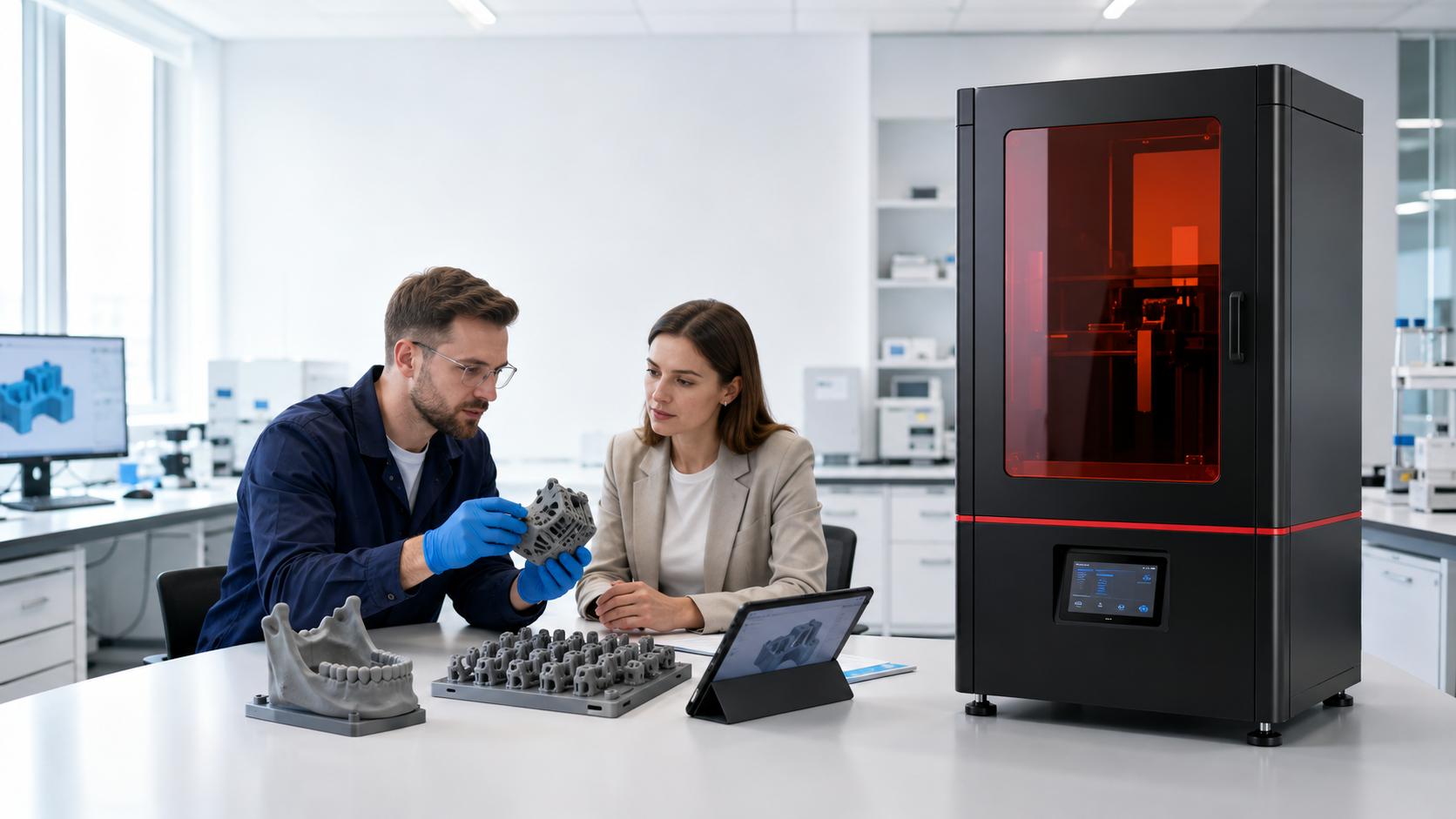
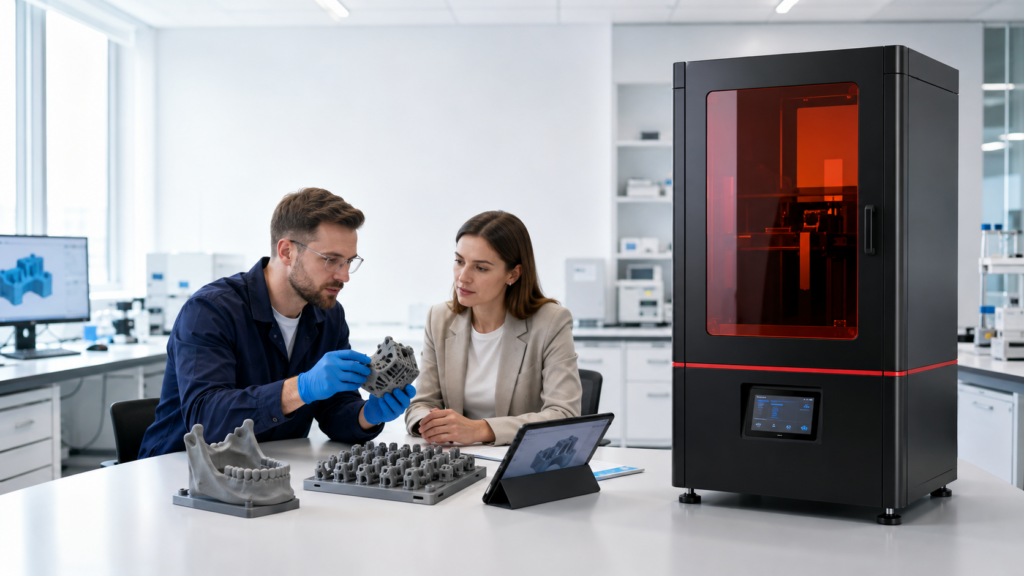
You can buy a 3D printer directly from a manufacturer, through an authorized distributor, from a specialist industrial equipment supplier, on a general online marketplace, or from a used-equipment seller. You can also order parts from a 3D printing service if your application or production volume does not yet justify purchasing equipment.
The right purchasing channel depends on what you plan to print, the level of technical support you need, your location, and whether the equipment will be used for hobbies, professional prototyping, dental laboratory work or industrial production.
For a simple desktop printer, purchasing convenience and price may be the main considerations. For professional equipment, the seller should also be able to evaluate applications, materials, post-processing, installation, training, maintenance and long-term parts availability.
Where Can You Buy a 3D Printer?
1. Directly from a 3D printer manufacturer
Buying directly from a manufacturer can provide access to the company that develops or produces the equipment. This may make it easier to discuss unusual materials, large models, production requirements, customized workflows or representative sample testing.
Direct purchasing may be suitable for:
- Engineering and product-development teams
- Dental laboratories
- Research laboratories
- Manufacturers
- Printing service providers
- Companies planning repeated or small-batch production
- Projects requiring material and workflow evaluation
However, direct purchasing is not automatically the best option. A manufacturer may sell internationally without maintaining installation or repair teams in every market. Buyers should confirm who will provide local service, which party handles importing, and how replacement parts will be delivered.
2. Through an authorized distributor
An authorized distributor represents a manufacturer in a particular country or region. A qualified distributor may provide local-language communication, demonstrations, installation, training, invoicing and technical support.
Before ordering, verify the distributor’s authorization directly with the manufacturer. Also determine whether the distributor can perform technical work or primarily handles sales and logistics.
Ask whether warranty service, spare parts and technical support are delivered by the distributor, the manufacturer or both.
3. From a specialist industrial equipment supplier
Some suppliers provide several types of manufacturing, scanning, prototyping or laboratory equipment. They may help integrate a 3D printer into a broader workflow involving CAD, 3D scanning, inspection, washing or UV post-curing.
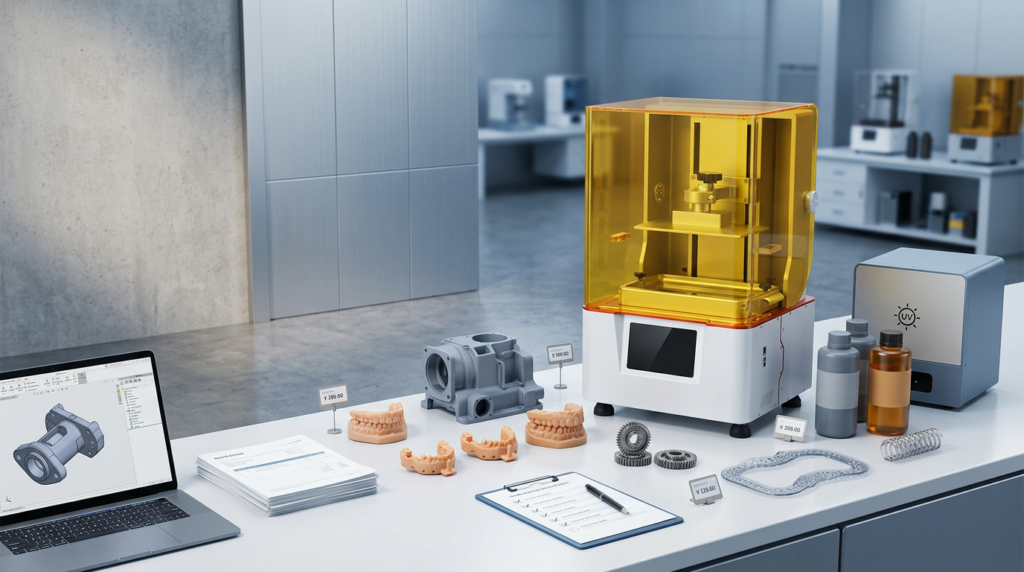
This channel may be useful when a project requires:
- Several pieces of connected equipment
- Local application consulting
- Installation planning
- Workflow integration
- Procurement through an established regional supplier
- Support for several manufacturing technologies
The quality of application knowledge can vary. Confirm that the supplier has experience with the specific printing technology, material and part type being evaluated.
4. From a general online marketplace
Online marketplaces offer convenient purchasing, visible prices and a wide selection of entry-level machines. They can be practical for hobby users, classrooms and buyers who already understand the equipment.
For professional purchases, marketplace listings require additional verification. The listed seller may be a manufacturer, authorized reseller, independent trader or unauthorized third party. Product descriptions may also omit software conditions, warranty limitations, post-processing requirements or regional electrical specifications.
Before ordering, verify:
- The legal identity of the seller
- Manufacturer authorization
- Exact product configuration
- Voltage and plug type
- Warranty coverage in your country
- Availability of replacement components
- Whether the equipment is new, returned or refurbished
- What accessories are included
- Who provides technical support
A marketplace’s return policy is not necessarily a substitute for manufacturer warranty or technical service.
5. From a refurbished or used-equipment seller
Used equipment can reduce the initial purchase price, but condition and support risks are higher. Wear may affect motion components, optical systems, build platforms, screens, resin tanks, release films, heaters and sensors.
Request:
- Serial number
- Manufacturing date
- Operating history
- Maintenance records
- Repair history
- Current software and firmware status
- Photographs of the actual machine
- A live operating demonstration
- A recent representative print
- A list of replaced or worn components
- Confirmation of transferable software licences
- Confirmation of available spare parts
Do not evaluate a used resin printer only by whether it powers on. A machine can appear operational while producing inconsistent exposure, motion or dimensional results.
6. From a 3D printing service instead of buying equipment
If you only need occasional prototypes or have not confirmed the correct technology, ordering parts from a printing service may be more practical than buying a machine immediately.
A service can help you:
- Test whether 3D printing suits the application
- Compare materials
- Evaluate surface quality
- Confirm the necessary build size
- Estimate recurring demand
- Identify post-processing requirements
- Produce parts without establishing an internal resin-handling area
Outsourcing becomes less attractive when confidentiality, rapid iteration, scheduling control or repeated production makes an internal system more valuable. Compare the annual cost and workflow impact of outsourcing with the complete cost of owning and operating equipment.
Purchasing-Channel Comparison
| Purchasing channel | Application support | Convenience | Technical communication | After-sales support | Price transparency | Typical risks |
|---|---|---|---|---|---|---|
| Direct manufacturer | Often strong for application-specific projects | Medium | Direct access may be available | Depends on location and service structure | Often quotation-based | Cross-border logistics, limited local service or unclear importing responsibilities |
| Authorized distributor | Often strong when technically trained | High within its region | Local communication may be easier | May include regional support | Usually clear after configuration | Authorization, service capability and stock should be verified |
| Specialist equipment supplier | Can be strong for integrated workflows | Medium to high | Depends on technical experience | Often regional | Usually quotation-based | Supplier may have limited knowledge of the specific printer or material |
| Online marketplace | Usually limited or seller-dependent | High | Often limited to sales communication | Highly variable | High for listed items | Unauthorized seller, incomplete configuration, limited warranty or incorrect voltage |
| Used-equipment seller | Usually limited | Medium | Depends on seller records | Usually limited | Initial price may be visible | Hidden wear, missing software, obsolete parts or unknown maintenance history |
| 3D printing service | Strong when the provider understands the application | High for occasional parts | Project-based | Not applicable to equipment ownership | Usually per-project quotation | Less control over schedule, process, confidentiality and repeated production costs |
What Should You Verify Before Buying?
Application and material compatibility
Start with the finished part rather than the printer specification. Define whether the part is an appearance model, engineering prototype, dental working model, casting pattern, flexible component, tooling aid or production part.
The material must support the actual requirements for surface finish, flexibility, strength, temperature, casting, dimensional evaluation or other relevant conditions. A generic material name does not confirm suitability.
For regulated or safety-sensitive applications, request the applicable documentation and verify the requirements in your market. Do not assume that every material marketed for a particular industry is suitable for every end use.
Printing technology
Different technologies serve different needs. FDM or FFF melts thermoplastic filament, while resin technologies use controlled light to cure liquid photopolymer. Powder-bed systems use different materials, equipment and handling processes.
Within vat photopolymerization, laser-based SLA, DLP and LCD or MSLA use different exposure methods. Buyers should not treat every resin printer as technically identical.
Build volume
Check all three build dimensions, but also assess whether the real part can fit after orientation and support structures are added. A model that fits inside the nominal machine dimensions may not fit in the orientation required for stable printing and acceptable surface quality.
For batch production, determine how many properly oriented and supported parts fit on the platform—not how many simplified rectangles fit inside the advertised area.
Representative sample printing
A sample made from your own file is usually more informative than a generic demonstration model. The file should include the features that matter to your project, such as thin walls, holes, fits, textures, curves, critical surfaces or dimensional checkpoints.
Evaluate the sample after the complete workflow: printing, draining, washing, drying, support removal, UV post-curing and inspection. YIDIMU’s equipment-selection guidance similarly recommends testing representative geometry and judging it only after the intended post-processing workflow is complete. How to Choose a Professional Resin 3D Printer
Installation and training
Confirm whether the equipment requires:
- Professional installation
- Platform calibration
- Software configuration
- Network access
- Operator training
- Material onboarding
- Post-processing training
- Facility preparation
- Compressed air or other utilities
- Dedicated extraction or ventilation
Ask whether training is remote, on-site, recorded or document-based, and whether it is included in the quotation.
Warranty terms
Read the written warranty instead of relying on a general statement such as “one-year warranty.” Verify:
- Warranty start date
- Covered components
- Excluded consumables and wear parts
- Labor coverage
- Shipping responsibility
- Remote diagnostic requirements
- Conditions that may void coverage
- Geographic limitations
- Whether the warranty transfers to another owner
Spare parts and consumables
Ask for a list of routine consumables, expected wear components and recommended spare parts. For a resin printer, these may include tanks, release films, screens, light-source components, platforms or other model-specific items.
Confirm how long parts are expected to remain available and where they will be shipped from. Do not rely on third-party compatibility unless it has been verified.
Software and updates
Determine whether the printer uses free software, a perpetual licence, a subscription or an account-based platform. Ask whether software access is tied to the original purchaser and whether updates, additional workstations, cloud functions or export features involve separate fees.
For used equipment, confirm that any required licence can legally be transferred.
Technical support
Ask how support requests are submitted and what information will be required. A technical support team may need the printer model, serial number, resin, sliced file, settings, photographs, video and error messages.
Avoid relying on an assumed response time unless it is stated in a written service agreement.
Shipping, taxes and importing
The equipment price and the landed cost are not the same. Landed cost may include the product price, freight, insurance, tariffs, taxes and other fees. Responsibilities for transport, customs clearance and risk also depend on the agreed shipping terms. International Trade Administration: Landed Cost, International Trade Administration: Incoterms
Before ordering internationally, request:
- Shipping dimensions and weight
- Packing method
- Shipping term
- Freight and insurance cost
- HS classification information
- Importer-of-record responsibility
- Estimated duties and taxes
- Customs documentation
- Delivery location and unloading requirements
- Procedures for reporting transit damage
Import requirements vary by country, so confirm them with a qualified customs professional or the relevant local authority.
Electrical and workplace requirements
Verify voltage, frequency, maximum power, plug type and grounding requirements. Also check machine dimensions, operating clearance, floor or bench capacity, environmental limits and access for delivery.
For resin printing, plan designated areas for printing, washing, drying, curing, spill control, material storage and waste handling.
Resin safety documentation
Request the current Safety Data Sheet, Technical Data Sheet and operating or processing instructions for every material under consideration.
Liquid photopolymer resins and associated cleaning processes may create skin and inhalation exposure concerns. NIOSH recommends appropriate ventilation, personal protective equipment and careful handling of uncured resin and solvents. Workplace controls should be based on the specific material, process and applicable regulations. NIOSH Safe 3D Printing Guidance
Questions to Answer Before Requesting a Quotation
Prepare the following information:
- What will the printed part be used for?
- What are its overall dimensions?
- What is the largest anticipated model?
- Which surfaces or features are most important?
- Are there critical dimensions or fits?
- What material behavior is required?
- How many parts are required per batch, week or month?
- Is the part for appearance, assembly, casting or functional evaluation?
- What surface finish is expected?
- What 3D file is available?
- Which printing or post-processing equipment is already available?
- Is sample printing required?
- Where will the equipment be installed?
- What voltage and plug type are required?
- Is local installation or training necessary?
- Are there documentation or regulatory requirements?
This information enables suppliers to recommend an equipment, material and post-processing configuration based on the real application.
Supplier-Verification Checklist
Before sending payment, confirm that:
- The company has a verifiable legal business identity
- Its website, email domain and quotation details are consistent
- The bank account belongs to the contracted company
- The seller’s manufacturer authorization has been confirmed
- The exact printer model and configuration are listed
- Included accessories are itemized
- Software terms are documented
- Warranty coverage and exclusions are written
- Technical support responsibilities are defined
- Spare parts and consumables are available
- Voltage and electrical requirements are confirmed
- Shipping terms and importing responsibilities are stated
- Safety and material documents can be supplied
- Sample results come from the proposed printer and material
- The quotation has a validity period and payment terms
- Any verbal commitments are included in the contract or order confirmation
Warning Signs of an Unreliable Seller
Proceed carefully if a seller:
- Refuses to identify the legal contracting company
- Cannot confirm whether it is authorized
- Uses payment information unrelated to the quotation
- Promises that one material works for every application
- Guarantees results without reviewing the model
- Avoids written warranty terms
- Cannot explain who provides technical support
- Cannot supply a manual, SDS or material documentation
- Uses only generic sample images
- Hides the exact model or configuration
- Pressures you to pay before shipping terms are defined
- Advertises performance without stating test conditions
- Cannot confirm replacement-part availability
When Is a Sample Print More Useful Than a Specification Sheet?
Specification sheets help eliminate clearly unsuitable machines, but they cannot fully predict how your particular model will print.
A representative sample is especially valuable when:
- Surface appearance is critical
- The model includes fine text or thin features
- Parts must fit with other components
- Warpage is a concern
- A flexible or application-specific resin is required
- Multiple parts will be printed in one batch
- Post-curing may affect dimensions
- The purchase is intended for repeated production
Use an agreed inspection method. Record the file version, orientation, support strategy, material, washing method, curing process and measurement conditions. Otherwise, it may be difficult to reproduce or compare the result.
Do Not Compare Machine Prices Alone
The lowest advertised price may exclude:
- Shipping
- Insurance
- Customs clearance
- Duties and taxes
- Installation
- Training
- Software
- Resin or filament
- Washing equipment
- UV curing equipment
- Cleaning solvents
- PPE
- Replacement tanks or films
- Spare parts
- Maintenance
- Technical service
For professional procurement, compare the cost of a complete usable workflow rather than the printer alone.
Common Purchasing Mistakes
Choosing from resolution alone
A high pixel count or small nominal layer height does not independently determine finished-part quality. Optics, mechanics, calibration, material behavior, orientation and post-processing also matter.
Buying before defining the application
A printer cannot be evaluated properly without knowing the intended part, material, size, quantity and inspection requirements.
Ignoring post-processing
Resin parts generally require draining, washing, drying and UV post-curing. These stages require equipment, space, labor and process control.
Assuming every resin is compatible
Wavelength is only one aspect of compatibility. Exposure behavior, viscosity, separation forces, software settings and post-curing requirements must also be considered.
Failing to calculate landed cost
International purchasing can involve freight, insurance, customs duties, taxes, brokerage and unloading expenses.
Not checking voltage
Equipment supplied for the wrong voltage, frequency or plug system may be unusable or unsafe.
Treating a generic sample as proof
A visually impressive demonstration model may not represent your geometry, material or production requirements.
Ignoring future support
Printer availability is only part of the decision. Software access, consumables, replacement components and technical support affect long-term operation.
Frequently Asked Questions
Where is the best place to buy a 3D printer?
It depends on your needs. Online marketplaces may be convenient for simple hobby equipment. Professional users may benefit from a manufacturer, authorized distributor or specialist supplier that can evaluate applications, materials, sample parts and post-processing requirements.
Can I buy a professional 3D printer online?
Yes, but verify the seller, exact configuration, warranty coverage, voltage, software, spare parts and technical support before ordering. A visible online price may not include the complete workflow or landed cost.
Is buying directly from a manufacturer always better?
No. Direct communication can be useful for technical or customized projects, while an authorized regional distributor may offer more convenient installation, local invoicing or service. Compare the actual support structure.
Should I buy a used 3D printer?
A used printer may be economical when its condition, operating history, software rights and parts availability can be verified. Request a recent representative print and inspect important wear components before purchasing.
Should I request a sample before buying?
For professional applications, a representative sample is strongly recommended. Use your own file and evaluate it after the complete post-processing procedure.
What additional equipment does a resin 3D printer need?
The workflow may require draining tools, washing containers or equipment, a drying area, UV post-curing equipment, PPE, spill-control supplies and suitable ventilation. Follow the printer and material documentation.
Will I have to pay import duties when buying internationally?
Possibly. Duties, taxes and customs procedures depend on the destination, product classification, declared value and applicable regulations. Confirm the landed cost and importing responsibilities before payment.
What should I send to a supplier for equipment selection?
Send the application, model dimensions, intended material, expected quantity, surface requirements, important dimensions, production frequency and desired result. A 3D model or representative sample file is particularly useful.
Can I use a printing service before purchasing a machine?
Yes. Sample printing can help verify the technology, material, part orientation, surface quality and post-processing workflow before committing to equipment.
Buying a Professional Resin 3D Printer from YIDIMU
YIDIMU is a Shenzhen-based manufacturer of industrial LCD and SLA resin 3D printers, resin materials and UV curing equipment for professional applications, including industrial prototyping, dental models, jewelry development, footwear projects and small-batch production. About YIDIMU
If you are evaluating a resin 3D printing system, submit:
- Your application
- Model dimensions
- 3D file or model images
- Material requirements
- Required quantity
- Surface expectations
- Critical dimensions
- Current equipment
- Expected result
YIDIMU can use this information to review printer size, resin compatibility, post-processing requirements and the suitability of representative sample printing. Contact YIDIMU